Yellow-eyed Penguin
Megadyptes antipodes
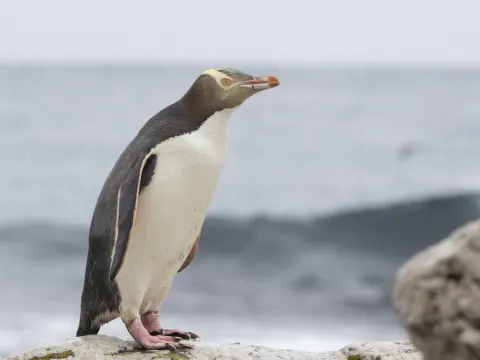
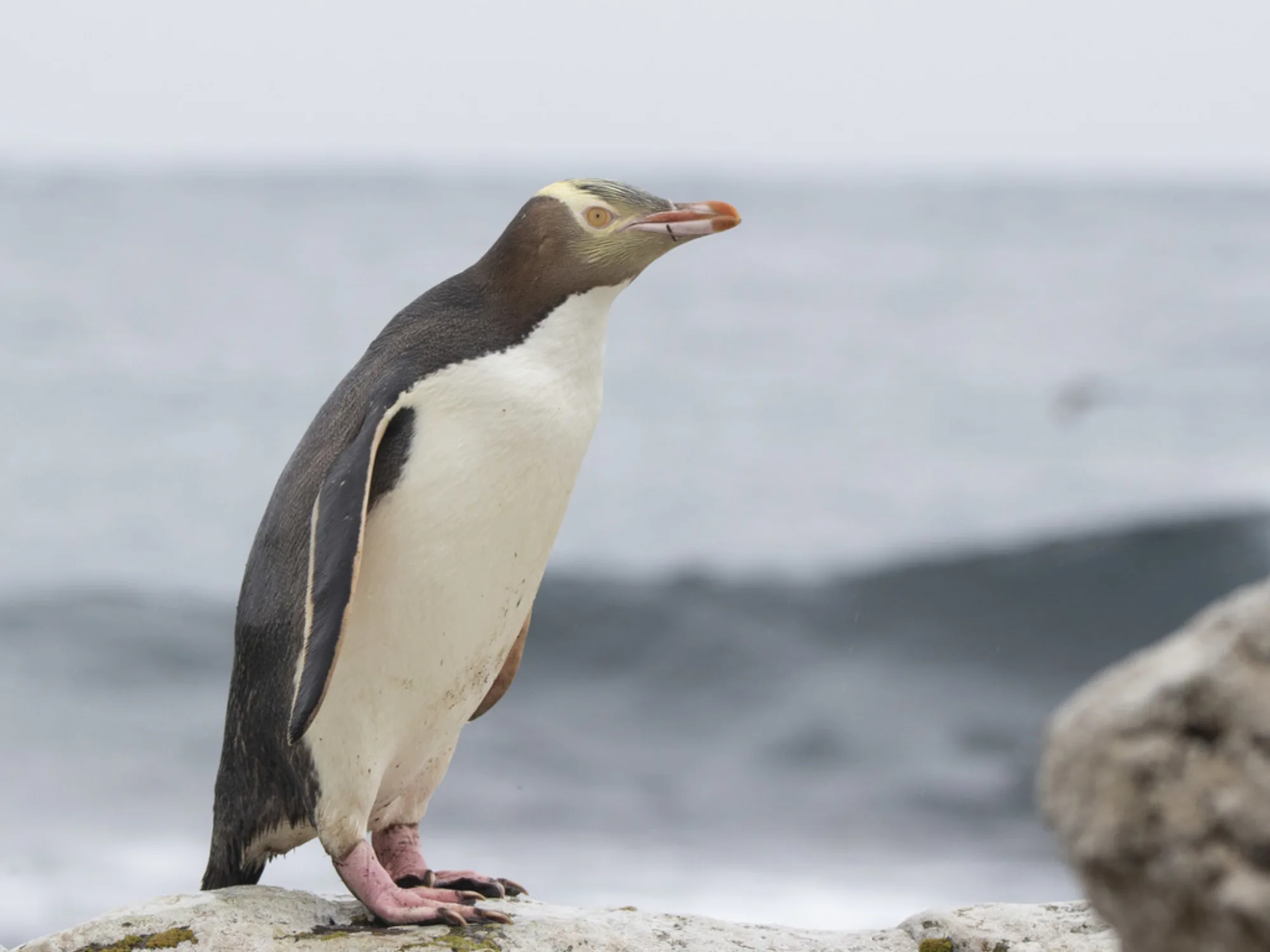
A pale yellow band around the eyes and across the back of the head makes the Yellow-eyed Penguin easy to recognise. Its eyes are yellow, its back is slate blue-black, and its chest and stomach are white. Young birds have greyer heads and lack the yellow eye band. Also known as the hoiho, this penguin lives only in New Zealand, with a northern population along the South Island's southeast coast and around Stewart and Codfish islands, and a southern population on the subantarctic Auckland and Campbell islands. On the Otago Peninsula, visitors can watch the birds from hides, trenches or tunnels.
Yellow-eyed Penguins may come ashore in groups, then follow tracks to separate nest sites, sometimes up to one kilometre inland. They favour forest or scrub with dense vegetation, nesting in solitary pairs or loose groups and often returning to the same area each year. Both parents share incubation, and after the chicks hatch, one guards them while the other feeds at sea. Once the chicks are six weeks old, both parents go to sea for food. Fish make up around 90% of the diet, much of it caught near the seafloor; the birds also eat squid and some crustaceans.
Poor nutrition, disease, predators and fishing are among the pressures on the species. Penguins can become caught in fishing equipment, including gillnets, while disease has caused heavy losses among chicks. People near landing sites can also deter birds from coming ashore, potentially reducing the food reaching their young. On the Otago Peninsula, numbers have fallen by 75% since the mid-1990s.
Written from the English Wikipedia article Yellow-eyed penguin (CC BY-SA 4.0).
- Records
- 4,654
- Countries
- 1
- Atlas places
- 3
These are open occurrence records, so they show where people looked for and recorded the Yellow-eyed Penguin as much as where it lives. Cells are up to 25 km across, and every location is generalised to its cell.
Generalised encounter areas, not exact locations. Each shape is a grid cell coloured by how likely the species is there.
- Very likelyNew Zealand25 km zone · high confidence · 4654 records · updated 80 days ago
Conservation status not assessed here yet, so every location is generalised to its grid cell.