Coachwhip
Masticophis flagellum
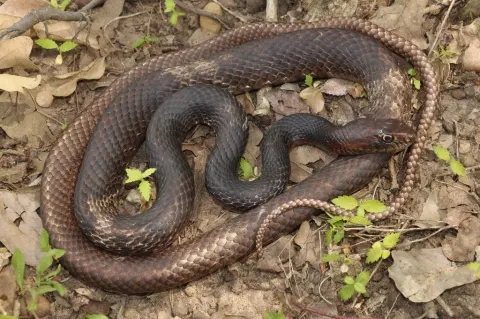
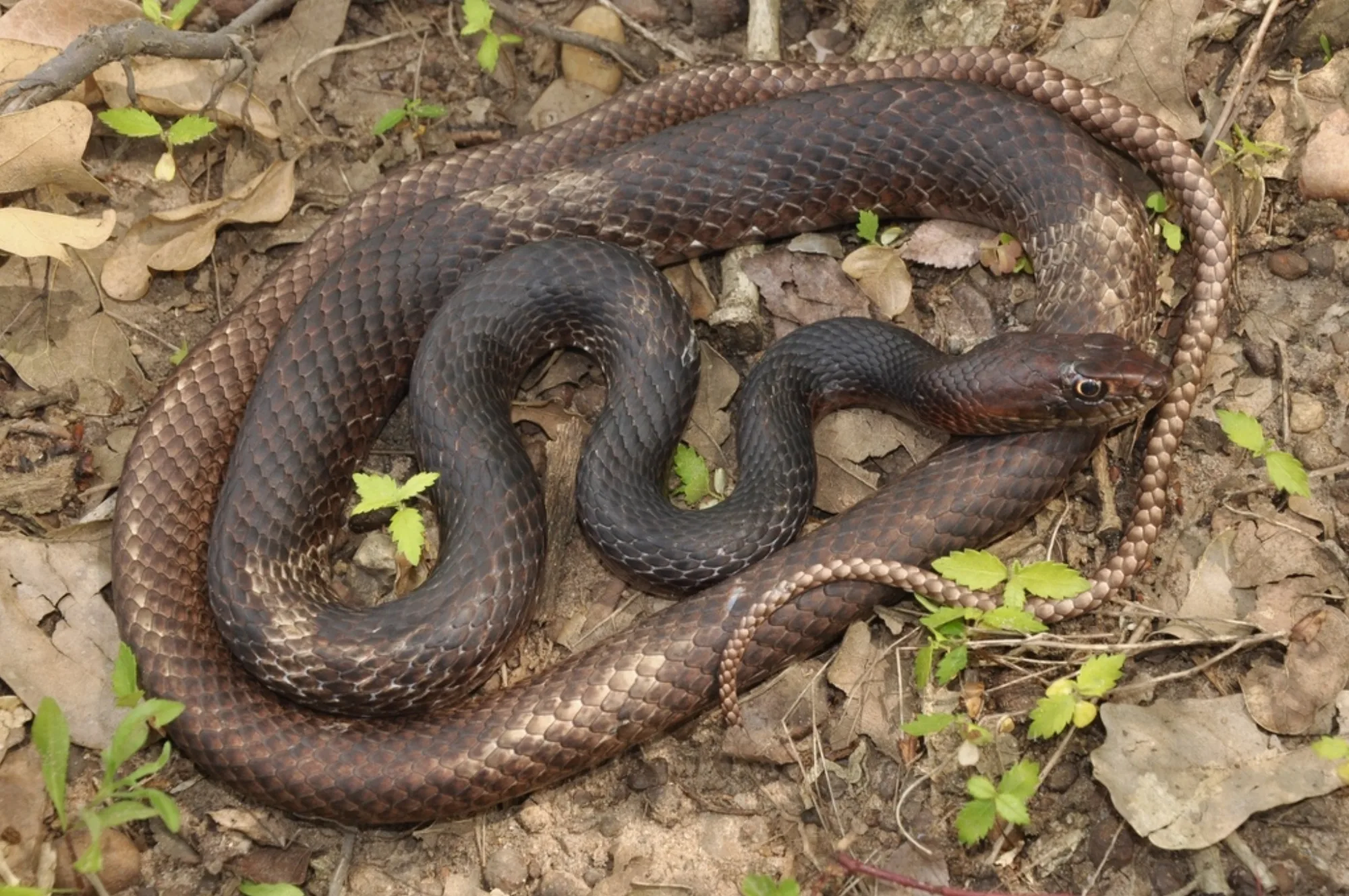
Across the southern United States and the northern half of Mexico, the Coachwhip moves through open country. This nonvenomous snake has a thin body, a small head and large eyes with round pupils. Its colour varies widely and usually provides camouflage in its surroundings. The patterned scales can make it look braided, while its long tail has a whip-like appearance. Common adult lengths are 127 to 183 cm, including the tail, though a record eastern specimen measured 259 cm.
Look for Coachwhips in sandy open areas, open pine forests, old fields and prairies, as well as sandhill scrub and coastal dunes. In eastern Texas, they favour oak savannas. Active by day, they sometimes raise their heads above grass or rocks to look around. A threatened Coachwhip often bolts, but may attack with its mouth when trapped. A bite may hurt, though it is generally harmless unless infection develops. Coachwhips hunt a varied menu of snakes, lizards, frogs, rodents, birds, bird eggs and insects, and have also been found eating carrion. They can lie in wait for prey, detecting it with eyesight and a sensitive sense of smell, then grasp and hold it in their jaws.
Some Coachwhips have been reported to use home ranges of up to 56 hectares. They can tolerate isolated habitat fragments, but the arrangement of those fragments and exposure at their edges may make them less suitable. When available habitat shrinks, the snakes can tolerate more crowded conditions, with smaller home ranges and more overlap between them.
Written from the English Wikipedia article Masticophis flagellum (CC BY-SA 4.0).
- Records
- 752
- Countries
- 2
- Atlas places
- 4
These are open occurrence records, so they show where people looked for and recorded the Coachwhip as much as where it lives. Cells are up to 25 km across, and every location is generalised to its cell.
Generalised encounter areas, not exact locations. Each shape is a grid cell coloured by how likely the species is there.
- Very likelyUnited States25 km zone · medium confidence · 699 records · updated 80 days ago
- Very likelyMexico25 km zone · medium confidence · 53 records · updated 80 days ago
Conservation status not assessed here yet, so every location is generalised to its grid cell.