Sable
Martes zibellina
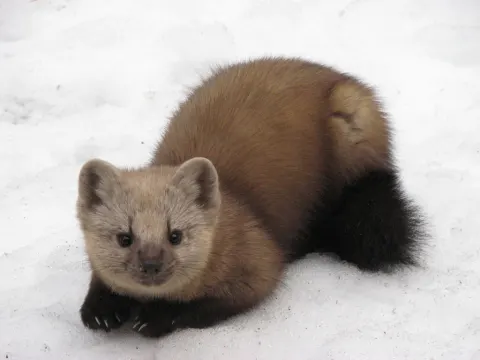
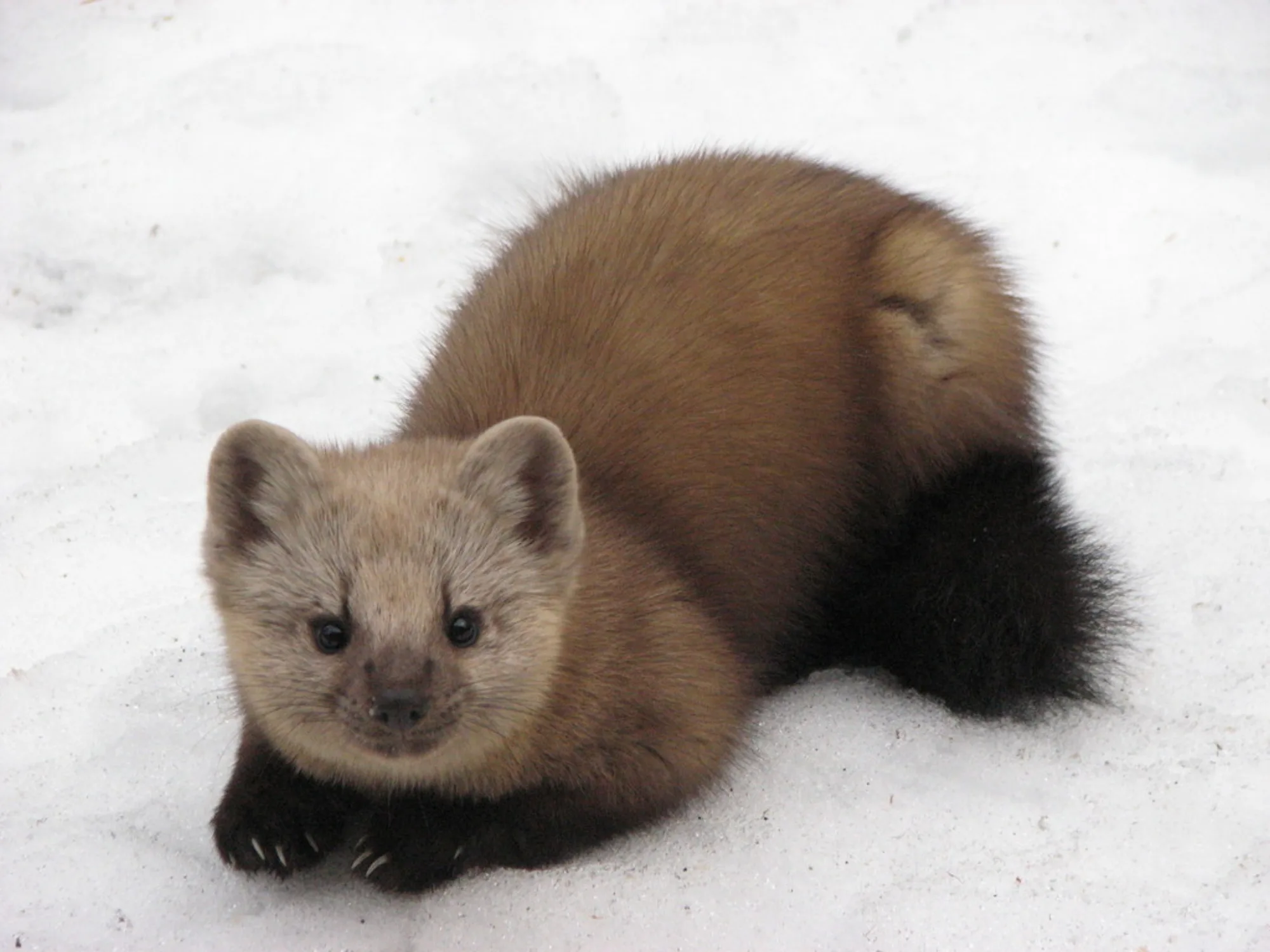
A small marten with an elongated head and long ears, the Sable (Martes zibellina) wears fur ranging from light to dark brown. Its back and legs are darker than its underside, and a pale throat patch may be grey, white or yellowish. The winter coat grows longer than the summer one. Sables inhabit forests across Russia from the Ural Mountains through Siberia, as well as northern Mongolia, with their range reaching parts of eastern Kazakhstan, China, North Korea and Hokkaido in Japan. They favour dense woodland in lowlands and mountains, where birch and conifers such as larch, pine, spruce and Siberian cedar dominate.
A skilled climber of trees and cliffs, the Sable usually hunts at twilight, relying on sound and scent. It shelters in well-hidden dens and burrows, often among tree roots near riverbanks or in the thickest woodland. When food is scarce, it can travel considerable distances, with journeys of 6 to 12 km a day recorded. Its varied diet changes with the seasons: mountain hares and other small mammals feature in summer, while winter food includes berries, rodents, hares and sometimes small musk deer. It also takes birds, slugs and occasionally fish, and may follow wolves or bears to feed on the remains of their kills. Mating generally takes place between June and August, and females give birth in tree hollows to litters most often numbering two or three young. Males help by defending territory and providing food.
Sable fur has long been prized in the fur trade, driving hunting over centuries. In Russia, heavy hunting during the 19th century and the beginning of the 20th caused a severe decline; hunting and poaching rose again in the 1990s. Sables also face predators including lynxes, tigers, foxes, wolves, wolverines, eagles and large owls.
Written from the English Wikipedia article Sable (CC BY-SA 4.0).
- Records
- 17
- Countries
- 3
No atlas park has a record of the Sable in or around it yet.
These are open occurrence records, so they show where people looked for and recorded the Sable as much as where it lives. Cells are up to 25 km across, and every location is generalised to its cell.
Generalised encounter areas, not exact locations. Each shape is a grid cell coloured by how likely the species is there.
- Very likelyFinland25 km zone · medium confidence · 10 records · updated 80 days ago
- Very likelyRussia25 km zone · medium confidence · 4 records · updated 80 days ago
- LikelyJapan25 km zone · medium confidence · 3 records · updated 80 days ago
Conservation status not assessed here yet, so every location is generalised to its grid cell.