American Marten
Martes americana
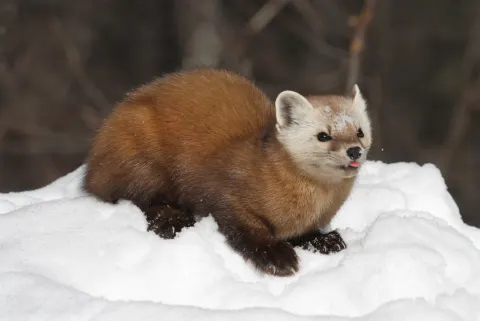
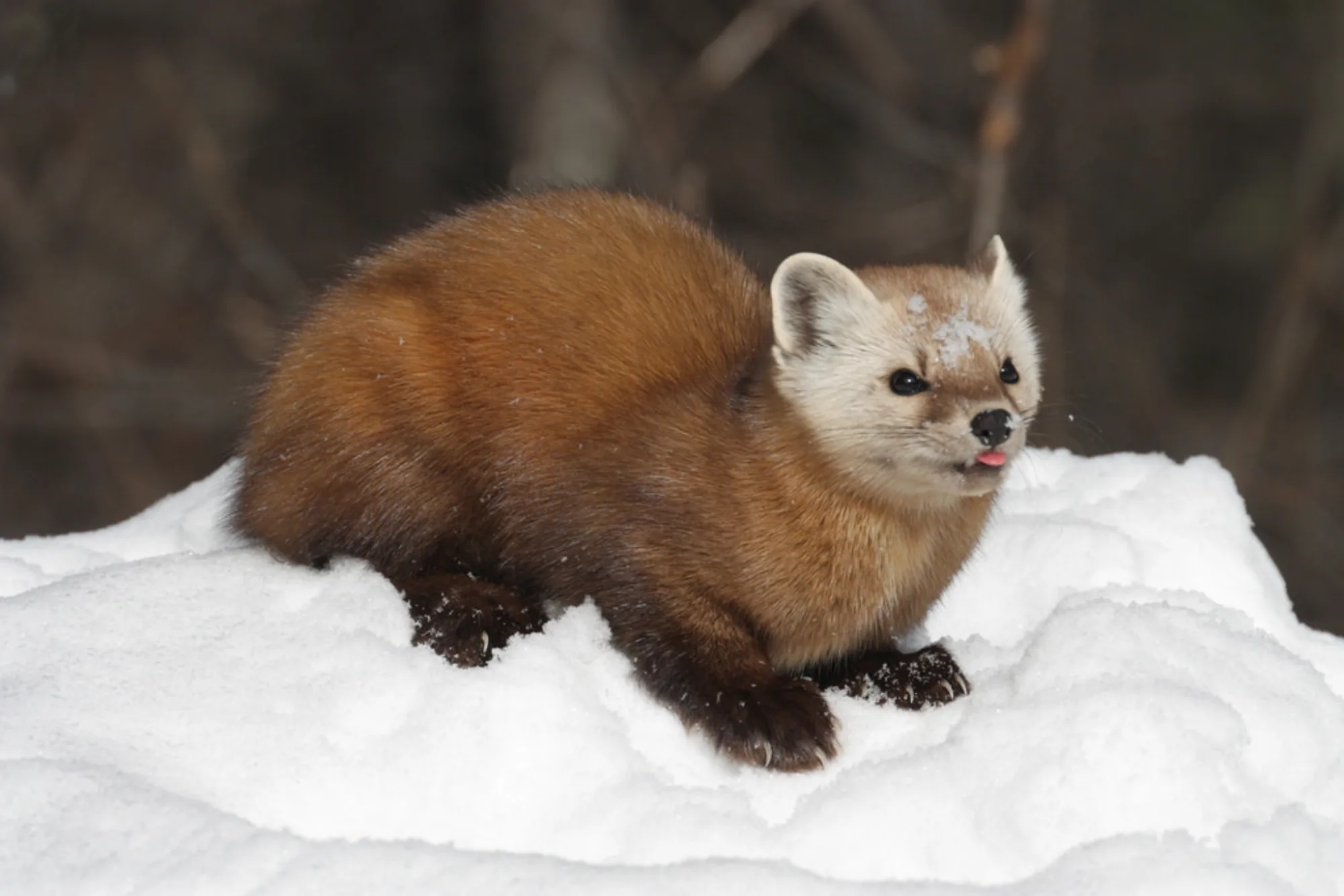
With its slender body, rounded ears and bushy tail, the American Marten is a weasel about the size of a mink. Its silky coat ranges from pale yellowish buff to almost black, usually with a lighter head and darker legs and tail. A bib on the throat and chest provides another clue: its colour can range from pale straw to vivid orange. Males are generally larger than females, although otherwise the sexes look alike.
The marten ranges across much of Canada and Alaska, from the northern treeline south to New York, and from Newfoundland west to Alaska and the Canadian Pacific coast. Suitable mountain habitat limits its distribution in the northeastern and midwestern United States. It lives in young and old forests, whether coniferous, deciduous or mixed. Individuals may be active by day or night, and can travel beneath the snowpack, which offers shelter and opportunities to forage and rest. Storms and extreme cold can keep them inactive.
Mostly solitary outside the summer breeding season, martens feed chiefly on small mammals, especially voles. Snowshoe hares and red squirrels can also be important prey, particularly in winter, while the summer diet includes more fruit, nuts, plants and insects. Females give birth in spring to one to five kits, sheltering them in dens that may be in trees, logs, rock piles or other structures. The young generally remain with their mother through their first summer before dispersing in autumn. Trapping and forest destruction have reduced marten numbers, and deforestation remains a problem across much of their habitat. Populations have recovered in some places, helped by protection and reintroduction, but overharvesting has contributed to local disappearances.
Written from the English Wikipedia article American marten (CC BY-SA 4.0).
- Records
- 1,171
- Countries
- 2
- Atlas places
- 11
- Algonquin Provincial Park· Canada
- Banff National Park· Canada
- Glacier Bay National Park· United States
- Jasper National Park· Canada
- Denali National Park· United States
- Kenai Fjords National Park· United States
- Kootenay National Park· Canada
- Glacier National Park· United States
- Waterton Lakes National Park· Canada
- Yellowstone National Park· United States
- Yoho National Park· Canada
These are open occurrence records, so they show where people looked for and recorded the American Marten as much as where it lives. Cells are up to 25 km across, and every location is generalised to its cell.
Generalised encounter areas, not exact locations. Each shape is a grid cell coloured by how likely the species is there.
- Very likelyUnited States25 km zone · medium confidence · 983 records · updated 80 days ago
- Very likelyCanada25 km zone · medium confidence · 188 records · updated 80 days ago
Conservation status not assessed here yet, so every location is generalised to its grid cell.