Olympic Marmot
Marmota olympus
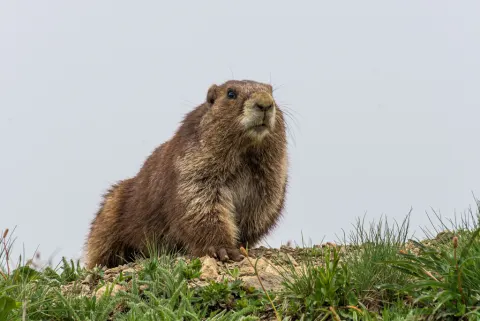
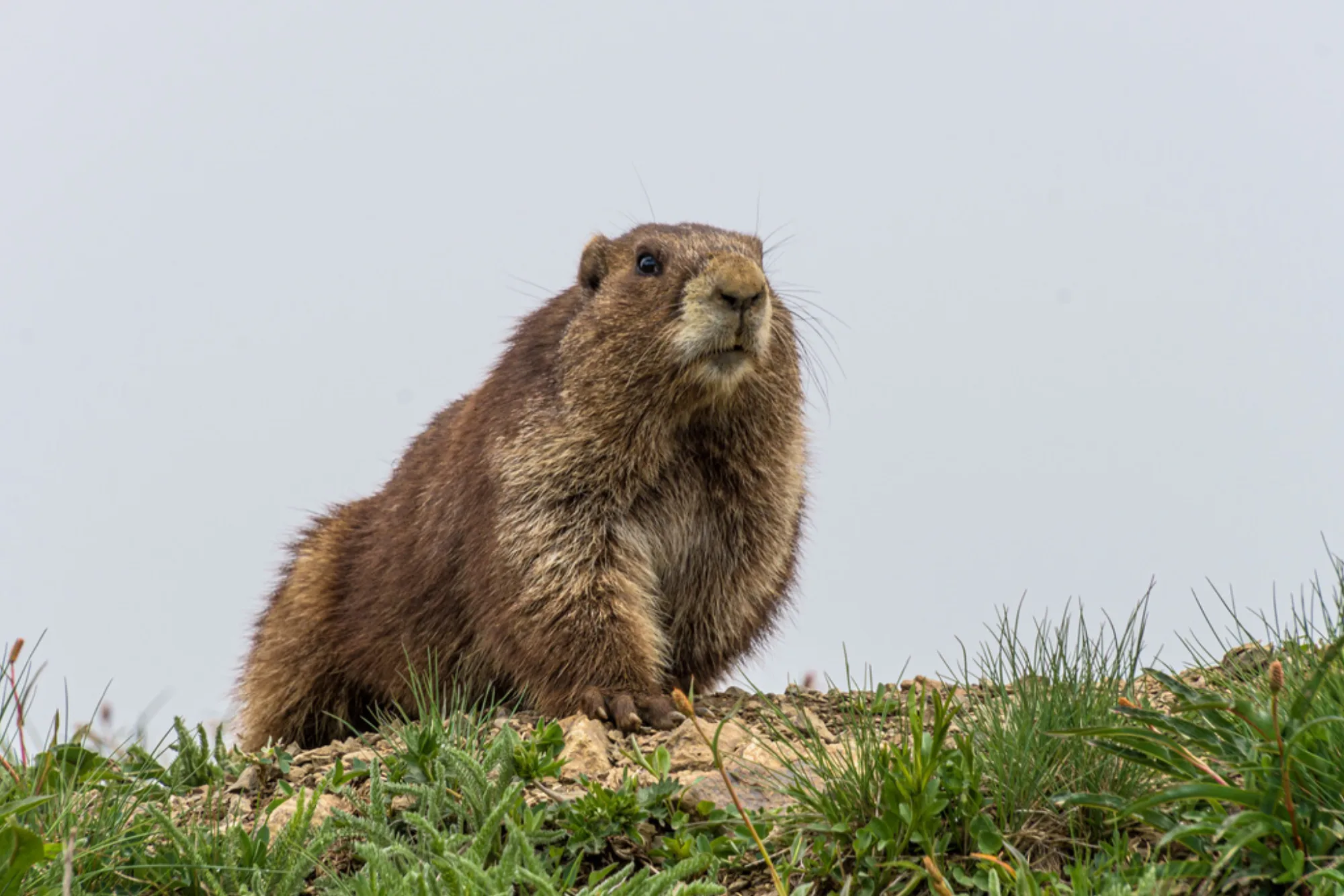
About the size of a domestic cat, the Olympic Marmot is a stocky member of the squirrel family with a broad head, small eyes and ears, short legs and a bushy tail. Its coat changes with age and season, but adults are brown with small pale patches for much of the year. Its face usually has a white muzzle and a white stripe just before the eyes.
Found only on Washington state's Olympic Peninsula, this marmot lives in mountain meadows, fields and scree slopes. Most of its habitat lies within Olympic National Park, where it is often seen, especially on Hurricane Hill. Its burrows are most commonly found between 1,500 m and 1,750 m, often on south-facing slopes. Marmots live in sociable colonies, where they may groom one another, play, feed together or sun themselves on rocks. They use four kinds of whistle to communicate, including an alarm call that warns others of approaching danger. Their food is mainly meadow plants, with tender green growth and flowers favoured, though roots are important in early spring. They also sometimes eat fruit and insects.
The marmots begin hibernating in September, sleeping together in a closed burrow without eating. In spring, adults come out in May, followed by the young in June. Females produce litters of one to six young in alternate years, and young stay with their families for at least two years. Coyotes are the main predator, while trees spreading into meadows have contributed to declines in some areas. Drier meadows, changes to food plants and warmer winters also pose threats, including by making marmots more accessible to coyotes.
Written from the English Wikipedia article Olympic marmot (CC BY-SA 4.0).
- Records
- 62
- Countries
- 1
- Atlas places
- 1
These are open occurrence records, so they show where people looked for and recorded the Olympic Marmot as much as where it lives. Cells are up to 25 km across, and every location is generalised to its cell.
Generalised encounter areas, not exact locations. Each shape is a grid cell coloured by how likely the species is there.
- Very likelyUnited States25 km zone · medium confidence · 62 records · updated 80 days ago
Conservation status not assessed here yet, so every location is generalised to its grid cell.