Groundhog
Marmota monax
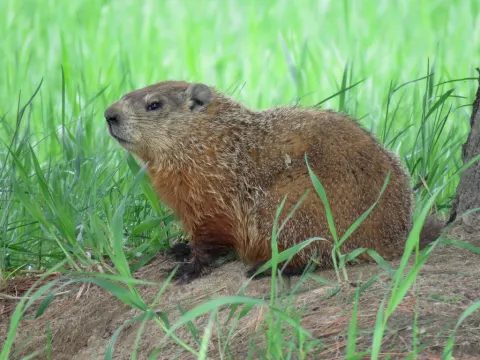
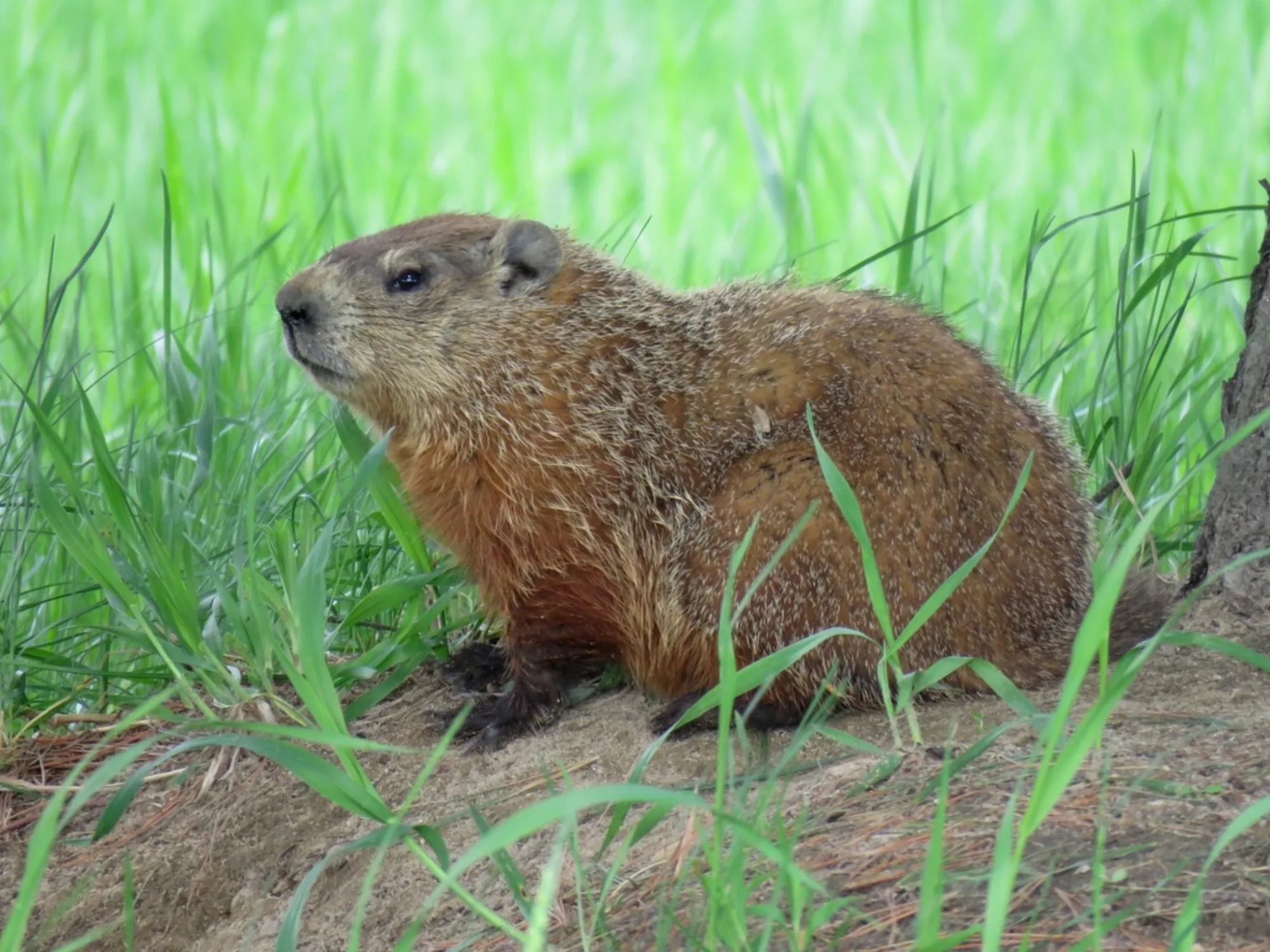
Watch the edge of a field or woodland for a Groundhog standing upright on its hind feet, keeping an eye out for danger. Also called the woodchuck, this large ground squirrel is a marmot with a heavy body, short, powerful legs and broad, long claws for digging. Adults measure 41.8 to 68.5 cm in total length and typically weigh 2 to 6.3 kg. A lowland animal, it ranges across much of the eastern United States, Canada and into Alaska. It favours open country and woodland edges, including fields, pastures, hedgerows and small woodlots, and is rarely far from a burrow entrance.
Groundhogs are mostly active during the day, often in the early morning or late afternoon. They may hide from an observer and usually retreat underground when threatened, although they can swim and sometimes climb trees to escape predators or survey their surroundings. An alarmed groundhog gives a high-pitched whistle. Burrows provide places to sleep, raise young and hibernate; most animals have separate summer and winter dens. In most areas, hibernation lasts from October to March or April. Groundhogs feed mainly on grasses and other plants, including berries and crops, but occasionally take small animals and bird eggs.
Breeding follows hibernation, and one litter is born each year, usually with 3 to 5 pups. The mother brings the young outside once they have fur and can see, and the family disperses by the end of August. Coyotes, badgers, bobcats and foxes prey on adults, while young groundhogs also face predators including hawks and cats. People kill groundhogs through pest control and hunting, and vehicles can also kill them. Parasites and bacteria transmitted by vectors can be fatal.
Written from the English Wikipedia article Groundhog (CC BY-SA 4.0).
- Records
- 3,649
- Countries
- 2
- Atlas places
- 5
These are open occurrence records, so they show where people looked for and recorded the Groundhog as much as where it lives. Cells are up to 25 km across, and every location is generalised to its cell.
Generalised encounter areas, not exact locations. Each shape is a grid cell coloured by how likely the species is there.
- Very likelyUnited States25 km zone · medium confidence · 2681 records · updated 80 days ago
- Very likelyCanada25 km zone · medium confidence · 968 records · updated 80 days ago
Conservation status not assessed here yet, so every location is generalised to its grid cell.