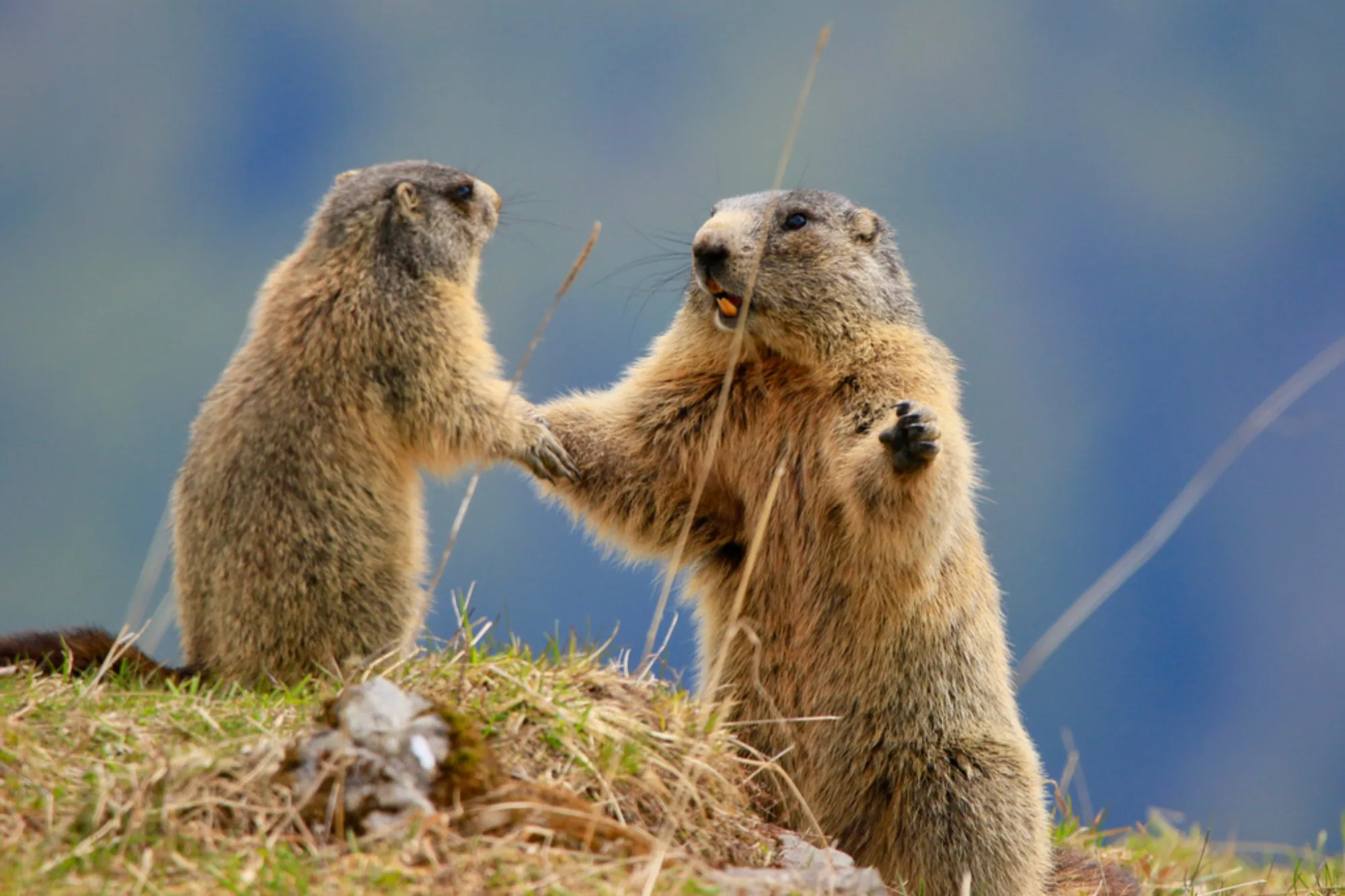
Alpine Marmot
Marmota marmota
A large ground-dwelling squirrel, the Alpine Marmot has a coat mixed with blonde, reddish and dark grey fur. Adults measure 43 to 73 cm in head-and-body length, with a tail 13 to 20 cm long. They are lighter in spring after hibernation than in autumn, when they have built up reserves for winter.
Look for them in mountain country across central and southern Europe, including the Alps, Carpathians, Tatras and Northern Apennines, at heights of 800 to 3,200 m. They were also successfully reintroduced to the Pyrenees in 1948. They favour alpine meadows and high pastures, where colonies occupy deep burrow systems in rocky ground or alluvial soil. A marmot may stand upright to watch for danger, and loud whistles can send colony members running for cover. Animals stretched out on flat rocks may look as though they are sunbathing, but they are thought to be cooling down.
Marmots emerge mainly in the morning and afternoon to feed on grasses, herbs and grain, as well as insects, spiders and worms. They prefer young, tender plants and may avoid feeding altogether on very warm days. Families occupy burrows that later generations may enlarge, and groups have a dominant breeding pair. After breeding in spring, females give birth to litters of one to seven young, usually three. The young are born blind and remain in the burrow while their mother searches for food. Marmots can spend up to nine months a year hibernating, huddling together and living on stored fat. Rising temperatures can cause habitat loss, while poorly regulated hunting is a danger because the animals reproduce relatively slowly. Poaching threatens a very small population in Rodna, Romania.
Written from the English Wikipedia article Alpine marmot (CC BY-SA 4.0).
- Records
- 112,545
- Countries
- 12
No atlas park has a record of the Alpine Marmot in or around it yet.
These are open occurrence records, so they show where people looked for and recorded the Alpine Marmot as much as where it lives. Cells are up to 25 km across, and every location is generalised to its cell.
Generalised encounter areas, not exact locations. Each shape is a grid cell coloured by how likely the species is there.
- Very likelySwitzerland25 km zone · high confidence · 54430 records · updated 86 days ago
- Very likelyFrance25 km zone · high confidence · 31908 records · updated 86 days ago
- Very likelyItaly25 km zone · high confidence · 21159 records · updated 86 days ago
- Very likelyAustria25 km zone · high confidence · 4052 records · updated 86 days ago
- LikelySpain25 km zone · medium confidence · 946 records · updated 86 days ago
- PossibleGermany25 km zone · medium confidence · 33 records · updated 86 days ago
- PossibleSlovenia25 km zone · medium confidence · 9 records · updated 86 days ago
- UncommonPoland25 km zone · medium confidence · 3 records · updated today
- UncommonSlovakia25 km zone · medium confidence · 3 records · updated 86 days ago
- UncommonRomania25 km zone · medium confidence · 2 records · updated today
Conservation status not assessed here yet, so every location is generalised to its grid cell.