Himalayan Marmot
Marmota himalayana
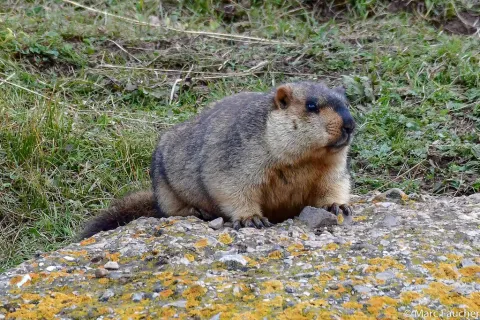
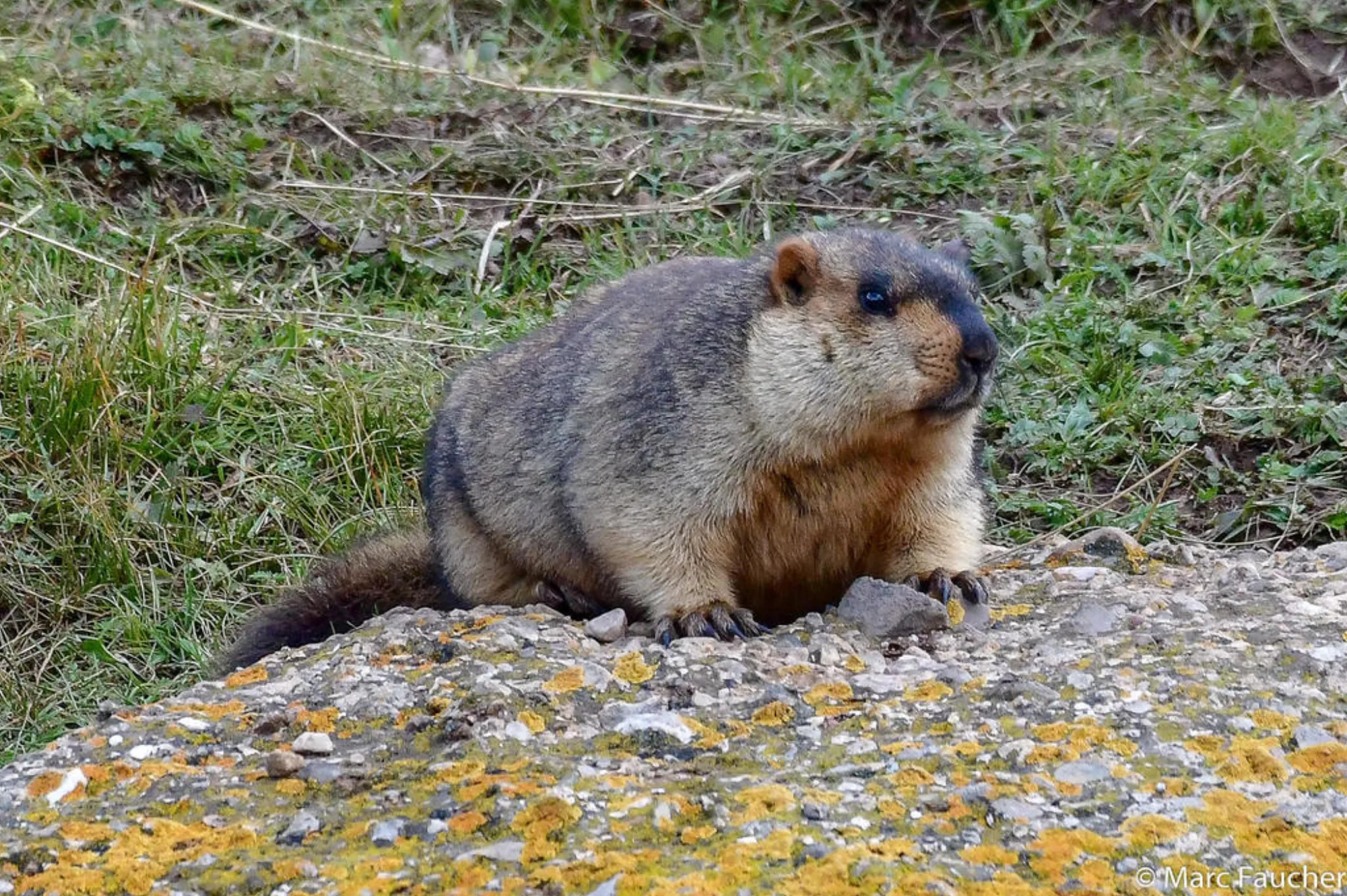
About the size of a large housecat, the Himalayan Marmot has dense, woolly fur, with a rufous grey back and rufous yellowish colouring on its underside, ears and legs. The bridge of its nose and the tip of its tail are dark brown. It measures about 45 to 67 cm in total, including a tail of 12 to 15 cm, and weighs an average of 4 to 9.2 kg. Weight is lowest after hibernation in spring and highest before it in autumn.
Across the Himalayas and Tibetan Plateau, this marmot lives at altitudes of 3,000 to 5,500 m, from northeastern Pakistan through northern India, Nepal and Bhutan to China. In India, travellers can see it in the high-altitude regions of Ladakh and Kashmir. It favours short-grass steppes and alpine habitats, generally above the tree line and below permanent snow. Colonies dig deep burrows and share them during hibernation, which lasts from late autumn to early spring, averaging 7½ months. Where the soil is suitable, burrows reach 2 to 10 m deep, and colonies on alluvial terraces can contain up to 30 families.
Himalayan Marmots feed on pasture plants, particularly the soft, juicy parts of grasses and flowering plants. Females reach sexual maturity at two years and produce two to 11 young after a month of gestation. Tibetan wolves, red foxes and large birds of prey, including golden eagles, hunt them, while marmot species also form part of the snow leopard's prey on the Tibetan Plateau. In Ladakh, people feed Himalayan Marmots, an interaction associated with reduced survival instinct behaviour and greater vulnerability to stray dogs and other predators.
Written from the English Wikipedia article Himalayan marmot (CC BY-SA 4.0).
- Records
- 40
- Countries
- 3
- Atlas places
- 1
These are open occurrence records, so they show where people looked for and recorded the Himalayan Marmot as much as where it lives. Cells are up to 25 km across, and every location is generalised to its cell.
Generalised encounter areas, not exact locations. Each shape is a grid cell coloured by how likely the species is there.
- Very likelyChina25 km zone · medium confidence · 26 records · updated 80 days ago
- Very likelyIndia25 km zone · medium confidence · 13 records · updated 80 days ago
- PossibleNepal25 km zone · medium confidence · 1 record · updated 80 days ago
Conservation status not assessed here yet, so every location is generalised to its grid cell.