Yellow-bellied Marmot
Marmota flaviventris
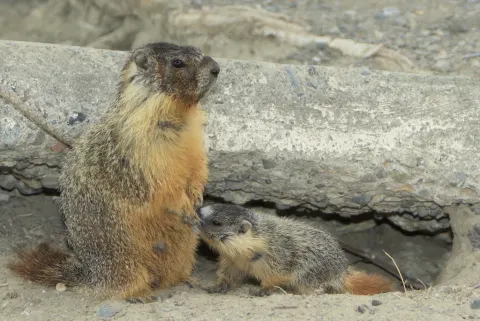
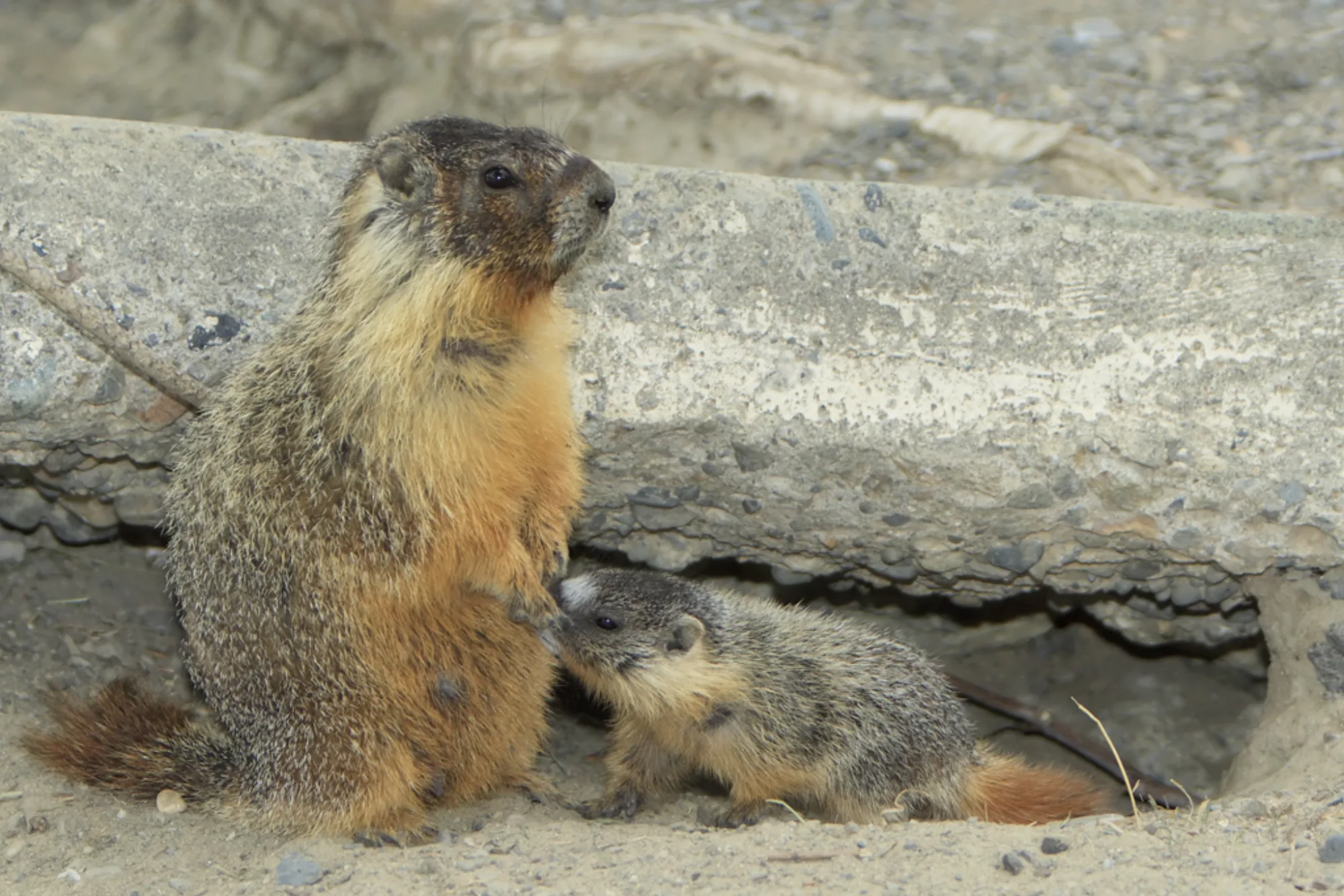
Look for a stout ground squirrel with mostly brown fur, a yellow chest, a dark bushy tail and a white patch between its eyes. The Yellow-bellied Marmot also has bright yellow fur on its belly, throat and the sides of its neck. Adults measure 47 to 68 cm long, and their weight changes considerably through the year, reaching its lowest point in early spring. Their range spans mountainous and semi-arid country from southwestern Canada into the western United States, taking in the Great Basin as well as the Sierra Nevada and the Rocky Mountains. Often found above 2,000 metres, they inhabit meadows, steppes, talus fields and other open ground, sometimes near forest edges. In Colorado, they occur from 1,600 m to over 4,300 m.
Active by day, these social animals may live alone, in pairs or in colonies, visiting one another's burrows and greeting or play-fighting with neighbours. They emerge to groom and sun themselves before feeding on grasses, leaves, flowers and grains, as well as insects and bird eggs. Burrows are usually dug beneath rocks, where they are less visible to predators, and marmots often shelter inside at midday and night. A high-pitched whistle warns others of danger, and a marmot that spots a predator typically hides among nearby rocks. Hibernation generally lasts from September to May, with much of the active season spent building fat reserves. Litters usually contain three to five young, though only about half survive to become yearlings. Foxes, dogs, coyotes, wolves and eagles prey on marmots, while rising temperatures have shifted the timing of hibernation and breeding.
Written from the English Wikipedia article Yellow-bellied marmot (CC BY-SA 4.0).
- Records
- 1,904
- Countries
- 2
- Atlas places
- 6
These are open occurrence records, so they show where people looked for and recorded the Yellow-bellied Marmot as much as where it lives. Cells are up to 25 km across, and every location is generalised to its cell.
Generalised encounter areas, not exact locations. Each shape is a grid cell coloured by how likely the species is there.
- Very likelyUnited States25 km zone · medium confidence · 1426 records · updated 80 days ago
- Very likelyCanada25 km zone · medium confidence · 478 records · updated 80 days ago
Conservation status not assessed here yet, so every location is generalised to its grid cell.