Hoary Marmot
Marmota caligata
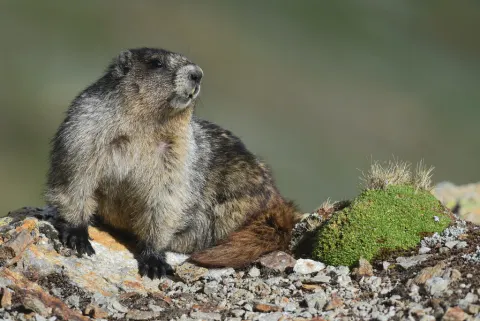
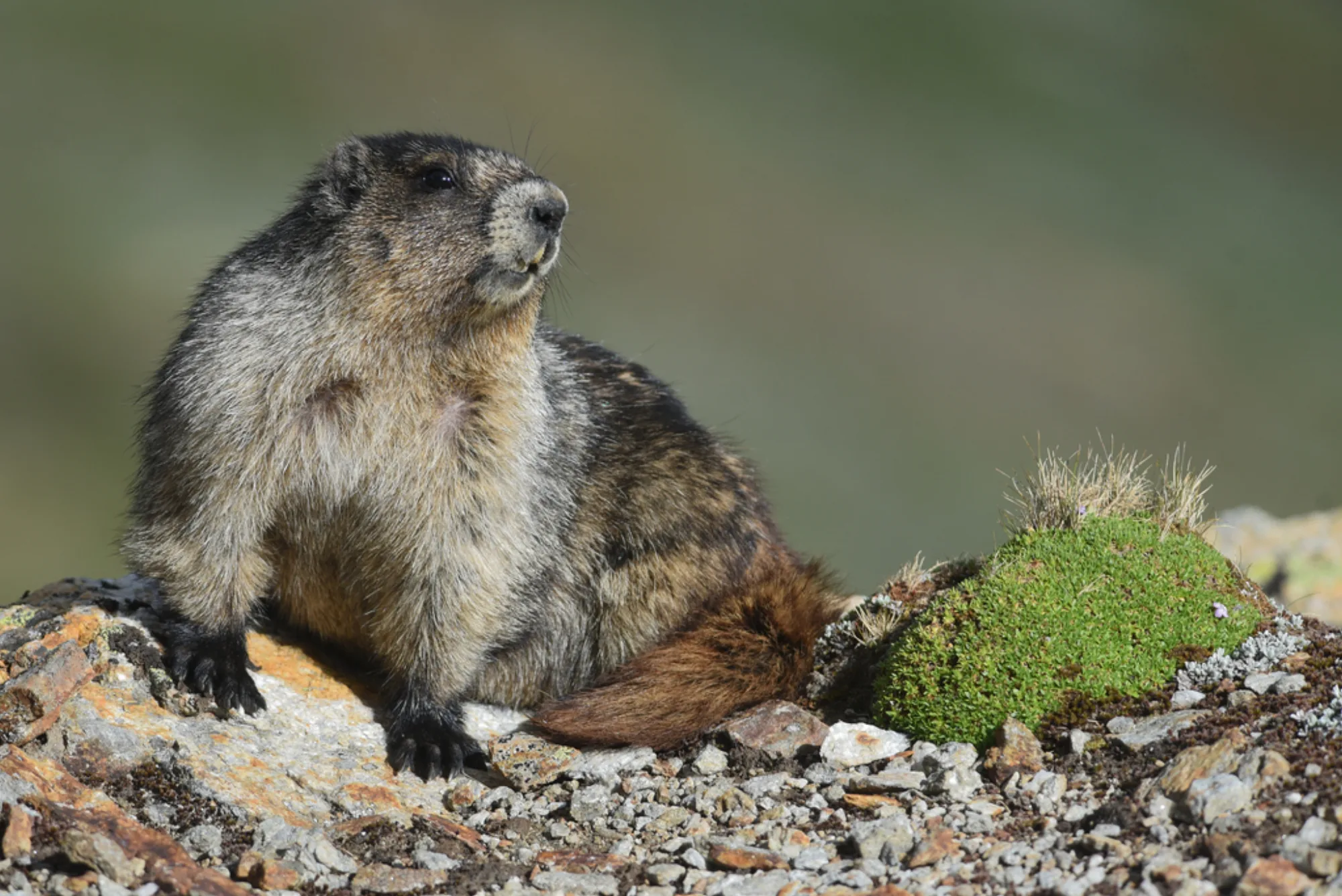
A bulky ground squirrel of the mountains of northwest North America, the Hoary Marmot has a broad head, short, heavy limbs and a long, furry tail. Its silver-grey shoulders and upper back give it its name, while the rest of its upper body is dull or reddish brown. Look for a black crown, a white patch on the muzzle and black feet and lower legs. Adults measure 62 to 82 cm in total length, including the tail. Its high-pitched warning call has earned it the nickname “the whistler”.
Hoary marmots range north from southern Washington and central Idaho into Alaska, where they live south of the Yukon River and on several islands. They live near or above the tree line in rocky terrain and alpine meadows, where grasses and other plants provide food and rocks offer cover. Their habitat reaches 2,500 metres in the mountains, although coastal populations can live at or near sea level. Active by day, they eat leaves, flowers, grasses and sedges, and often sun themselves on rocks in the morning. In places visited by people, they may continue their activities while being watched.
Colonies can contain up to 36 marmots, which play, wrestle, groom one another and touch noses. They spend seven to eight months each year hibernating in excavated burrows, and use smaller burrows for sleep and shelter from predators. Females usually raise a litter only every other year; at three to four weeks old, the young leave their birth den. Golden eagles, bears, wolverines, coyotes and several other predators hunt hoary marmots.
Written from the English Wikipedia article Hoary marmot (CC BY-SA 4.0).
- Records
- 694
- Countries
- 2
- Atlas places
- 11
- Banff National Park· Canada
- Glacier National Park· United States
- Jasper National Park· Canada
- Denali National Park· United States
- Glacier Bay National Park· United States
- Kootenay National Park· Canada
- Waterton Lakes National Park· Canada
- Kenai Fjords National Park· United States
- Yoho National Park· Canada
- Kluane National Park and Reserve· Canada
- Katmai National Park· United States
These are open occurrence records, so they show where people looked for and recorded the Hoary Marmot as much as where it lives. Cells are up to 25 km across, and every location is generalised to its cell.
Generalised encounter areas, not exact locations. Each shape is a grid cell coloured by how likely the species is there.
- Very likelyUnited States25 km zone · medium confidence · 417 records · updated 80 days ago
- Very likelyCanada25 km zone · medium confidence · 277 records · updated 80 days ago
Conservation status not assessed here yet, so every location is generalised to its grid cell.