Gadwall
Mareca strepera
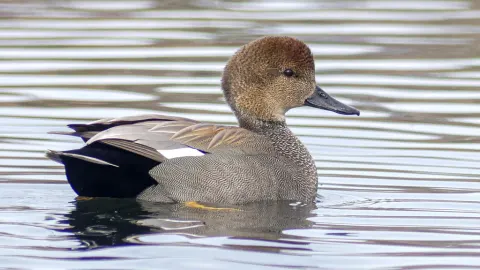
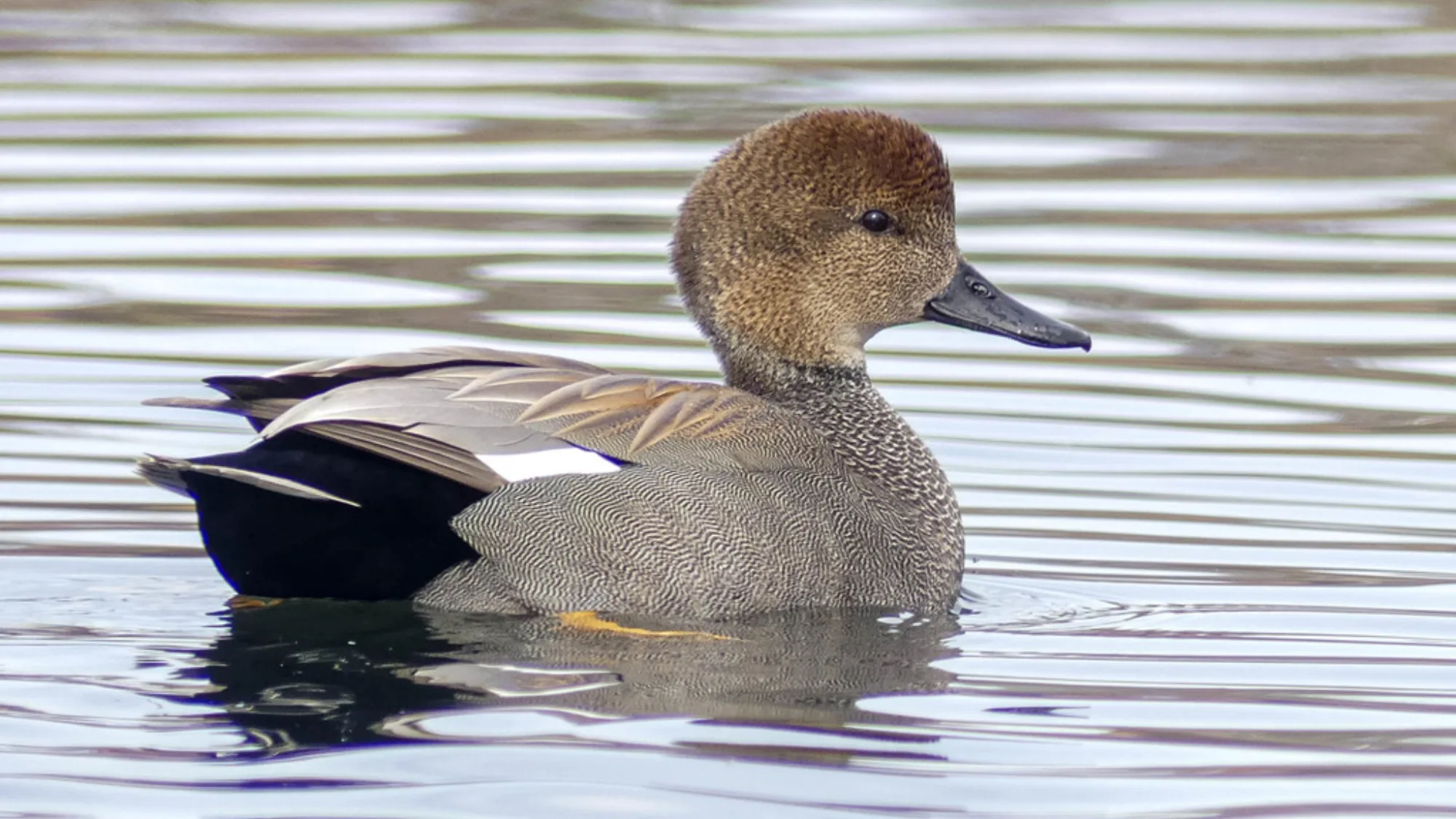
A widespread dabbling duck, the Gadwall measures 47 to 58 cm in length and has a wingspan of 78 to 85 cm. In breeding plumage, the male has grey patterning, black at the rear and light chestnut wings, with a bright white wing patch visible both in flight and at rest. Outside the breeding season, he looks more like the light brown female, though he keeps his distinctive wing pattern. The female has a dark bill edged with orange, a white belly and a white wing patch. Gadwalls are generally quiet, but become more vocal during courtship; females give a high-pitched quack, while males grunt and whistle.
Gadwalls breed across northern Europe and the Palearctic, as well as in central North America. They migrate south for winter, and are also seen in parts of South Asia, particularly southern India. In Great Britain they are winter visitors and scarce breeding birds, while a small breeding population has become established in Ireland. Look for them on open wetlands, including prairie or steppe lakes, wet grassland and marshes with dense vegetation around their edges. They usually feed on plants by dipping their heads underwater, but can also dive for food or take it from diving birds such as coots. Outside the breeding season, they tend to gather in small flocks.
Pairs may form during autumn migration or on the breeding grounds, and they nest on land, sometimes well away from water. A female lays 7 to 12 eggs, which hatch after 24 to 27 days of incubation; the young leave the nest after around 1 to 2 days. Hunting is a pressure: Gadwalls are among the most hunted ducks, with 1.7 million shot each year.
Written from the English Wikipedia article Gadwall (CC BY-SA 4.0).
- Records
- 1,964,164
- Countries
- 12
No atlas park has a record of the Gadwall in or around it yet.
These are open occurrence records, so they show where people looked for and recorded the Gadwall as much as where it lives. Cells are up to 25 km across, and every location is generalised to its cell.
Generalised encounter areas, not exact locations. Each shape is a grid cell coloured by how likely the species is there.
- Very likelyUnited States25 km zone · high confidence · 1360248 records · updated 80 days ago
- Very likelyCanada25 km zone · high confidence · 279203 records · updated 80 days ago
- Very likelyBelgium25 km zone · high confidence · 130375 records · updated 80 days ago
- Very likelyUnited Kingdom25 km zone · high confidence · 108494 records · updated 80 days ago
- Very likelyNetherlands25 km zone · high confidence · 29188 records · updated 80 days ago
- Very likelyMexico25 km zone · high confidence · 16279 records · updated 80 days ago
- Very likelySpain25 km zone · high confidence · 15610 records · updated 80 days ago
- Very likelyFrance25 km zone · high confidence · 8213 records · updated 80 days ago
- Very likelyNorway25 km zone · high confidence · 6023 records · updated 80 days ago
- Very likelyPortugal25 km zone · high confidence · 5361 records · updated 80 days ago
Conservation status not assessed here yet, so every location is generalised to its grid cell.