Noisy Miner
Manorina melanocephala
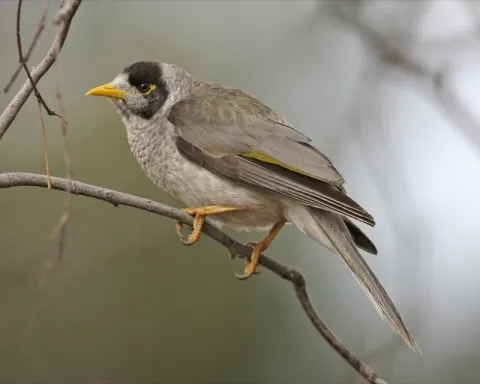
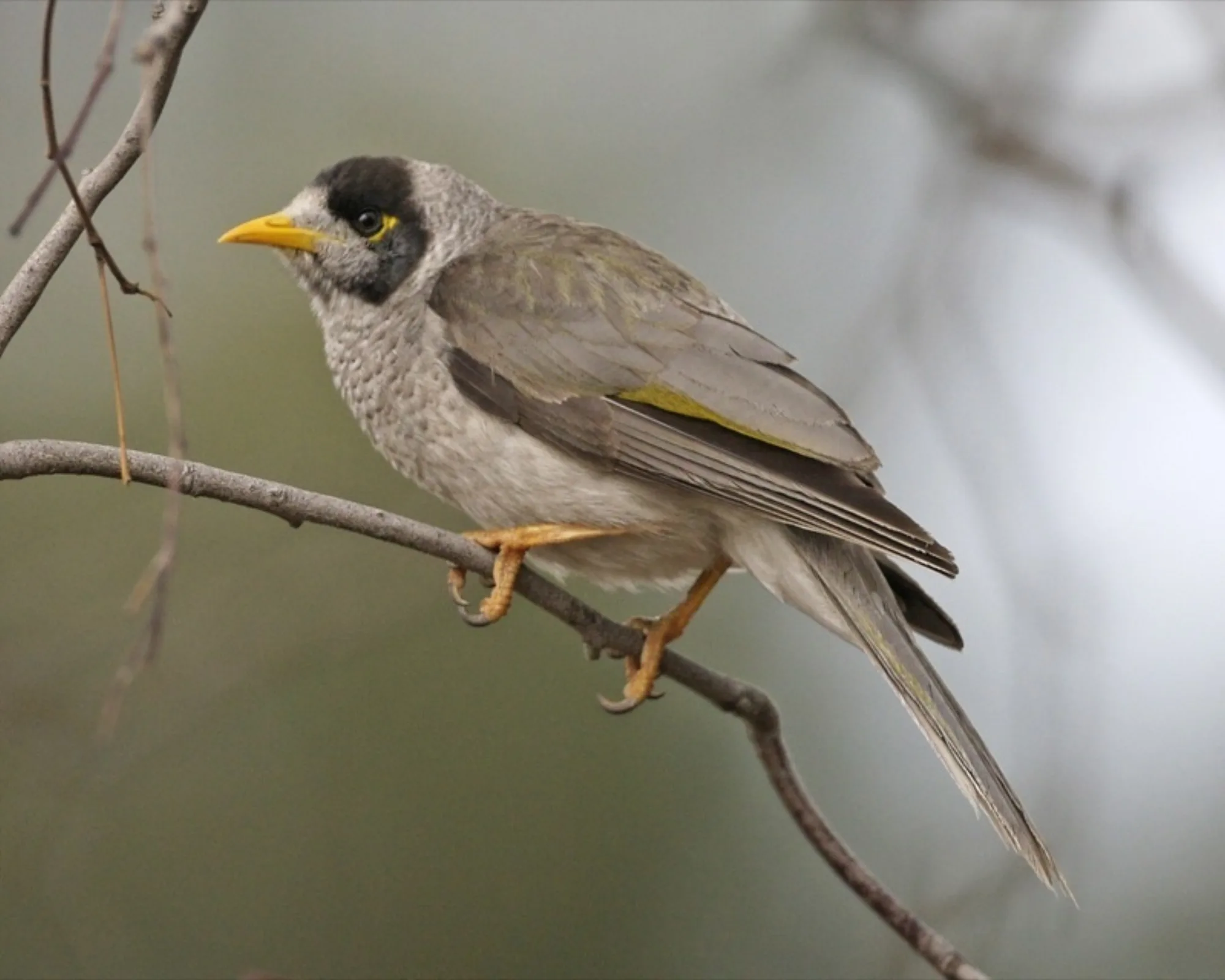
A chorus of loud calls may announce the Noisy Miner before it comes into view. This large honeyeater is grey, with a black head, an orange-yellow beak and feet, and a yellow patch behind each eye. Its tail feathers have white tips, while young birds have a brownish-grey colouring. Calls, scoldings and alarms are frequent, especially from young birds.
Found only in eastern and southeastern Australia, its range stretches from Far North Queensland south across New South Wales and Victoria, reaching Tasmania and the southeast of South Australia. It favours dry, open eucalypt forest with few shrubs beneath the trees. Look for it in roadside reserves, lightly wooded farmland and suburban parks and gardens where trees and grass replace dense shrubbery. Open, eucalypt-dominated landscaping has helped its numbers increase in many places.
Noisy miners live in territorial colonies that can contain several hundred birds, foraging, bathing and roosting together. They spend much of their feeding time searching eucalypt foliage, but also forage on branches and the ground for nectar, fruit and insects. Birds join forces to mob predators and chase other birds from their territory, sometimes excluding smaller species. Breeding takes place throughout the year, with most activity from July through November. The female builds a deep cup-shaped nest and incubates two to four eggs, while male helpers care for the young. Nests can still fail because of the variety of predators in open woodland, despite group defence. Culling has been proposed in response to the species' abundance, although it is protected across Australia.
Written from the English Wikipedia article Noisy miner (CC BY-SA 4.0).
- Records
- 842,462
- Countries
- 1
- Atlas places
- 4
These are open occurrence records, so they show where people looked for and recorded the Noisy Miner as much as where it lives. Cells are up to 25 km across, and every location is generalised to its cell.
Generalised encounter areas, not exact locations. Each shape is a grid cell coloured by how likely the species is there.
- Very likelyAustralia25 km zone · high confidence · 842462 records · updated 86 days ago
Conservation status not assessed here yet, so every location is generalised to its grid cell.