Chinese Pangolin
Manis pentadactyla
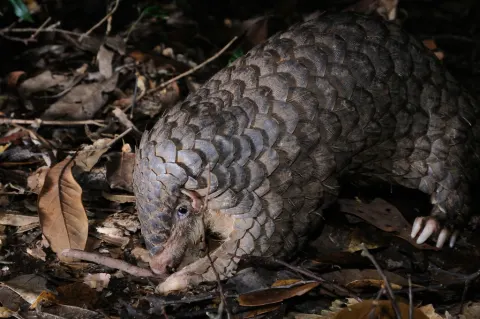
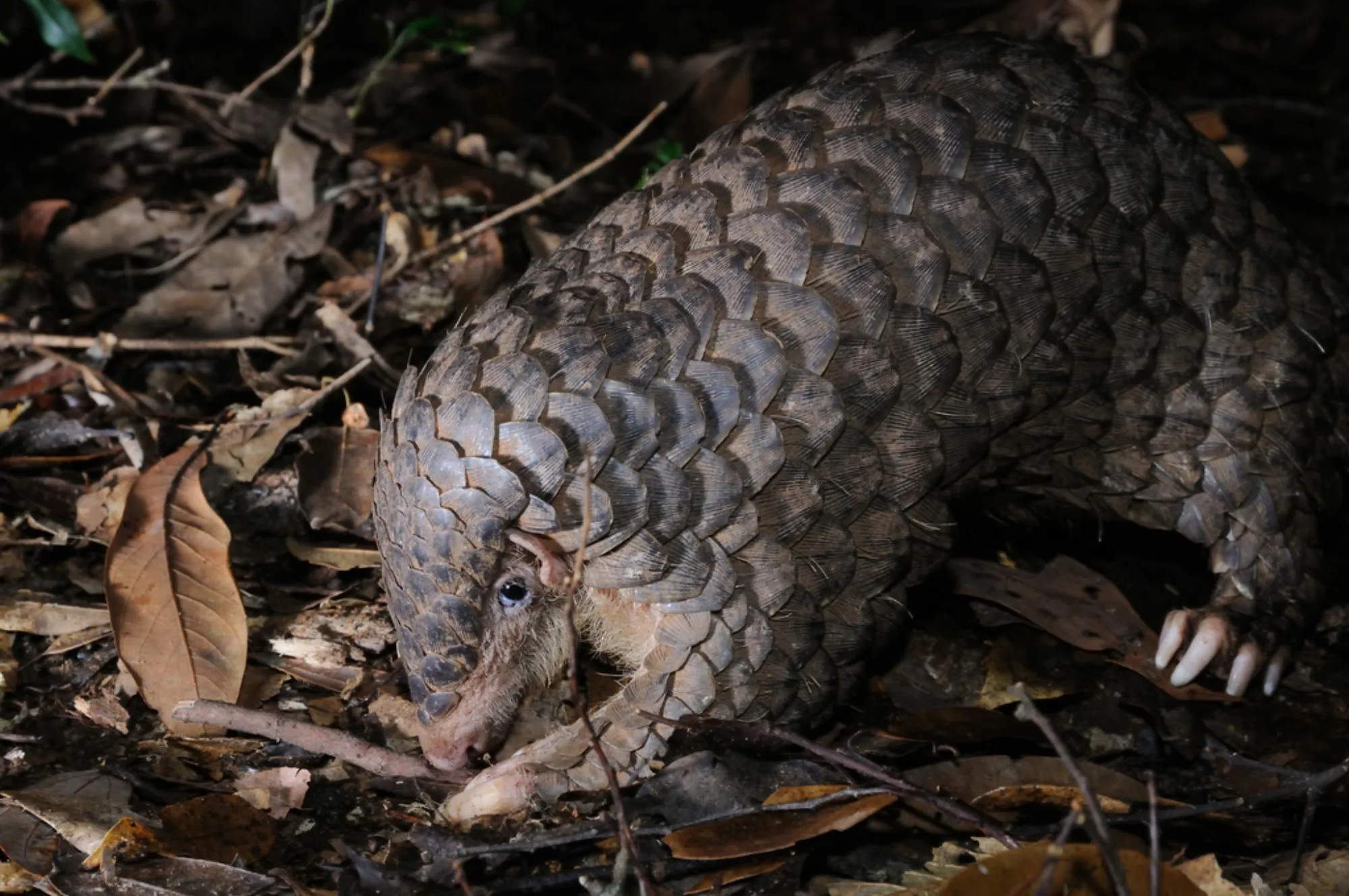
With its small pointed head and overlapping scales, the Chinese Pangolin resembles a scaly anteater. Its scales are usually greyish blue and grow alongside hair, while its mouth is small and narrow. Head and body measure about 40 to 58 cm, with a tail of about 25 to 38 cm; adults weigh 2 to 7 kilograms. Native to the northern Indian subcontinent, northern Southeast Asia and southern China, it occurs in southern Nepal and northeast India, as well as on Hainan and much of Taiwan. It has been recorded at elevations up to 3,000 m. Its habitats include primary and secondary tropical forests, bamboo, limestone, broadleaf and coniferous forests, as well as grasslands and agricultural fields.
Secretive and nocturnal, it moves slowly and curls into a ball when threatened, relying on its hard scales for protection. It digs long burrows for sleeping and hunting termites. Ants and termites make up much of its diet: powerful foreclaws break into their nests and mounds, and a long, sticky tongue collects the insects. It also eats other invertebrates, including worms, crickets and bee larvae. Breeding takes place in April and May, and a female gives birth to one young at a time. The newborn can walk on its first day, though its mother transports it on her back or tail; its soft scales harden after two days. Poaching for the illegal wildlife trade is a major threat. Its meat is eaten, while its scales and other body parts are used in traditional Chinese medicine.
Written from the English Wikipedia article Chinese pangolin (CC BY-SA 4.0).
- Records
- 80
- Countries
- 1
No atlas park has a record of the Chinese Pangolin in or around it yet.
These are open occurrence records, so they show where people looked for and recorded the Chinese Pangolin as much as where it lives. Cells are up to 25 km across, and every location is generalised to its cell.
Generalised encounter areas, not exact locations. Each shape is a grid cell coloured by how likely the species is there.
- Very likelyTaiwan25 km zone · medium confidence · 80 records · updated 80 days ago
Conservation status not assessed here yet, so every location is generalised to its grid cell.