Sunda Pangolin
Manis javanica
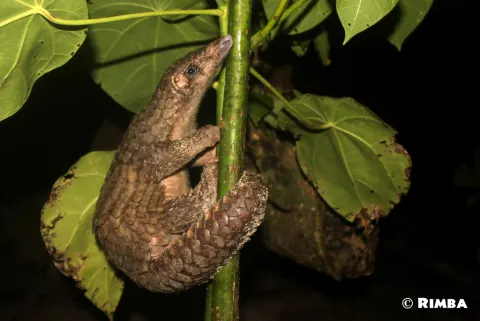
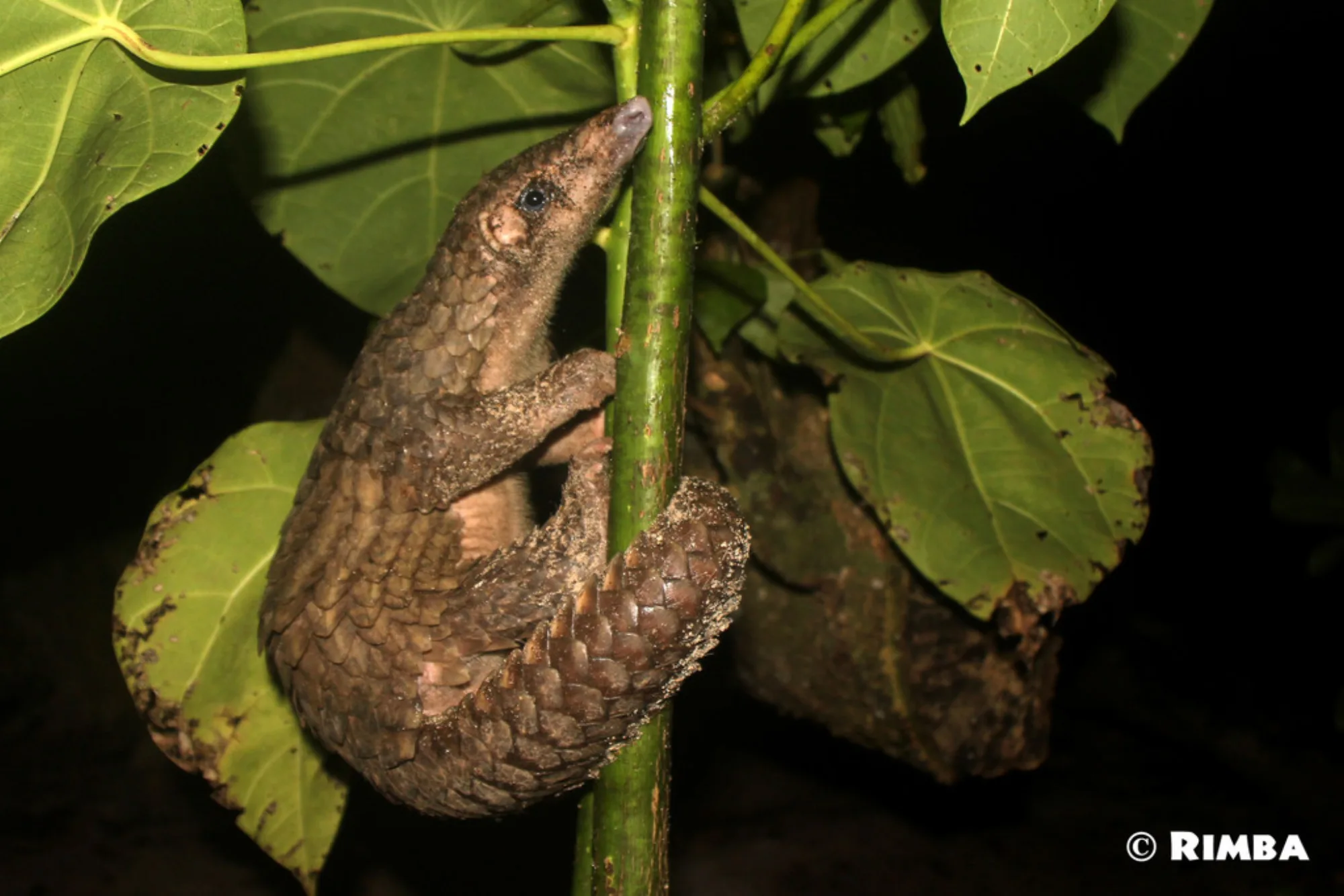
Brown scales cover the Sunda Pangolin, with fibrous hair between them and, in some individuals, white scales along the tail. Its head and body measure 40 to 65 cm, with a tail of 35 to 56 cm; males are larger than females. Its eyesight is weak, but its sense of smell is keen, and powerful claws help it dig for ant nests and break into termite mounds.
Native to Southeast Asia, it ranges from Myanmar and Thailand to Vietnam, Singapore and islands including Borneo, Java and Sumatra. It favours primary, secondary and scrub forests, and can also be found on plantations growing rubber or oil palms. Much of its life is spent in trees. Usually solitary, nocturnal and timid, it is sometimes found in pairs. When threatened, it rolls into a ball to protect its soft underside. It also digs burrows near ant nests and termite mounds, lining them with vegetation for insulation.
Ants and termites are gathered with a long, sticky tongue. Pangolins breed in autumn, and females give birth in a winter burrow to one or two young each year. Mothers care for their offspring for about three months, travelling and foraging over a much smaller range during that time. Hunting is the principal threat across most of Southeast Asia, with the animals taken for their skin, scales and meat. Illegal international trade has driven a rapid population decline, while habitat loss has accelerated it. In Singapore, habitat loss and vehicle collisions are the main dangers.
Written from the English Wikipedia article Sunda pangolin (CC BY-SA 4.0).
- Records
- 8
- Countries
- 2
No atlas park has a record of the Sunda Pangolin in or around it yet.
These are open occurrence records, so they show where people looked for and recorded the Sunda Pangolin as much as where it lives. Cells are up to 25 km across, and every location is generalised to its cell.
Generalised encounter areas, not exact locations. Each shape is a grid cell coloured by how likely the species is there.
- Very likelySingapore25 km zone · medium confidence · 8 records · updated 80 days ago
- UncommonCambodia25 km zone · low confidence · 0 records · updated 80 days ago
Conservation status not assessed here yet, so every location is generalised to its grid cell.