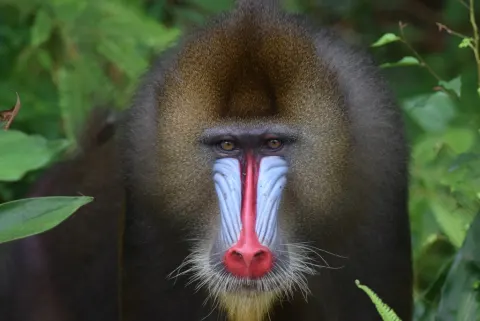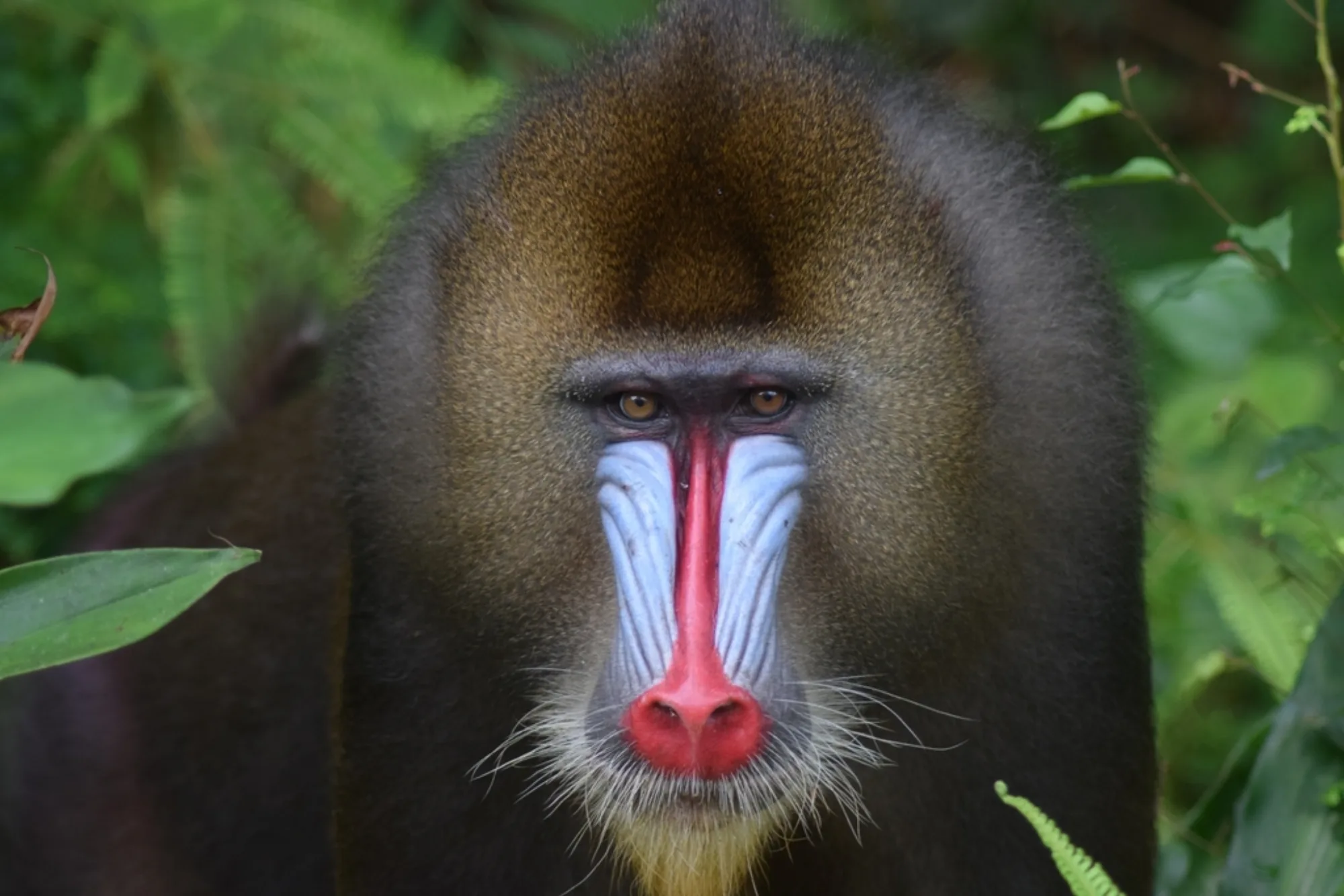
Mandrill
Mandrillus sphinx
A stocky monkey with a short tail and a yellow-orange beard, the Mandrill stands out against the forest greenery. A red stripe runs down its face to the nose, with grooved blue skin on either side. Males are larger and more brightly coloured than females, whose faces range from softer red and blue to nearly black. The species lives in west-central Africa, from southern Cameroon and mainland Equatorial Guinea through Gabon to parts of the Republic of the Congo. Tropical rainforest is its main habitat, particularly primary forest, although it also uses patches of gallery forest surrounded by savanna and crosses grassy areas.
Mandrills are active by day and spend much of their time on the ground, though they also feed high in the canopy. Fruit and seeds are favoured foods, supplemented by leaves, shoots, plant pith, mushrooms and animals ranging from insects to young bay duikers. During the wet season they forage in continuous forest, moving to gallery forests and forest and savanna edges in the dry season. They live in large, stable groups called hordes, sometimes numbering hundreds, with related females at their social core. Adult males generally live alone outside the breeding season and rejoin groups when females become receptive. Most births take place between January and March, and mothers carry dependent infants on their bellies.
Habitat destruction and hunting for bushmeat are the main threats. Habitat has been lost in southern Cameroon and Equatorial Guinea, where hunting also appears to have reduced group sizes. Gabon remains an important refuge for the species, with extensive rainforests and protected areas.
Written from the English Wikipedia article Mandrill (CC BY-SA 4.0).
- Records
- 1
- Countries
- 1
No atlas park has a record of the Mandrill in or around it yet.
These are open occurrence records, so they show where people looked for and recorded the Mandrill as much as where it lives. Cells are up to 25 km across, and every location is generalised to its cell.
Generalised encounter areas, not exact locations. Each shape is a grid cell coloured by how likely the species is there.
- Very likelyGabon25 km zone · medium confidence · 1 record · updated 80 days ago
Conservation status not assessed here yet, so every location is generalised to its grid cell.