Drill
Mandrillus leucophaeus
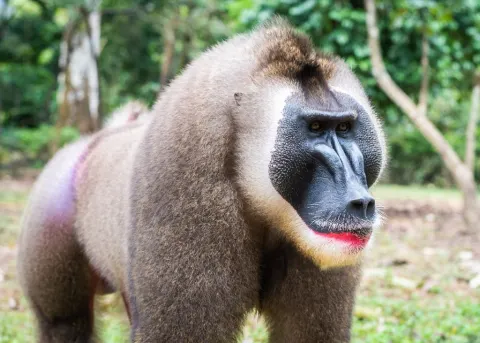
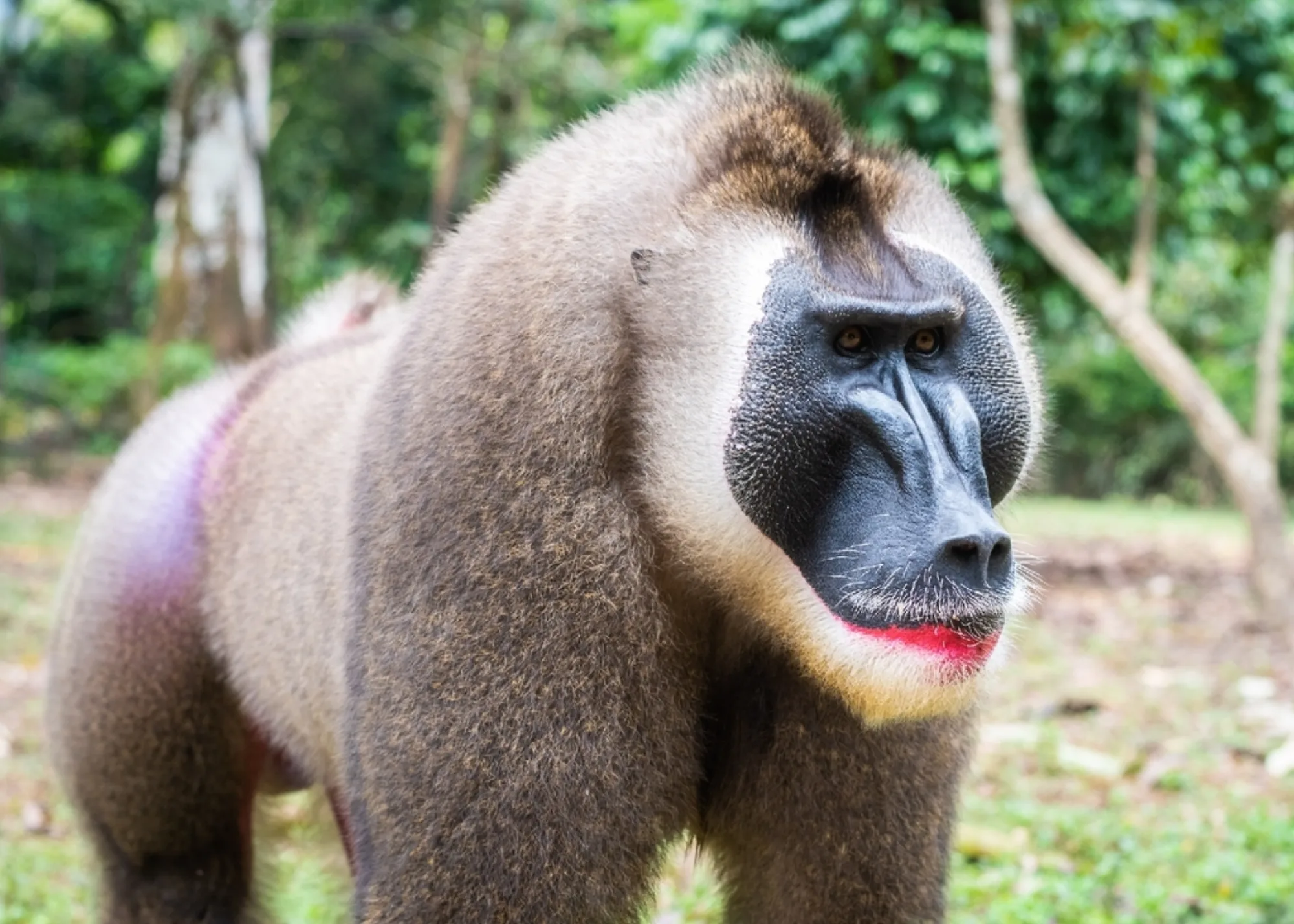
This large, semi-terrestrial monkey is a relative of the mandrill and baboon. Drills are distinguished by their black faces, brownish-gray fur, and short tails. They exhibit extreme sexual dimorphism, with males averaging 32.3 kg and 82 cm in length, while females are much smaller at 11.7 kg and 66 cm. Dominant males possess colorful rear, groin, and chin areas featuring red, blue, and white markings. They also have large muzzle swellings that serve as reproductive signals.
Native to Nigeria, Cameroon, and Equatorial Guinea, the remaining wild population of approximately 4,000 individuals is fragmented into small pockets. They inhabit diverse environments including lowland coastal forests, mountain peaks, savanna, and inland cliffs. These semi-nomadic primates travel on all fours and sleep in trees to avoid predators. Living in troops of 15 to 75 members, they are led by dominant males who compete for breeding rights. Females usually give birth to a single infant after a gestation of 179 to 182 days.
As opportunistic omnivores, drills forage for fruits, seeds, mushrooms, and insects like ants. They provide a vital ecosystem service by dispersing seeds throughout their range. However, they face significant threats from hunting and the pet trade. Human activities such as commercial logging and clearing forest for agriculture cause habitat loss and degradation. Because they often live near high human populations, their limited range is increasingly under pressure, though they are now protected in several national parks and sanctuaries.
Written from the English Wikipedia article Drill (animal) (CC BY-SA 4.0).
- Atlas places
- 0
These are open occurrence records, so they show where people looked for and recorded the Drill as much as where it lives. Cells are up to 25 km across, and every location is generalised to its cell.
No encounter zones yet
Where and when you can expect to see Drill is calculated from observation density. No zones have been computed for this species yet.