Splendid Fairywren
Malurus splendens
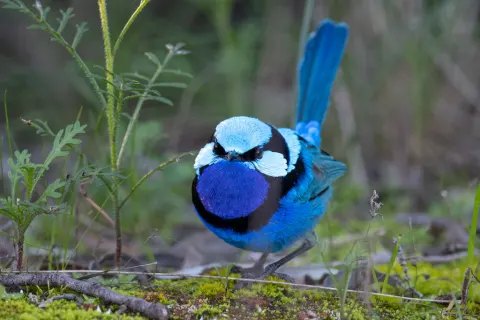
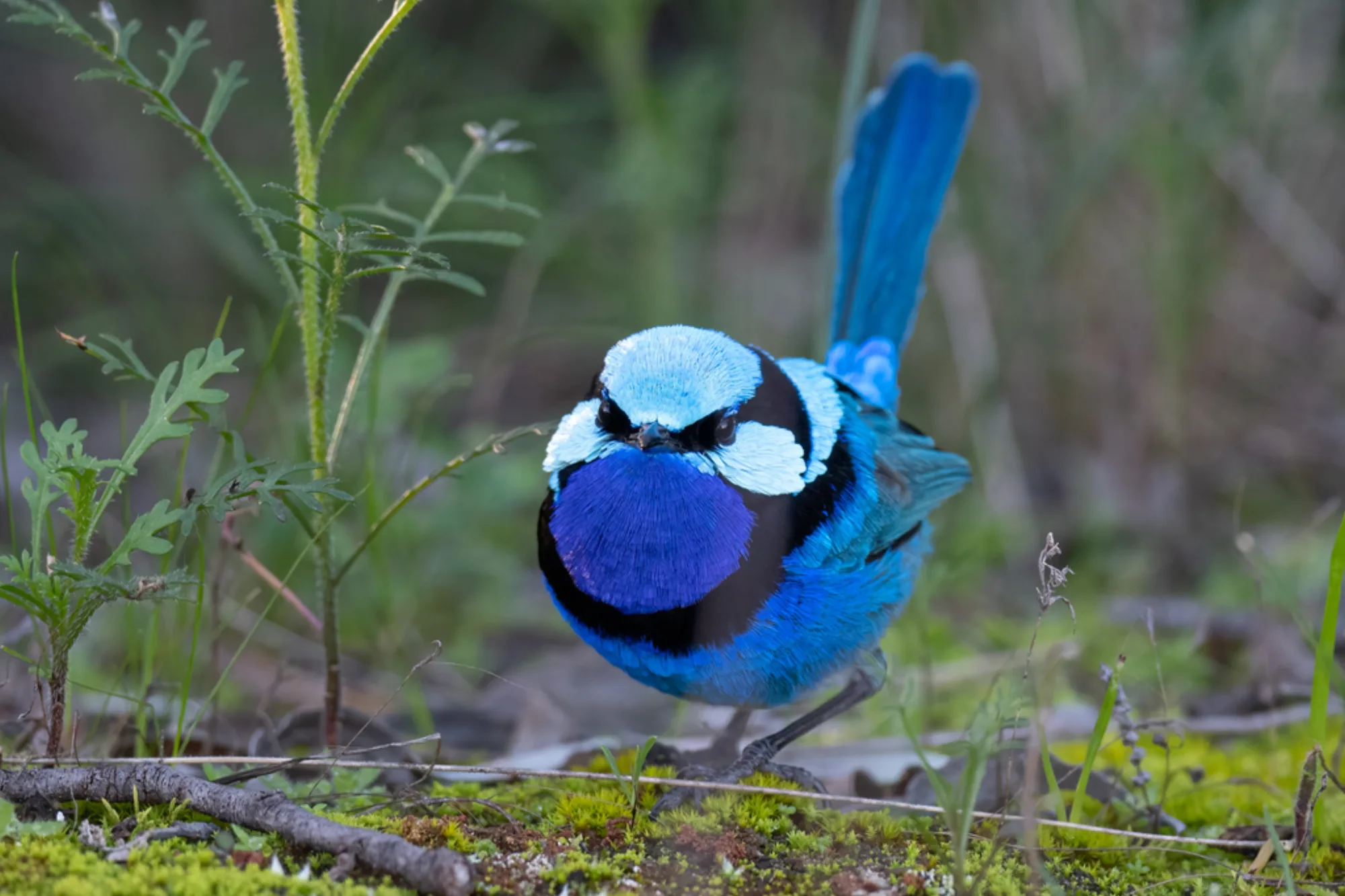
A flash of blue in dry Australian scrub may be a male Splendid Fairywren in breeding plumage. This small, long-tailed bird measures 14 cm, and the breeding male has a bright blue forehead, violet throat and darker blue back, wings, chest and tail. Black bands cross his eye and chest. Non-breeding males are brown, with blue wings and a bluish tail; females look similar but have a chestnut bill and eye patch. Its range stretches across much of Australia, from the coast of Western Australia to southwestern Queensland and central-western New South Wales. It favours arid and semiarid country, from mulga and mallee scrub to forests in the southwest, with vegetation for shelter.
Look for these restless birds hopping on open ground near cover or searching through low foliage. They forage in groups, eating mainly insects and other small creatures, including ants, grasshoppers, crickets and spiders, with some seeds, flowers and fruit. During spring and summer they feed in bursts and often rest together in shelter during the heat of the day. In winter, when food is harder to find, they must forage throughout the day. Groups defend a territory year-round, and helper birds feed and care for the young. Breeding runs from late August to January, although heavy August rain can delay it. The female builds a concealed, rounded nest of grasses and spider webs close to the ground, often among thorny plants. Nest predators include magpies, kookaburras and crows, as well as introduced foxes, cats and black rats. The fairywren has disappeared from some urbanised areas, and plantations without undergrowth are unsuitable habitat.
Written from the English Wikipedia article Splendid fairywren (CC BY-SA 4.0).
- Records
- 49,631
- Countries
- 1
No atlas park has a record of the Splendid Fairywren in or around it yet.
These are open occurrence records, so they show where people looked for and recorded the Splendid Fairywren as much as where it lives. Cells are up to 25 km across, and every location is generalised to its cell.
Generalised encounter areas, not exact locations. Each shape is a grid cell coloured by how likely the species is there.
- Very likelyAustralia25 km zone · high confidence · 49631 records · updated 80 days ago
Conservation status not assessed here yet, so every location is generalised to its grid cell.