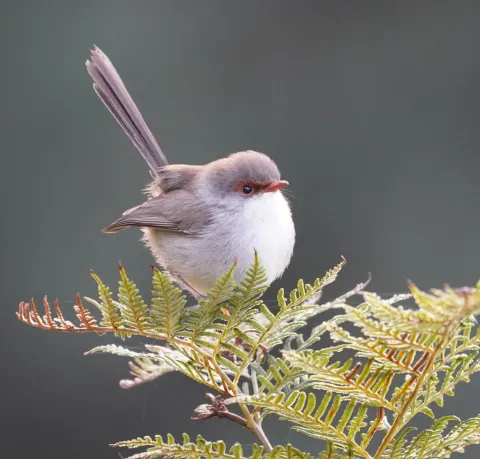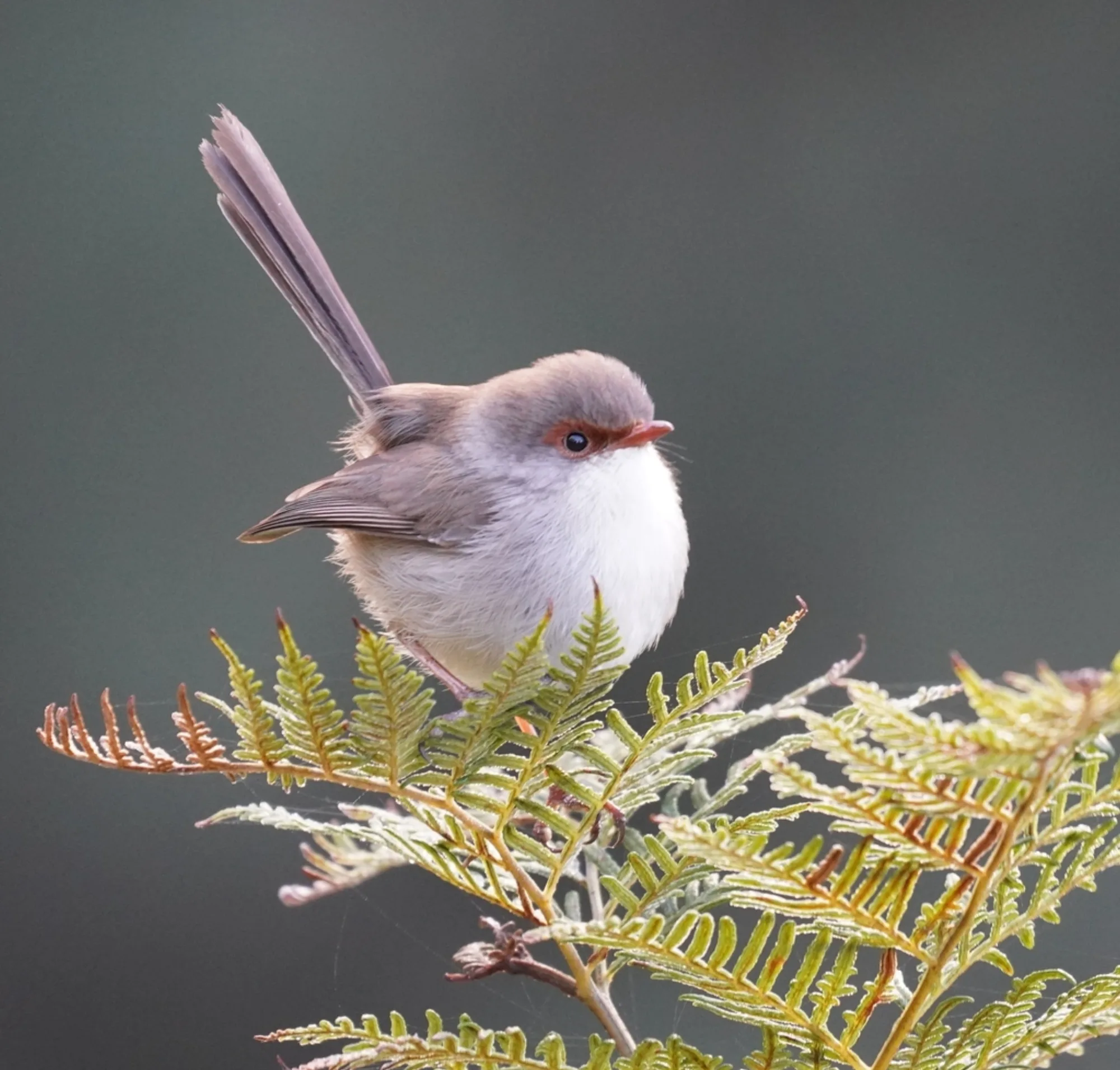
Superb Fairywren
Malurus cyaneus
A flash of blue among low shrubs may be a male Superb Fairywren in breeding plumage, with a bright blue forehead and tail, brown wings and a black throat and eye band. Females, young birds and males outside the breeding season are mostly grey-brown, making them easy to mistake for one another. At 14 cm long, this restless bird moves in hops and bounces, usually holding its tail upright. Both males and females sing a high-pitched, rolling song, while their alarm call consists of short, sharp notes.
Superb Fairywrens are common across much of south-eastern Australia, including Tasmania and Kangaroo Island. They live in woodland, heath, grassland with scattered shrubs and gardens, wherever there is some dense undergrowth for shelter. In cities, look for them in gardens and parks with native undergrowth nearby, including Sydney's Royal Botanic Gardens. They feed mainly on insects, searching on the ground or among low shrubs, and also eat small amounts of seeds, flowers and fruit. Staying close to cover and foraging in groups helps protect them from predators.
Pairs or small groups defend territories throughout the year, and helpers assist with feeding and raising young. From spring to late summer, the birds build a rounded nest of grasses and spider webs, tucked into thick vegetation close to the ground. Nest predators include magpies, butcherbirds, kookaburras and crows, as well as introduced foxes, cats and black rats. A bird may try to draw a predator away from a nest with young by running rapidly, fluffing its feathers and calling continuously. Superb Fairywrens also host cuckoos that lay their eggs in other birds' nests.
Written from the English Wikipedia article Superb fairywren (CC BY-SA 4.0).
- Records
- 751,044
- Countries
- 1
- Atlas places
- 5
These are open occurrence records, so they show where people looked for and recorded the Superb Fairywren as much as where it lives. Cells are up to 25 km across, and every location is generalised to its cell.
Generalised encounter areas, not exact locations. Each shape is a grid cell coloured by how likely the species is there.
- Very likelyAustralia25 km zone · high confidence · 751044 records · updated 86 days ago
Conservation status not assessed here yet, so every location is generalised to its grid cell.