Reticulated Python
Malayopython reticulatus
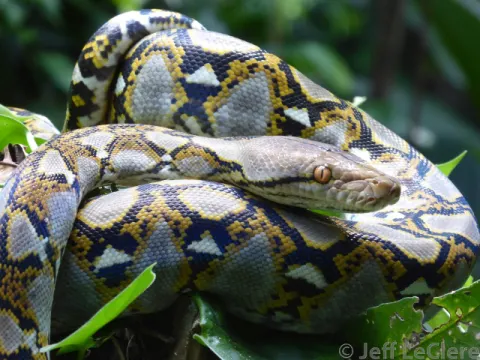
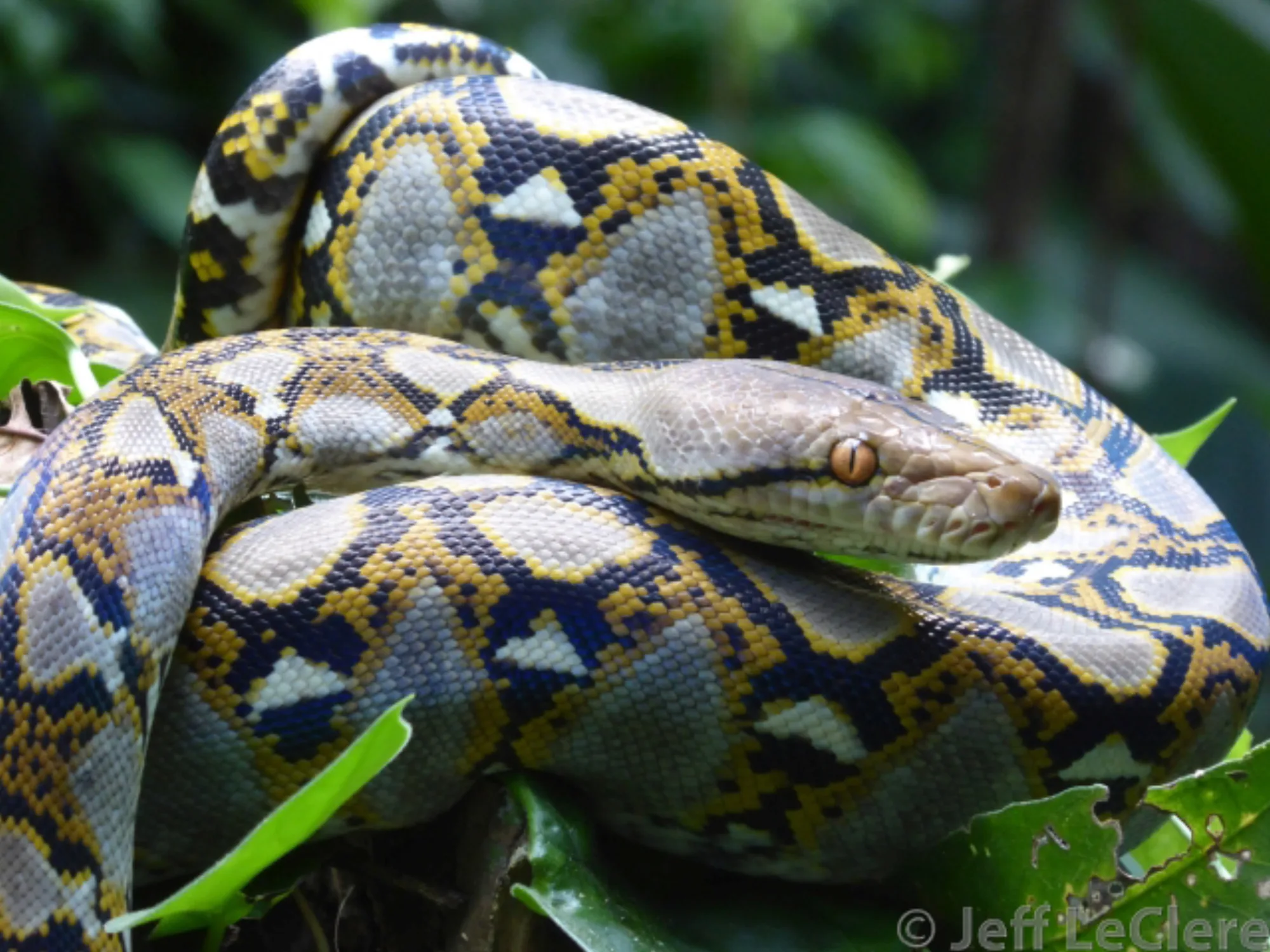
A network of irregular diamonds runs along the back of the Reticulated Python (Malayopython reticulatus), with smaller, light-centred markings along its sides. Its colours and markings vary across its range, but the pattern can make the snake difficult to spot among fallen leaves and debris in a shadowy forest. This non-venomous constrictor is the world's longest snake, although individuals over 6 m are rare. In a study in southern Sumatra, wild snakes were estimated to measure from 1.5 to 6.5 m.
Across South and Southeast Asia, its range extends from the Nicobar Islands and mainland countries through Indonesia to Timor-Leste and the Philippines. It inhabits rainforests, woodlands and nearby grasslands, often near rivers, streams or lakes. A strong swimmer, it has reached many small islands within its range and has even been sighted far offshore. The python usually waits in ambush for prey to come close, then seizes it in its coils and kills it by constriction. Smaller snakes feed mainly on small mammals, including rats, bats and treeshrews, while larger ones take animals such as civets, primates, wild boar and deer. Birds are eaten occasionally, and snakes living near people sometimes take stray chickens, cats or dogs.
Females lay clutches of 15 to 80 eggs, and hatchlings are at least 0.61 m long. In several countries, people hunt the python for its skin, traditional medicine and the pet trade. People have also killed individual pythons following fatal attacks on humans, which have occasionally occurred.
Written from the English Wikipedia article Reticulated python (CC BY-SA 4.0).
- Records
- 108
- Countries
- 8
- Atlas places
- 7
These are open occurrence records, so they show where people looked for and recorded the Reticulated Python as much as where it lives. Cells are up to 25 km across, and every location is generalised to its cell.
Generalised encounter areas, not exact locations. Each shape is a grid cell coloured by how likely the species is there.
- Very likelyMalaysia25 km zone · medium confidence · 33 records · updated 81 days ago
- Very likelyThailand25 km zone · medium confidence · 30 records · updated 81 days ago
- Very likelyPhilippines25 km zone · medium confidence · 24 records · updated 81 days ago
- Very likelySingapore25 km zone · medium confidence · 8 records · updated 81 days ago
- LikelyIndonesia25 km zone · medium confidence · 11 records · updated 81 days ago
- LikelyVietnam25 km zone · medium confidence · 1 record · updated 81 days ago
- PossibleBrunei25 km zone · medium confidence · 1 record · updated 81 days ago
- PossibleCambodia25 km zone · low confidence · 0 records · updated 81 days ago
Conservation status not assessed here yet, so every location is generalised to its grid cell.