Blue Marlin
Makaira nigricans
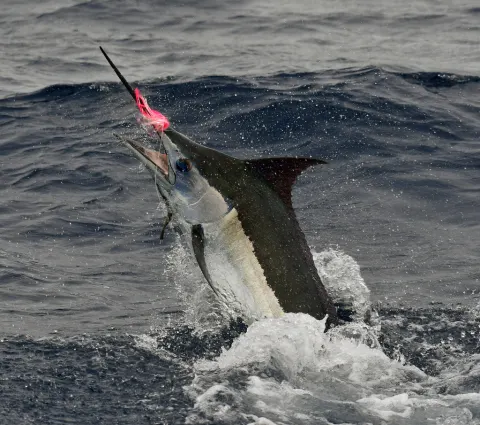
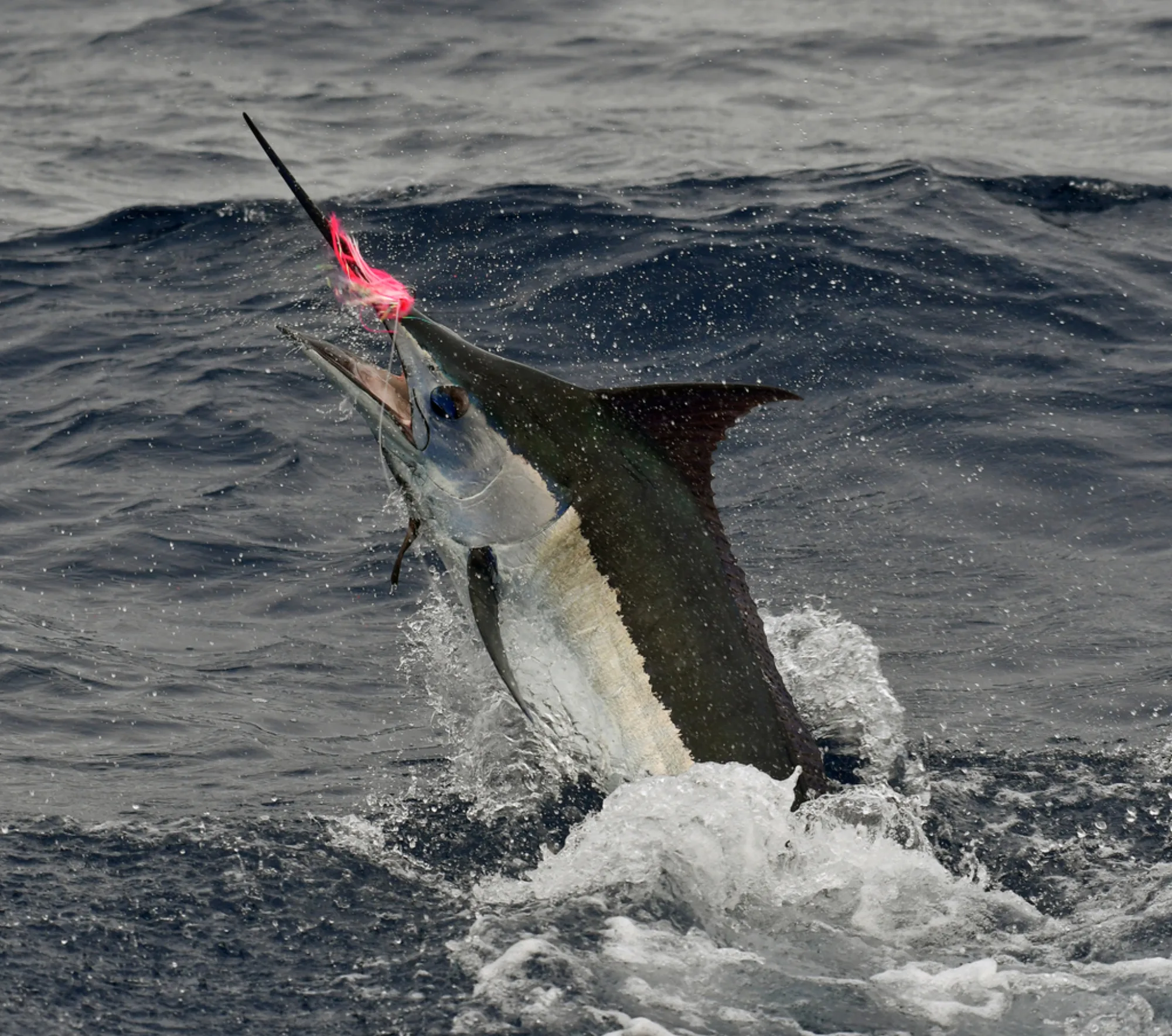
Far out in the Atlantic, the Blue Marlin spends most of its life in open water away from land. Its long, stout bill and blue-black back help distinguish it, while the underside is silvery white. Around 15 rows of pale cobalt stripes, made up of dots or thin bars, run along each side. Blue marlin can also change colour rapidly. The longest females can reach 5 m, including the bill, and the biggest can weigh over four times as much as the biggest males.
These fish occur year-round in the tropical Atlantic, extending into temperate waters during warmer months and moving towards the Equator as conditions cool. They spend much of their time between the surface and 100 m, usually staying near the surface at night and diving deeper by day. Tagged fish have travelled between the Caribbean, the Bahamas and Venezuela, and between the Caribbean and West Africa. Blue marlin feed on a wide range of fish and squid, often hunting near the surface. They may use the bill to stun or injure prey before returning to eat it. Near oceanic islands and coral reefs, their diet includes young inshore fish. Breeding takes place in late summer and autumn, and females may spawn up to four times in a season. The young drift freely in the open ocean and feed on zooplankton, fish eggs and other larvae.
Overfishing puts pressure on blue marlin, including from longlines. They are caught deliberately by commercial fishers and anglers, and also taken accidentally in tuna fisheries. Even when released, many do not survive injuries sustained during capture.
Written from the English Wikipedia article Atlantic blue marlin (CC BY-SA 4.0).
- Records
- 138
- Countries
- 11
No atlas park has a record of the Blue Marlin in or around it yet.
These are open occurrence records, so they show where people looked for and recorded the Blue Marlin as much as where it lives. Cells are up to 25 km across, and every location is generalised to its cell.
Generalised encounter areas, not exact locations. Each shape is a grid cell coloured by how likely the species is there.
- Very likelyColombia25 km zone · medium confidence · 28 records · updated 80 days ago
- Very likelyAustralia25 km zone · medium confidence · 26 records · updated 80 days ago
- Very likelyUnited States25 km zone · medium confidence · 26 records · updated 80 days ago
- Very likelyUnnamed area25 km zone · medium confidence · 17 records · updated 80 days ago
- Very likelySouth Africa25 km zone · medium confidence · 8 records · updated 80 days ago
- Very likelyBahamas25 km zone · medium confidence · 5 records · updated 80 days ago
- LikelyGuinea25 km zone · medium confidence · 9 records · updated 80 days ago
- LikelyAngola25 km zone · medium confidence · 7 records · updated 80 days ago
- LikelyFrench Polynesia25 km zone · medium confidence · 3 records · updated 80 days ago
- LikelySenegal25 km zone · medium confidence · 3 records · updated 80 days ago
Conservation status not assessed here yet, so every location is generalised to its grid cell.