Kirk's Dik-dik
Madoqua kirkii
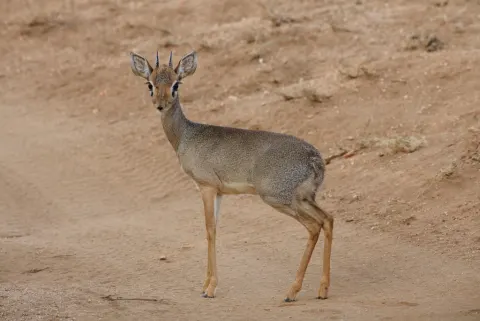
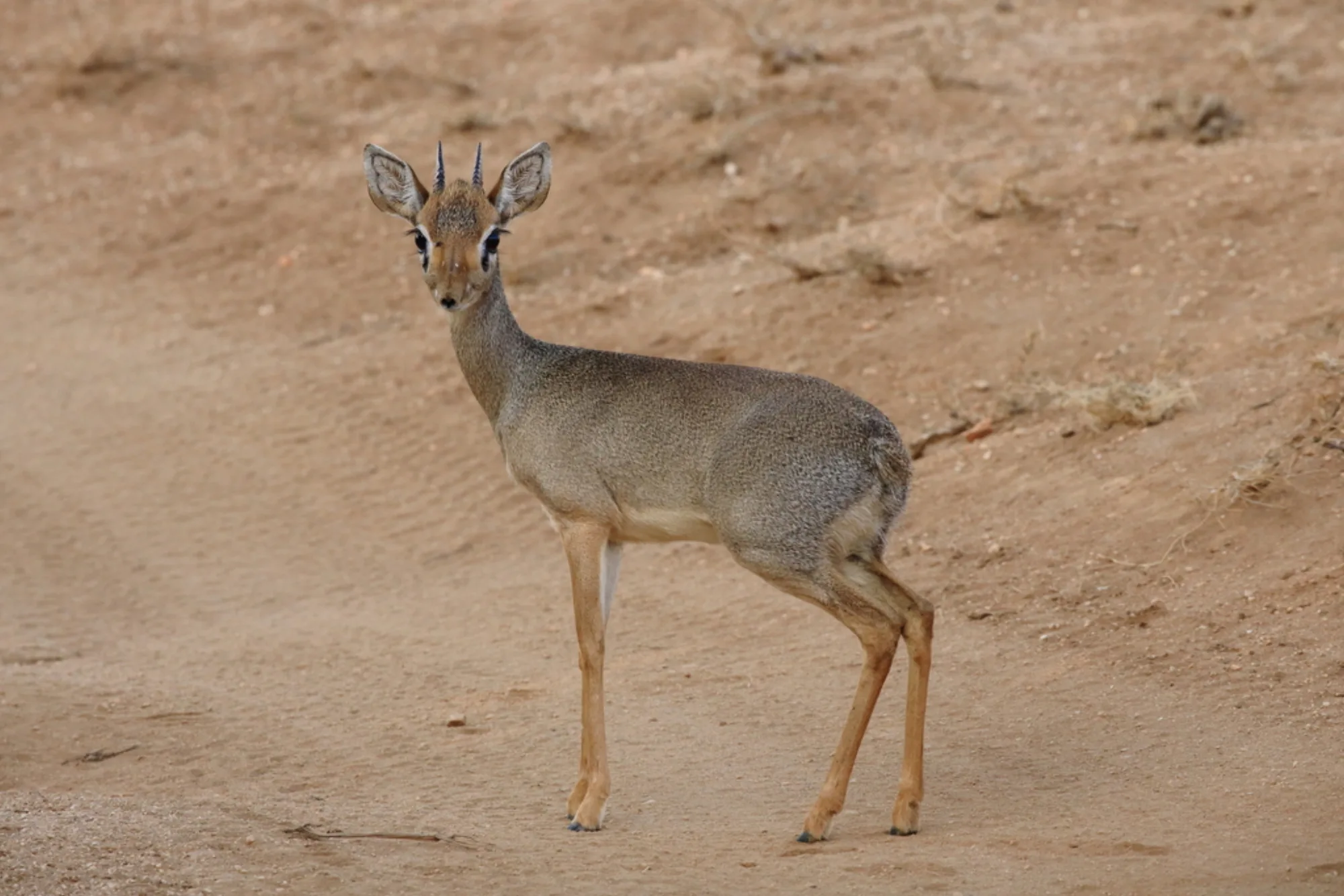
Small enough to disappear into scrub, Kirk's Dik-dik is an antelope of eastern and southwestern Africa. It stands 35 to 45 cm tall and weighs 3.8 to 7.2 kg, with slender legs, large eyes and ears, and a pointed, mobile snout. Its coat varies from grey to grey-brown, with tan sides and pale rings around the eyes. Females are larger and hornless, while males have backward-slanting horns about 7.5 cm long.
Its range is patchy, reflecting a preference for places with cover and shade but little tall vegetation. Look for it among thickets with a well-developed shrub layer and sparse, short grass. When grass grows high enough to block its view, it moves elsewhere. Kirk's Dik-diks are most active at night and rest in shade during the hottest part of the day. They live in pairs, sometimes occupying the same territory for life, and feed selectively on foliage, fruit, shoots and berries. Vegetation supplies their water, and they feed and ruminate at intervals through the day and night.
After a pregnancy of 5 to 6 months, a female gives birth to one young, which stays hidden away from its mother for 2 to 3 weeks. Most births fall in November and December or April and May, around the rainy seasons. When danger approaches, dik-diks lie low; if discovered, they sprint in a zigzag towards a thicket, sounding a trumpet-like alarm. Predators include jackals, leopards and pythons, while eagles and baboons also take young. People are their greatest threat, sometimes hunting them with snares for their hides and bones.
Written from the English Wikipedia article Kirk's dik-dik (CC BY-SA 4.0).
- Records
- 994
- Countries
- 2
- Atlas places
- 4
These are open occurrence records, so they show where people looked for and recorded the Kirk's Dik-dik as much as where it lives. Cells are up to 25 km across, and every location is generalised to its cell.
Generalised encounter areas, not exact locations. Each shape is a grid cell coloured by how likely the species is there.
- Very likelyKenya25 km zone · high confidence · 991 records · updated 80 days ago
- LikelyUnited States25 km zone · medium confidence · 3 records · updated 80 days ago
Conservation status not assessed here yet, so every location is generalised to its grid cell.