Greater Bilby
Macrotis lagotis
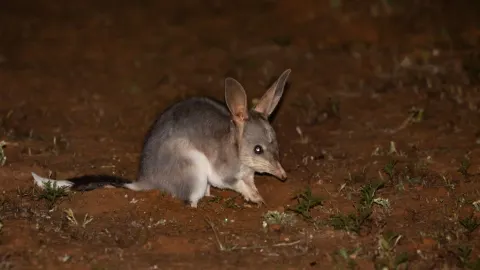
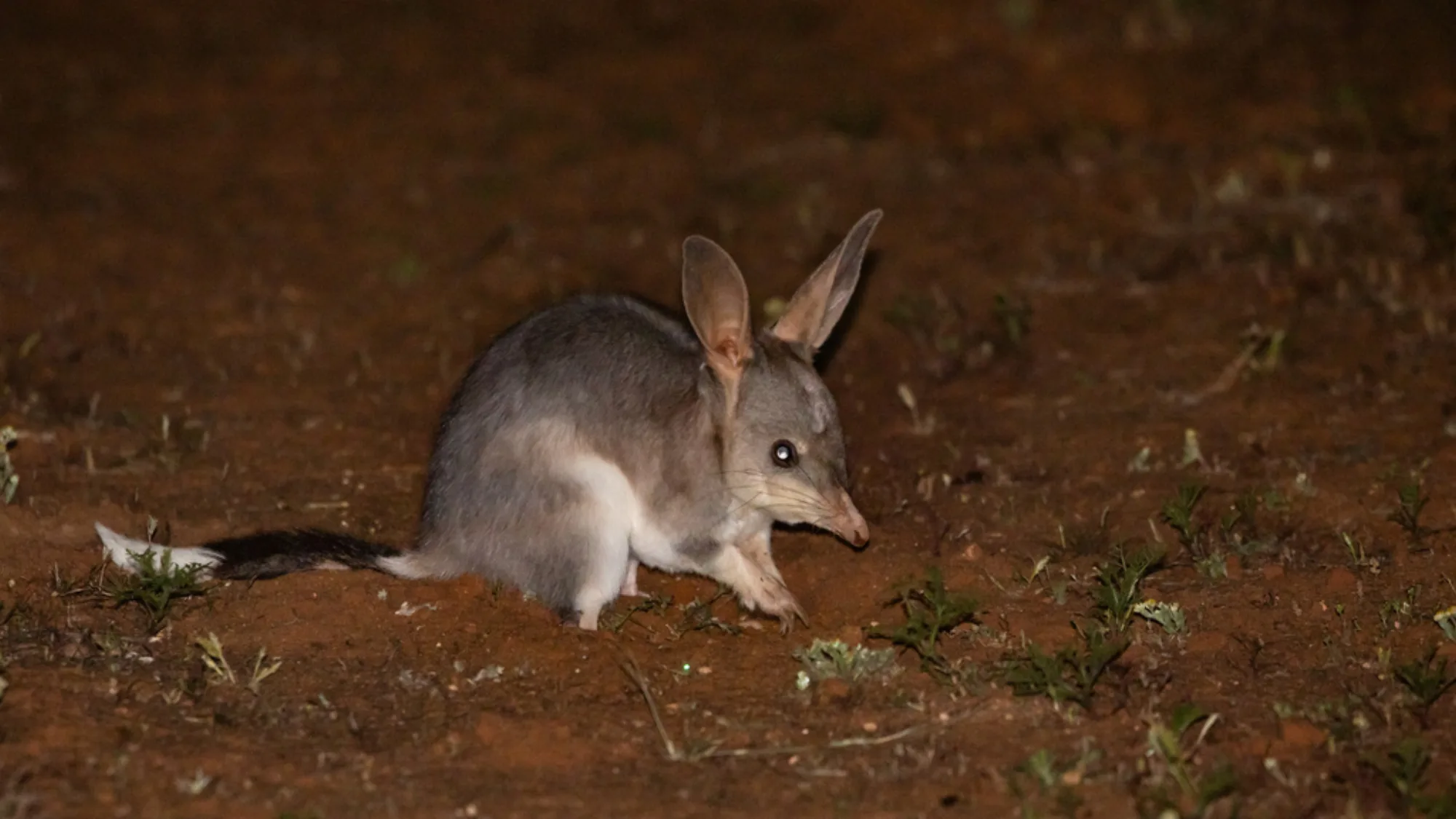
With long ears, a pointed muzzle and soft blue-grey fur, the Greater Bilby has a rabbit-like appearance. Tan patches colour its coat, while its black and white tail has a distinct crest. Its hearing and sense of smell are sharp, helping it navigate a world it sees poorly. Males weigh 1 to 2.4 kilograms, while smaller females weigh around 0.8 to 1.1 kilograms. Once found across much of mainland Australia, bilbies are now restricted to parts of the north-west and centre. They favour arid country with spinifex grass and acacia shrubs, taking refuge underground from predators and daytime heat.
A bilby may make as many as a dozen burrows within its home range, moving between them. Its burrow spirals downwards, making entry difficult for predators. At night it searches for insects, spiders, seeds, bulbs, fruit, fungi and very small animals, often digging or scratching in the soil to find food. It gets the moisture it needs from its meals and does not need to drink. Bilbies usually live alone, though pairs are sometimes seen travelling together. Females can breed throughout the year when conditions are favourable, usually producing litters of one to three joeys. After 70 to 75 days, the young leave the pouch and spend another two to three weeks in their birth burrow before they are independent.
Introduced predators, particularly red foxes, are believed to pose the greatest threat. Habitat loss and change, competition with other animals, disease, changing fire patterns and pastoralism also affect bilbies. Recovery efforts include captive breeding, population monitoring and returning bilbies to places where they once lived.
Written from the English Wikipedia article Greater bilby (CC BY-SA 4.0).
- Records
- 137,105
- Countries
- 1
No atlas park has a record of the Greater Bilby in or around it yet.
These are open occurrence records, so they show where people looked for and recorded the Greater Bilby as much as where it lives. Cells are up to 25 km across, and every location is generalised to its cell.
Generalised encounter areas, not exact locations. Each shape is a grid cell coloured by how likely the species is there.
- Very likelyAustralia25 km zone · high confidence · 137105 records · updated 80 days ago
Conservation status not assessed here yet, so every location is generalised to its grid cell.