Western Grey Kangaroo
Macropus fuliginosus
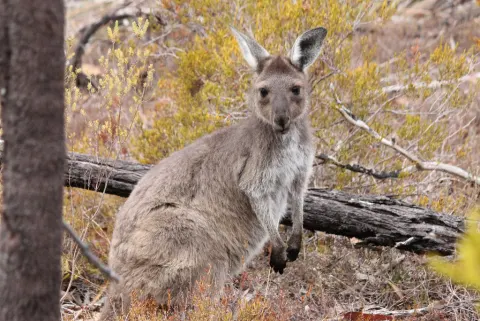
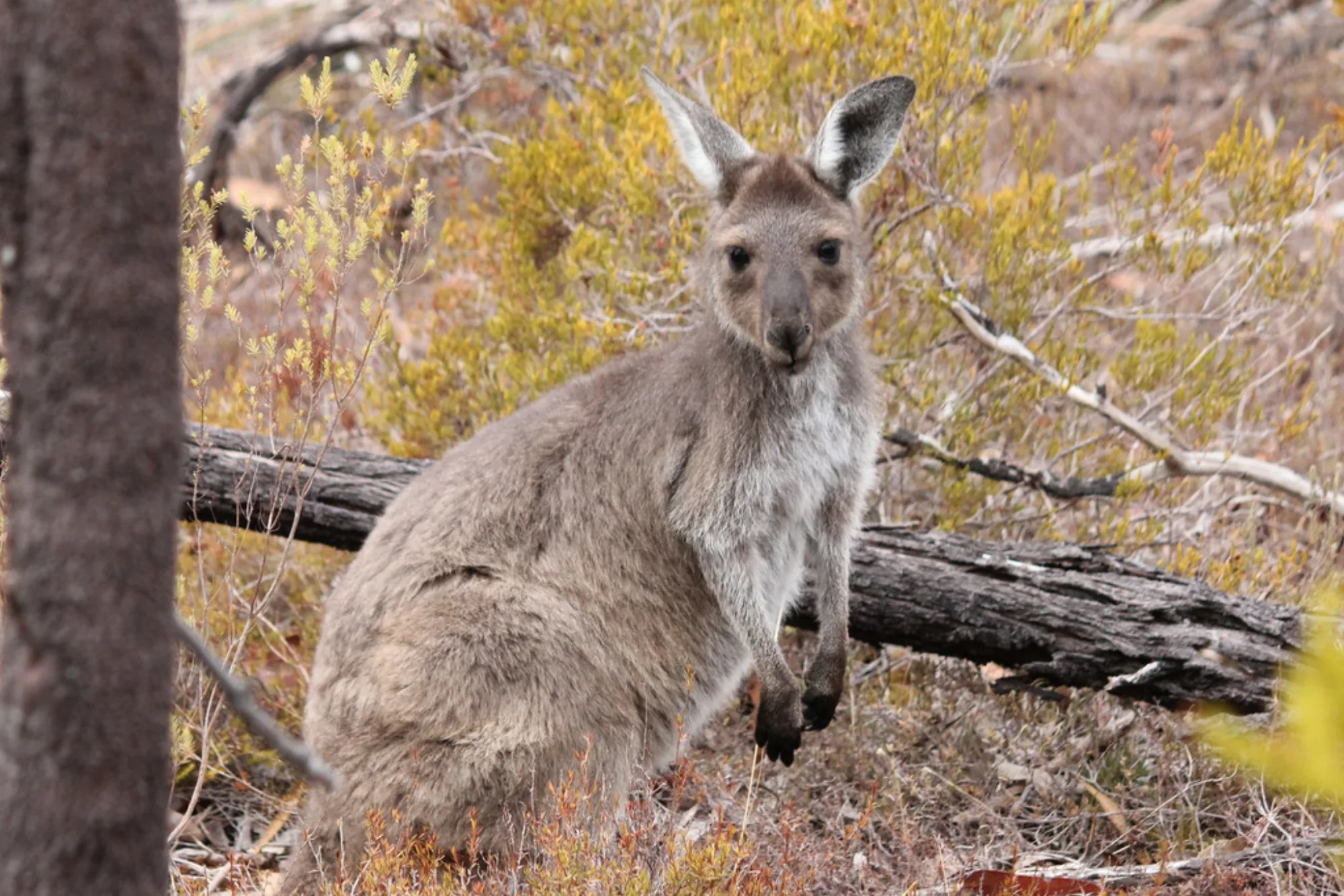
Across much of southern Australia, the Western Grey Kangaroo is a large, common animal whose thick, coarse coat varies in colour between light grey and brown.
Its throat, chest and belly are paler, while the head is darker and sometimes a blackish patch marks the elbow. It can be difficult to distinguish from the eastern grey kangaroo, though its fur is darker grey-brown. Males can reach twice the size of females, and mature males have a distinctive curry-like smell.
Its range extends along the coasts of Western Australia and South Australia, starting just south of Shark Bay, and reaches western Victoria. It also covers the whole Murray-Darling basin, spanning parts of New South Wales and Queensland. It also lives on Kangaroo Island, where a subspecies is found only on the island. Western greys are nocturnal and feed mainly on grasses and forbs, along with leafy shrubs and low trees. They gather in groups of up to 15. In the breeding season, males vie for females in boxing contests, locking arms and trying to push one another over. Usually only the dominant male in a group mates. After a gestation of 30-31 days, a joey spends 130-150 days attached to a teat in its mother's pouch.
In some areas, ranchers regard the kangaroo as a competitor for water and pasture, and its feeding can cause problems for agriculture. Culling is allowed under licence each year to limit agricultural damage, while regulated commercial hunting supplies meat and skins. Hunters may take western greys commercially in Western Australia, mainland South Australia and New South Wales, though this is prohibited on Kangaroo Island.
Written from the English Wikipedia article Western grey kangaroo (CC BY-SA 4.0).
- Records
- 78,378
- Countries
- 1
- Atlas places
- 2
These are open occurrence records, so they show where people looked for and recorded the Western Grey Kangaroo as much as where it lives. Cells are up to 25 km across, and every location is generalised to its cell.
Generalised encounter areas, not exact locations. Each shape is a grid cell coloured by how likely the species is there.
- Very likelyAustralia25 km zone · high confidence · 78378 records · updated 80 days ago
Conservation status not assessed here yet, so every location is generalised to its grid cell.