Australian False Vampire Bat
Macroderma gigas
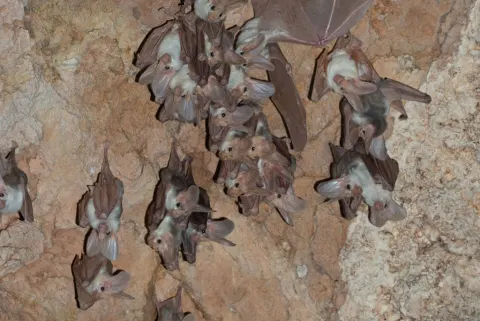
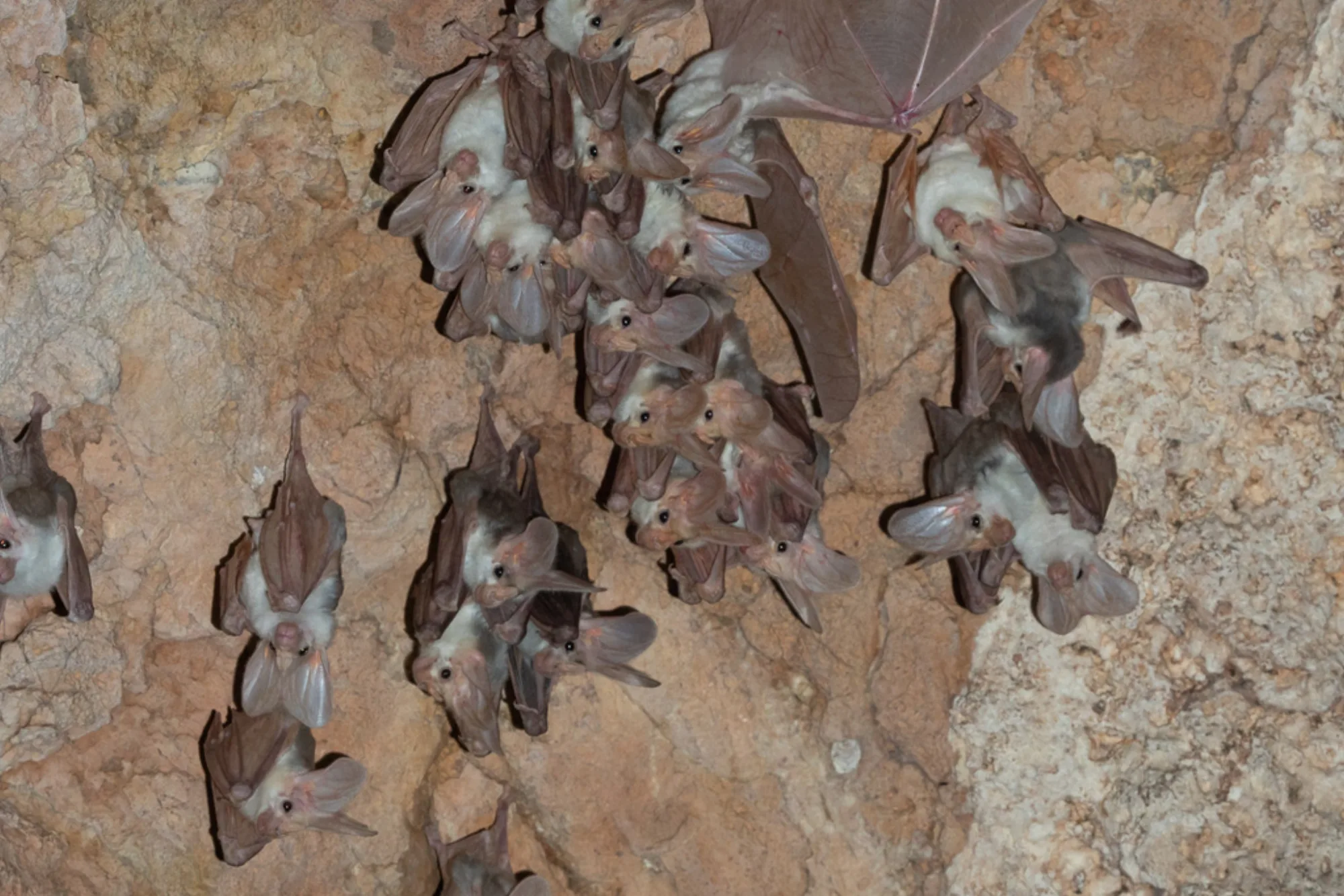
Pale wings, large dark eyes and long ears joined halfway up give the Australian False Vampire Bat, also known as the ghost bat, a distinctive appearance. Its fur ranges from dark or mid-grey to very pale grey on the back, with a whitish head and underside. The largest bat of its kind in Australia, it has a head and body length of 98 to 120 mm and no visible tail.
Found only in Australia, it survives in scattered colonies across the northern Pilbara and Kimberley, the Top End and Queensland. In the Kimberley, its range follows rocky cliffs, gorges and outcrops along watercourses. During the day it shelters in caves, rock crevices, boulder piles and disused mines, favouring sites with several openings. It needs different places for resting, feeding and breeding, and moves between sites with the seasons.
Several hours after sunset, ghost bats leave their roosts alone, in pairs or in small groups. They wait for prey while hanging from a tree, or hunt low over vegetation, using sight, hearing and echolocation to find food. Their diet includes other bats, small birds, frogs, geckos, snakes and large insects. Females gather in maternity colonies and each gives birth to a single young in spring; the youngster can fly after seven weeks and hunts alongside its mother until independent. Barbed wire can catch and tear their wings, while introduced lantana presents a similar danger. Cane toads are strongly implicated in declines, and mining can affect colonies or leave former roosts at risk of collapse. Ghost bats are especially sensitive to disturbance at their roosts, and even a brief visit can cause them to abandon a winter shelter for weeks or longer.
Written from the English Wikipedia article Ghost bat (CC BY-SA 4.0).
- Records
- 990
- Countries
- 1
- Atlas places
- 1
These are open occurrence records, so they show where people looked for and recorded the Australian False Vampire Bat as much as where it lives. Cells are up to 25 km across, and every location is generalised to its cell.
Generalised encounter areas, not exact locations. Each shape is a grid cell coloured by how likely the species is there.
- Very likelyAustralia25 km zone · high confidence · 990 records · updated 80 days ago
Conservation status not assessed here yet, so every location is generalised to its grid cell.