Alligator Snapping Turtle
Macrochelys temminckii
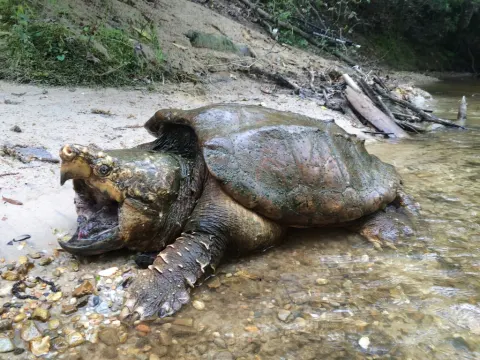
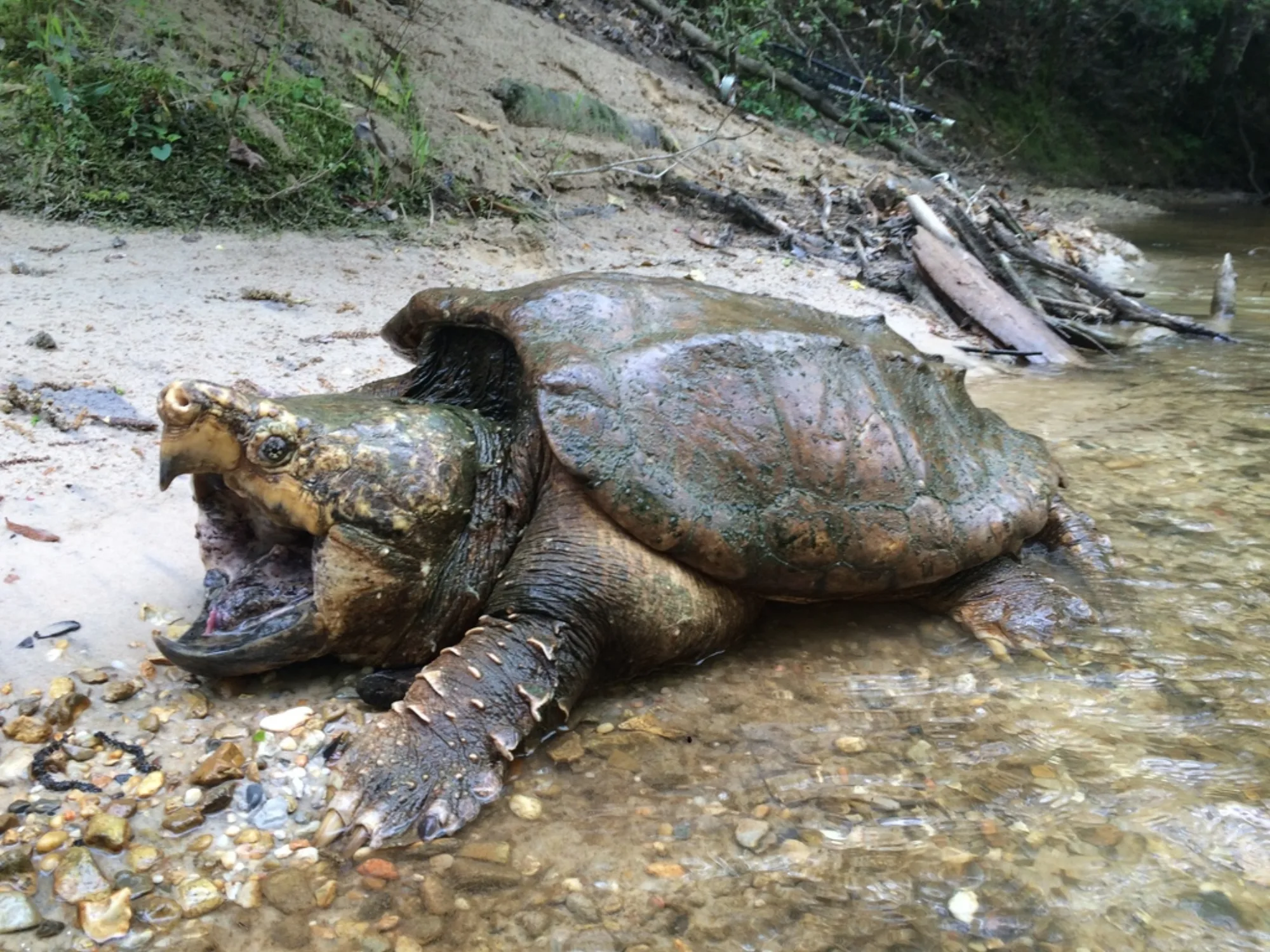
A heavy head, powerful jaws and a thick, ridged shell give the Alligator Snapping Turtle (Macrochelys temminckii) an imposing profile. Its shell has three rows of spikes and raised plates, though the spikes flatten with age. Its colouring ranges from grey and brown to black or olive-green, and algae often coats its shell. Yellow patterns radiate around its eyes, helping to camouflage them. It is the largest freshwater turtle in North America, although males are typically larger than females.
The turtle lives in fresh water in the southeastern United States, ranging west as far as East Texas and north into parts of the Midwest. It generally inhabits waters that drain into the Gulf of Mexico, favouring cover such as overhanging trees, submerged dead trees, root balls and cut banks. It is rarely seen basking, and usually only nesting females come onto open land. Most hunting appears to take place at night, but by day it may lie still on the bottom of murky water, using a worm-like lure on its tongue to draw fish close. It catches live prey and scavenges, eating fish, molluscs, amphibians and other animals, as well as plant matter.
Females build nests about two months after mating and lay 10 to 50 eggs, with some nesting annually and others every other year. The eggs and newly hatched turtles are particularly exposed to predators, including birds and mammals. People also threaten the species through habitat destruction, collection for the exotic pet trade and harvesting for meat, the main reason its US populations have fallen to historic lows.
Written from the English Wikipedia article Alligator snapping turtle (CC BY-SA 4.0).
- Records
- 343
- Countries
- 1
No atlas park has a record of the Alligator Snapping Turtle in or around it yet.
These are open occurrence records, so they show where people looked for and recorded the Alligator Snapping Turtle as much as where it lives. Cells are up to 25 km across, and every location is generalised to its cell.
Generalised encounter areas, not exact locations. Each shape is a grid cell coloured by how likely the species is there.
- Very likelyUnited States25 km zone · medium confidence · 343 records · updated 80 days ago
Conservation status not assessed here yet, so every location is generalised to its grid cell.