Murray Cod
Maccullochella peelii
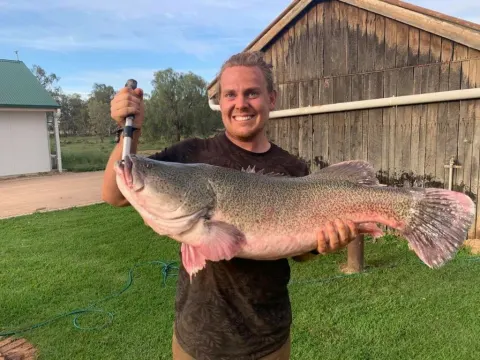
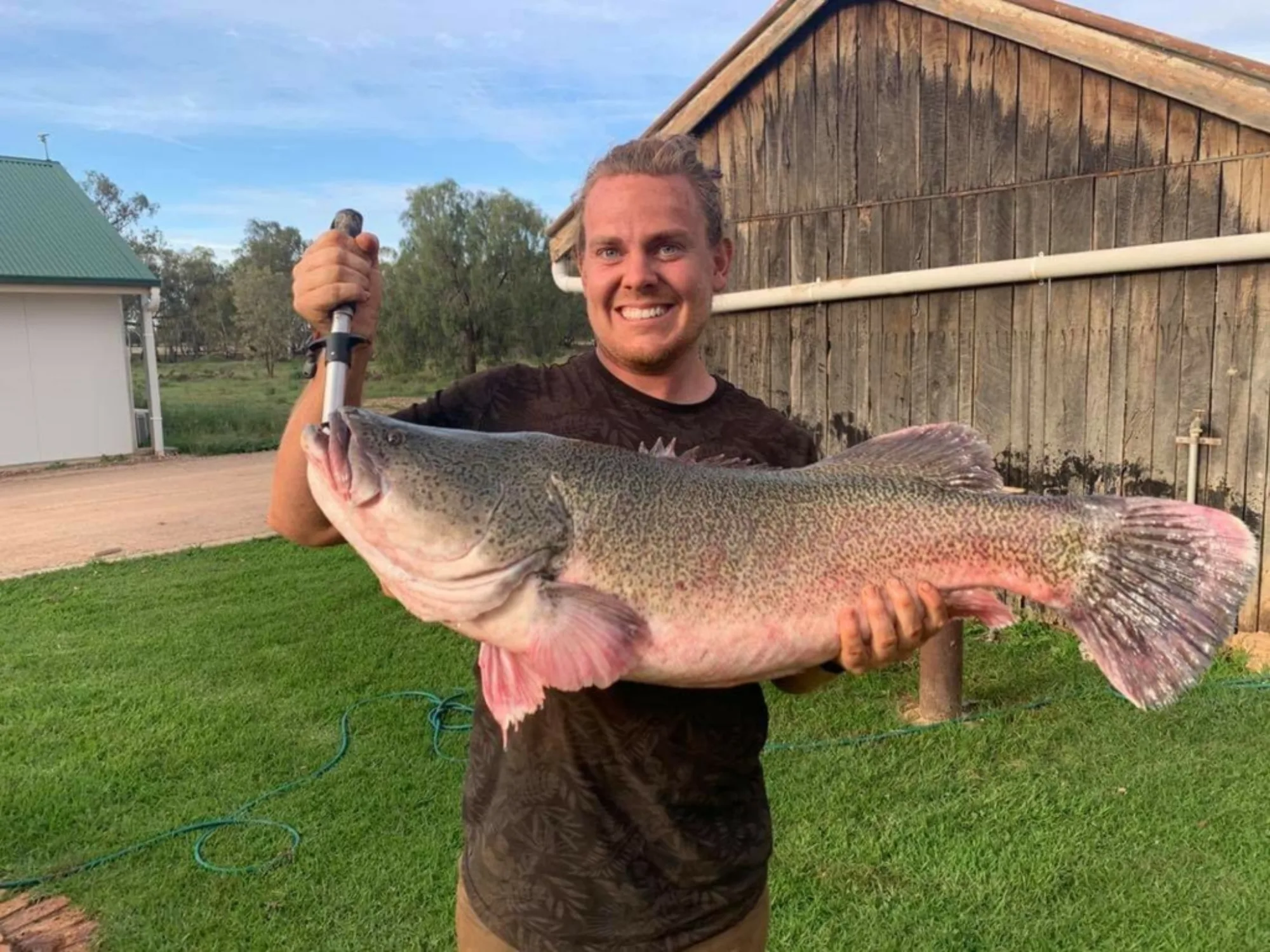
Australia's largest exclusively freshwater fish, the Murray Cod (Maccullochella peelii) is a deep-bodied predator with a wide, hollowed head and a sizeable mouth. Its back and sides are usually yellowish-green to green, with darker mottling that gives it a marbled appearance. The belly is white to cream, while the large, rounded tail is dusky grey or black with a white edge. Adults regularly reach 80 to 100 cm in length, although larger fish are possible.
In eastern Australia, its natural range extends across nearly the entire Murray-Darling basin, from the lowlands well into the uplands. It lives in habitats ranging from cool, clear, fast-flowing streams with rocky beds to large, slow, winding lowland rivers. During the day, it typically ambushes prey, but at night it moves into shallow water and often feeds at the surface. Crustaceans tend to dominate its diet under natural conditions, though it also eats fish and has been known to take animals including frogs, snakes and ducks. Murray Cod spawn in spring, usually depositing their eggs on hard surfaces, including the interiors of hollow logs. Some travel upstream to spawn and return to the same snag afterwards. The male guards the eggs and then the young larvae until they disperse.
Populations have declined severely under pressure from overfishing, river regulation and habitat degradation. Dams and weirs block migration, while the removal of submerged timber takes away important habitat and spawning sites. Cold water released from reservoirs can hinder breeding and the survival of larvae. In lowland rivers, blackwater events can reduce dissolved oxygen to levels fatal to fish.
Written from the English Wikipedia article Murray cod (CC BY-SA 4.0).
- Records
- 21,656
- Countries
- 1
- Atlas places
- 3
These are open occurrence records, so they show where people looked for and recorded the Murray Cod as much as where it lives. Cells are up to 25 km across, and every location is generalised to its cell.
Generalised encounter areas, not exact locations. Each shape is a grid cell coloured by how likely the species is there.
- Very likelyAustralia25 km zone · high confidence · 21656 records · updated 80 days ago
Conservation status not assessed here yet, so every location is generalised to its grid cell.