Tibetan Macaque
Macaca thibetana
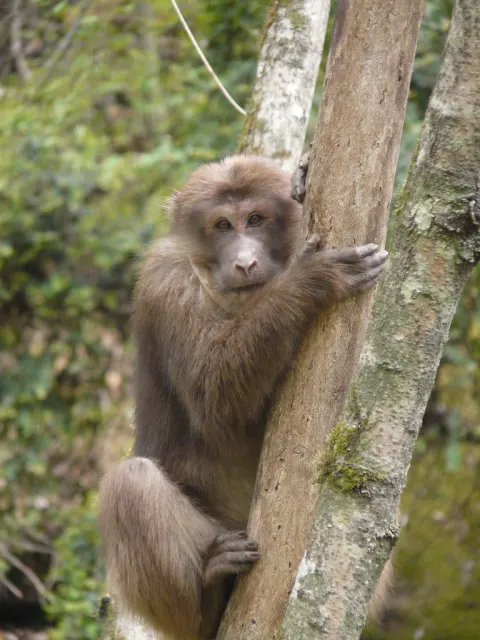
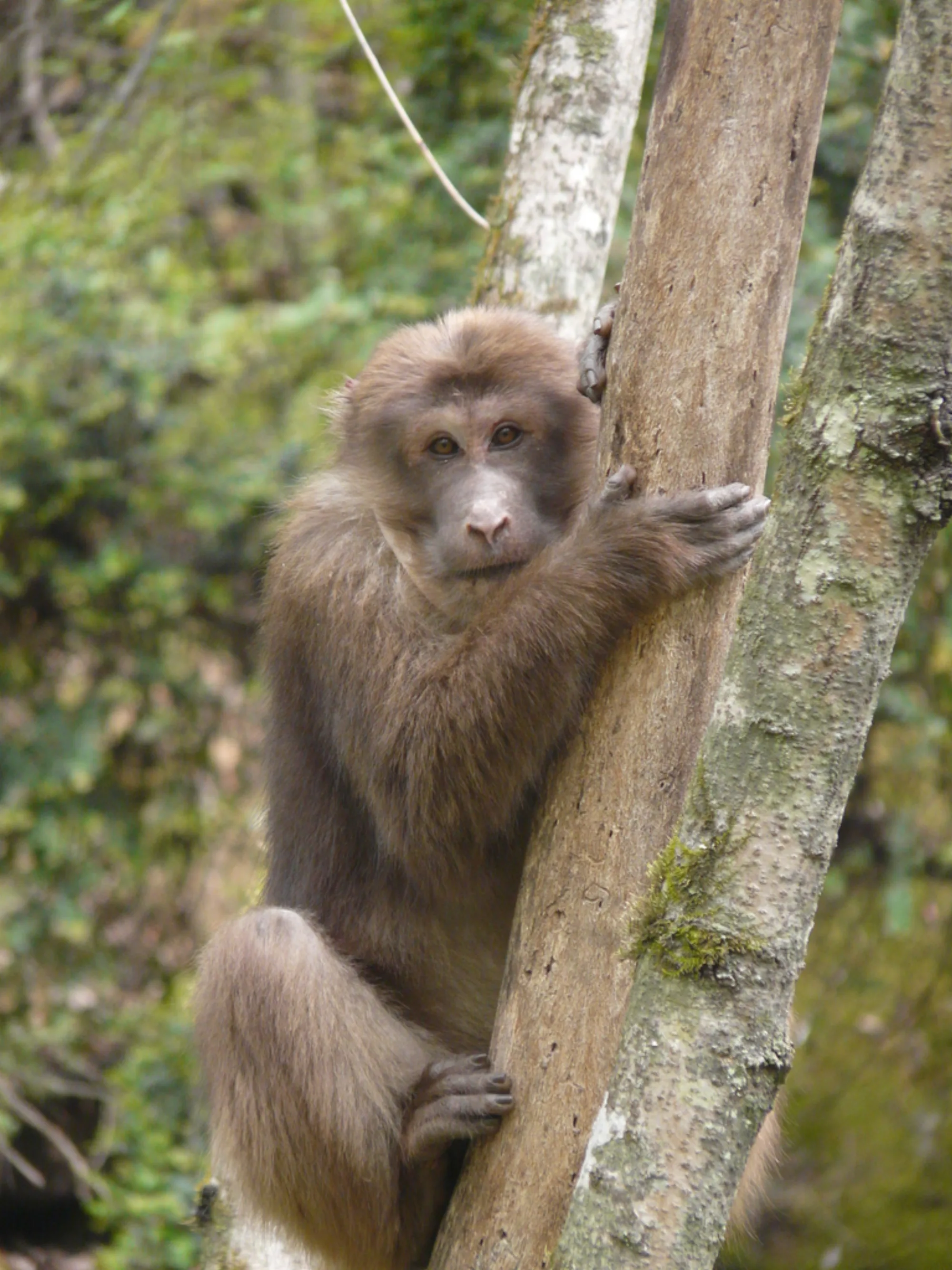
A heavy coat, pale beard and very short tail give the Tibetan Macaque a distinctive appearance. The largest macaque species, it has long, dense fur that is brown on the back and creamy-buff to grey underneath. Adults vary in colour, with some dark brown and others sandy yellowish-brown. Long whiskers frame a relatively hairless face, which is pale pinkish in males and more vivid reddish-pink in females. Youngsters start life with a silver-and-black coat, gaining their adult colour at the age of two.
In China, the species ranges eastwards from eastern Tibet to Guangdong, reaching Shaanxi in the north; reports also place it in northeastern India. It lives in subtropical forests, from mixed deciduous to evergreen, at elevations of 800 to 2,500 m. Active during the day, it forages mainly on the ground for leaves, fruit and grass, with flowers, seeds, roots and insects making up a smaller part of its diet. Bamboo shoots, fruits and leaves are particular favourites when available.
Tibetan macaques live in mixed-sex groups with a social hierarchy. Females stay in the group where they were born, while males leave shortly after adolescence. When a group grows large and competition for resources increases, some members may split off and move to another home range. Females first breed at around five years old, and most infants are born in January and February. Each pregnancy produces a single offspring, which is nursed for a year or sometimes longer. Forest destruction is a principal threat, while poisoning by herbicides and pesticides, diseases passed on by humans, and illegal poaching also affect the species.
Written from the English Wikipedia article Tibetan macaque (CC BY-SA 4.0).
- Records
- 24
- Countries
- 1
No atlas park has a record of the Tibetan Macaque in or around it yet.
These are open occurrence records, so they show where people looked for and recorded the Tibetan Macaque as much as where it lives. Cells are up to 25 km across, and every location is generalised to its cell.
Generalised encounter areas, not exact locations. Each shape is a grid cell coloured by how likely the species is there.
- Very likelyChina25 km zone · medium confidence · 24 records · updated 80 days ago
Conservation status not assessed here yet, so every location is generalised to its grid cell.