Barbary Macaque
Macaca sylvanus
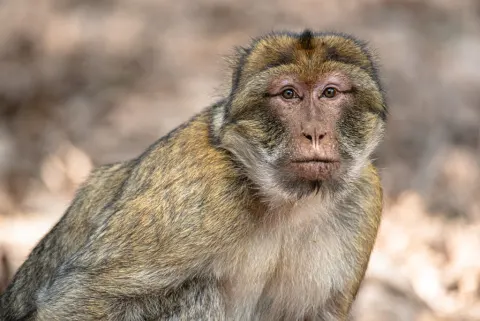
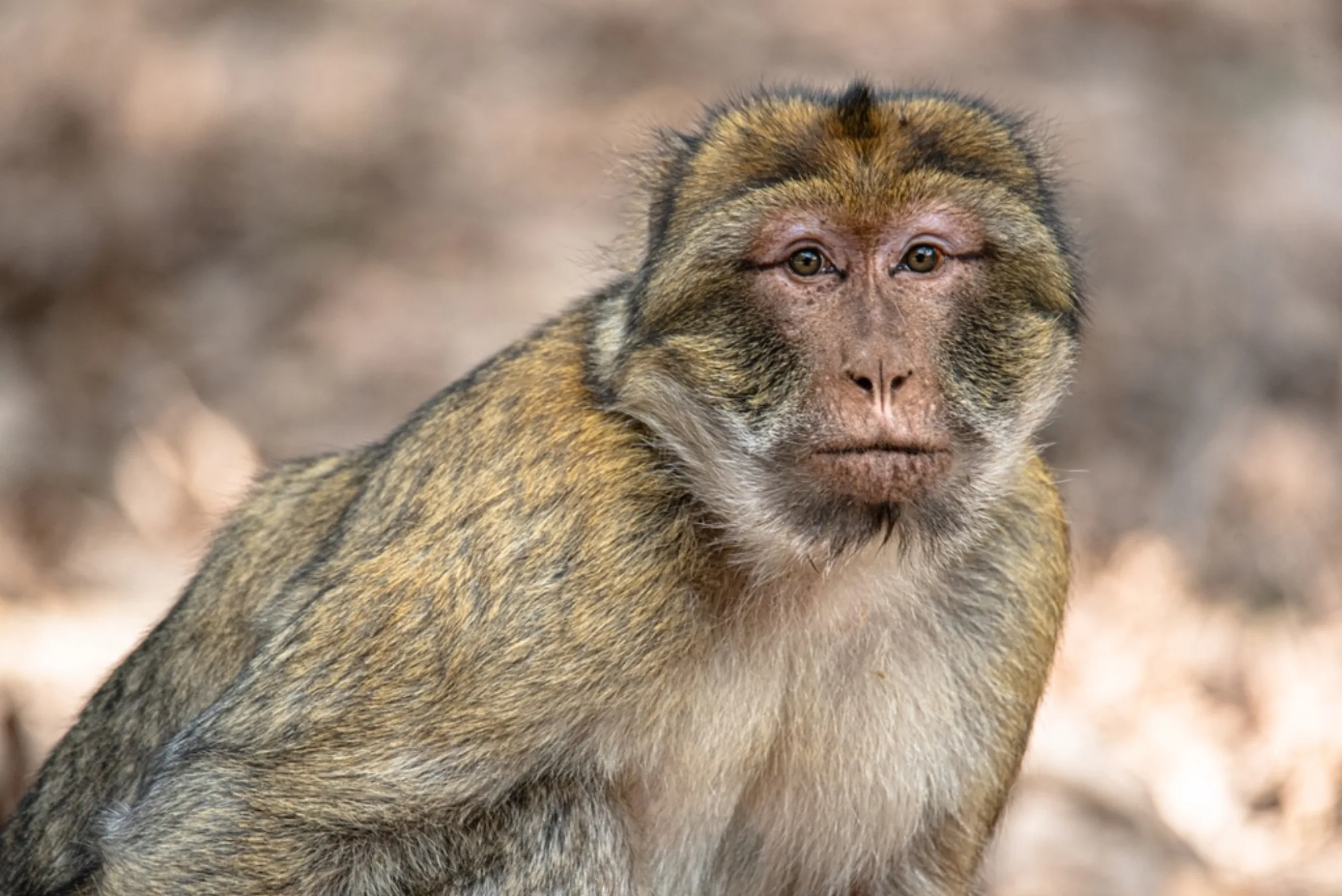
A dark pink face and a tiny or absent tail help distinguish the Barbary Macaque (Macaca sylvanus). Its coat ranges from pale buff and golden brown to grey, with a lighter underside, and adults shed their thick winter fur as temperatures rise. Males are larger than females, averaging 63.4 cm in head-body length compared with 55.7 cm for females.
Today, the macaque lives mainly in fragmented mountain habitats in Morocco and Algeria, with a small introduced population on the Rock of Gibraltar. It occupies cedar, fir and oak forests, as well as grasslands, scrub and vegetated rocky ridges. In Morocco, most inhabit Atlas cedar forests, although that may reflect the habitat available to them. These social monkeys travel in mixed groups of males and females, with troops ranging from 10 to 100 individuals. Their hierarchy follows the lineage of the lead female. Males spend time playing with and grooming infants, including youngsters that are not their own, while macaques of both sexes and all ages can help care for young. Females usually give birth to a single offspring after a gestation of 147 to 192 days. The diet is varied: plants provide foods from flowers and fruit to leaves, bark and roots, while animal prey includes insects, snails and spiders.
Forest fragmentation and degradation, logging and livestock grazing threaten the macaque's habitat. Animals are also captured for the illegal pet trade or killed in retaliation for crop raiding. Close contact with tourists can cause stress, and macaques living near people have more parasites and poorer health, partly associated with food provided by humans.
Written from the English Wikipedia article Barbary macaque (CC BY-SA 4.0).
- Records
- 865
- Countries
- 4
No atlas park has a record of the Barbary Macaque in or around it yet.
These are open occurrence records, so they show where people looked for and recorded the Barbary Macaque as much as where it lives. Cells are up to 25 km across, and every location is generalised to its cell.
Generalised encounter areas, not exact locations. Each shape is a grid cell coloured by how likely the species is there.
- Very likelyAlgeria25 km zone · high confidence · 665 records · updated 80 days ago
- Very likelySpain25 km zone · high confidence · 85 records · updated 80 days ago
- LikelyMorocco25 km zone · medium confidence · 77 records · updated 80 days ago
- LikelyGibraltar25 km zone · medium confidence · 38 records · updated 80 days ago
Conservation status not assessed here yet, so every location is generalised to its grid cell.