Lion-tailed Macaque
Macaca silenus
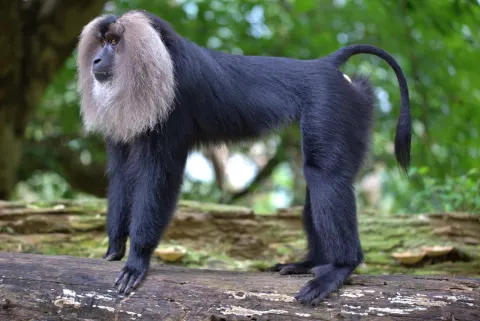
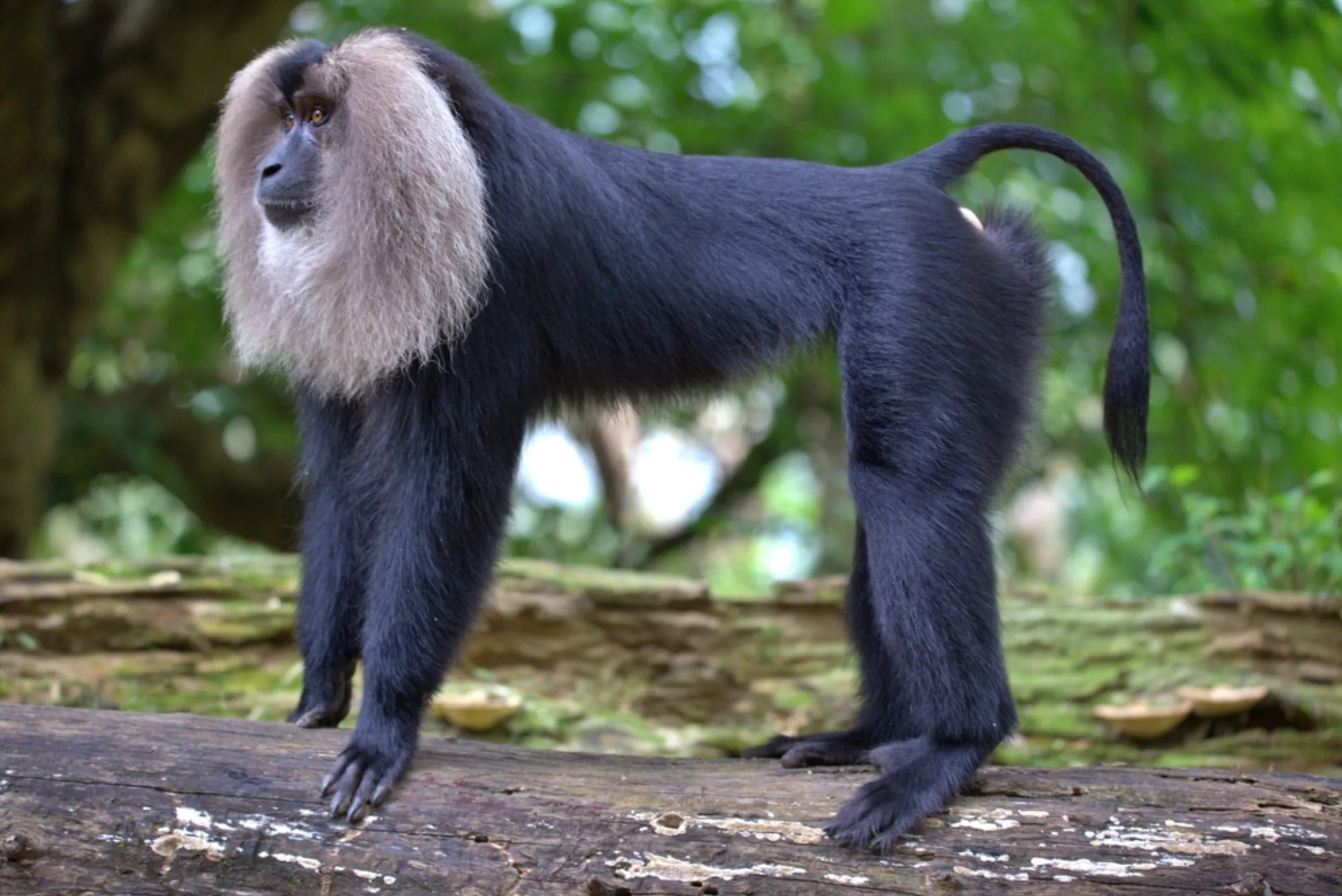
A silver or grey mane frames the black, hairless face of an adult Lion-tailed Macaque, contrasting with its black fur. This small Old World monkey takes its name from its long, thin tail, which ends in a black tuft. Its head and body measure 42 to 61 cm, and it weighs 2 to 10 kg. Infants have pinkish faces and are born without a mane, which starts to grow about two months later.
Found only in the Western Ghats of South India, the macaque lives in rainforest, often high in the canopy of moist evergreen or monsoon forests. Silent Valley National Park in Kerala holds the largest number in South India. Active during daylight, these monkeys spend half their day looking for food and the rest resting or seeking new foraging areas. They usually live in groups of 10 to 20, with a few males and many females, and defend their territory with loud calls and bared teeth. In undisturbed forest, they eat mainly native plant foods, including fruit, seeds and flowers, as well as insects, snails and small vertebrates. Breeding can occur throughout the year, though it tends to peak in the wet season; pregnancy lasts about six months, and young nurse for one year.
Logging and plantations have broken up the macaque's forest habitat, making food harder to find and exposing the animals to cars and power lines. Small, isolated populations are also susceptible to inbreeding. Hunting and trapping for meat are another major threat, while macaques leaving forests in search of food can come into conflict with people.
Written from the English Wikipedia article Lion-tailed macaque (CC BY-SA 4.0).
- Records
- 216
- Countries
- 2
- Atlas places
- 2
These are open occurrence records, so they show where people looked for and recorded the Lion-tailed Macaque as much as where it lives. Cells are up to 25 km across, and every location is generalised to its cell.
Generalised encounter areas, not exact locations. Each shape is a grid cell coloured by how likely the species is there.
- Very likelyIndia25 km zone · medium confidence · 211 records · updated 80 days ago
- LikelyUnited States25 km zone · medium confidence · 5 records · updated 80 days ago
Conservation status not assessed here yet, so every location is generalised to its grid cell.