Celebes Crested Macaque
Macaca nigra
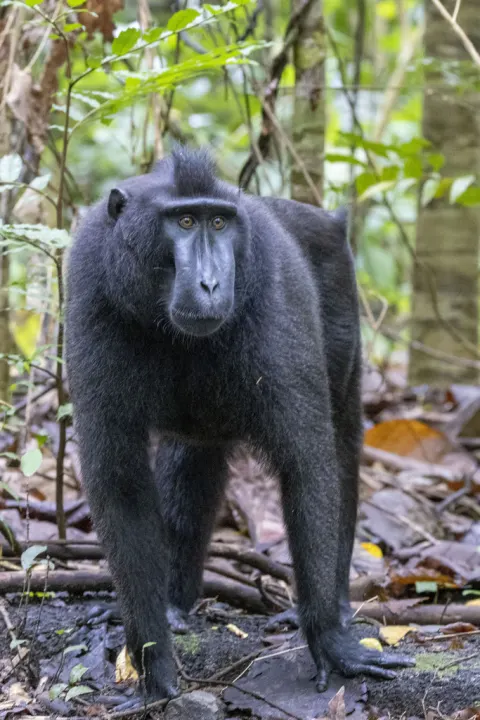
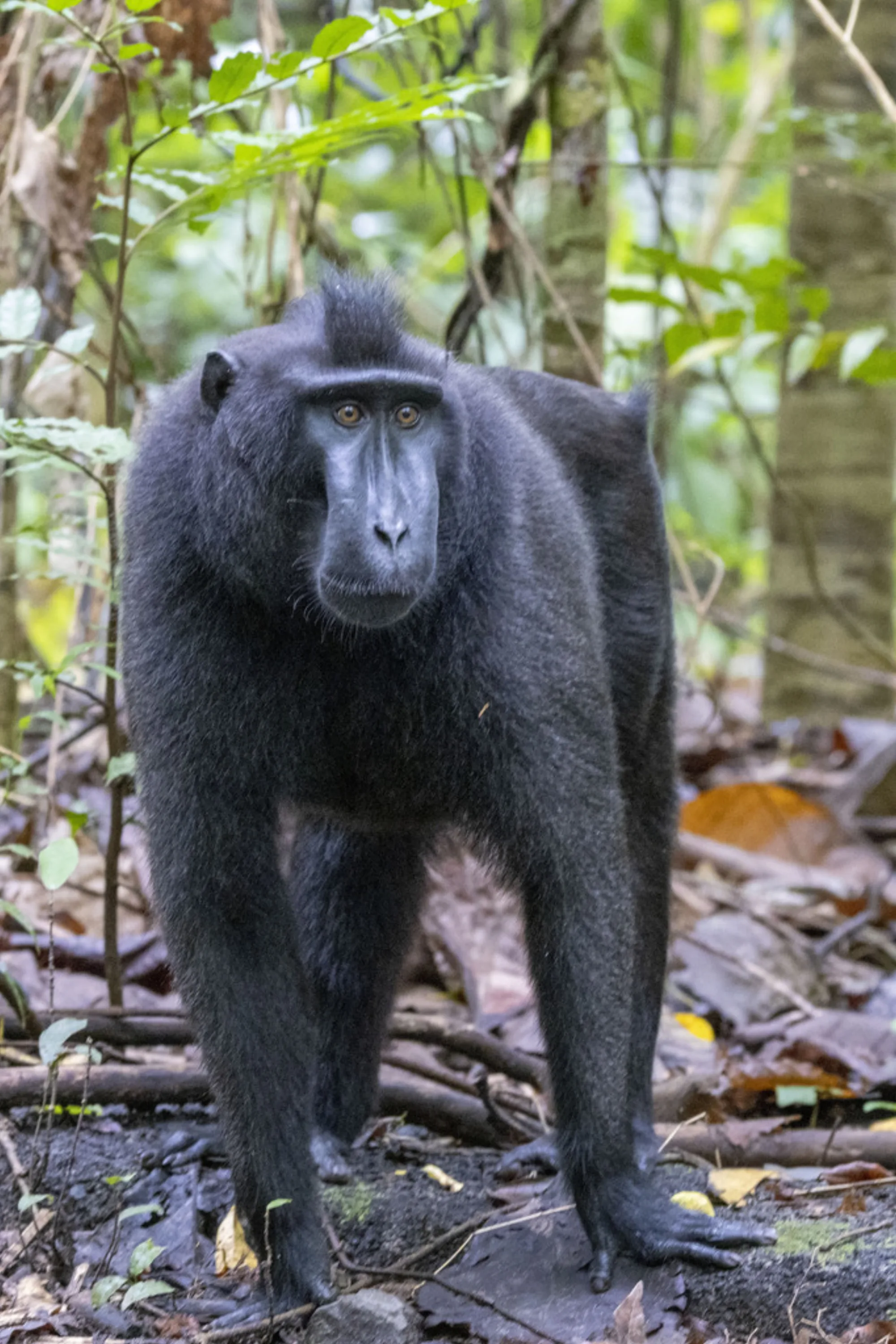
A tall tuft of hair and reddish-brown eyes help distinguish the Celebes Crested Macaque, an Old World monkey of northern Sulawesi. Its skin and bare face are jet black, apart from some white hair around the shoulders, and its muzzle is long with high cheeks. Despite its ape-like appearance, it has a barely visible tail stub, approximately 2 cm long. It lives in tropical rainforest and appears to favour closed-canopy forest, with higher occupancy in protected areas. An introduced population also lives on Bacan.
Active by day, the macaque spends more than 60% of its time on the ground, looking for food and socialising, but sleeps and also forages in trees. Fruit makes up 70% of its diet, supplemented by leaves, buds, seeds, mushrooms and a range of small animals, from insects and snails to occasional lizards or frogs. Groups usually number five to twenty-five animals, sometimes reaching seventy-five, with roughly four adult females for every adult male. Young males leave their birth group when mature and may join bachelor groups before seeking a mixed-sex group. After a gestation of 174 days, a female usually gives birth to one young in spring, when food is more plentiful. The young are nursed for approximately one year and reach full maturity in three to four years.
Rainforest clearance threatens the macaque, which is also hunted for bushmeat and killed as a pest because it eats crops. Outside Tangkoko reserve, crested black macaques remain unprotected and are regularly hunted and killed.
Written from the English Wikipedia article Celebes crested macaque (CC BY-SA 4.0).
- Records
- 47
- Countries
- 1
No atlas park has a record of the Celebes Crested Macaque in or around it yet.
These are open occurrence records, so they show where people looked for and recorded the Celebes Crested Macaque as much as where it lives. Cells are up to 25 km across, and every location is generalised to its cell.
Generalised encounter areas, not exact locations. Each shape is a grid cell coloured by how likely the species is there.
- Very likelyIndonesia25 km zone · medium confidence · 47 records · updated 80 days ago
Conservation status not assessed here yet, so every location is generalised to its grid cell.