Rhesus Monkey
Macaca mulatta
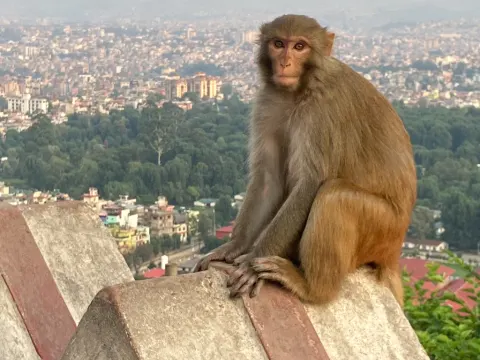
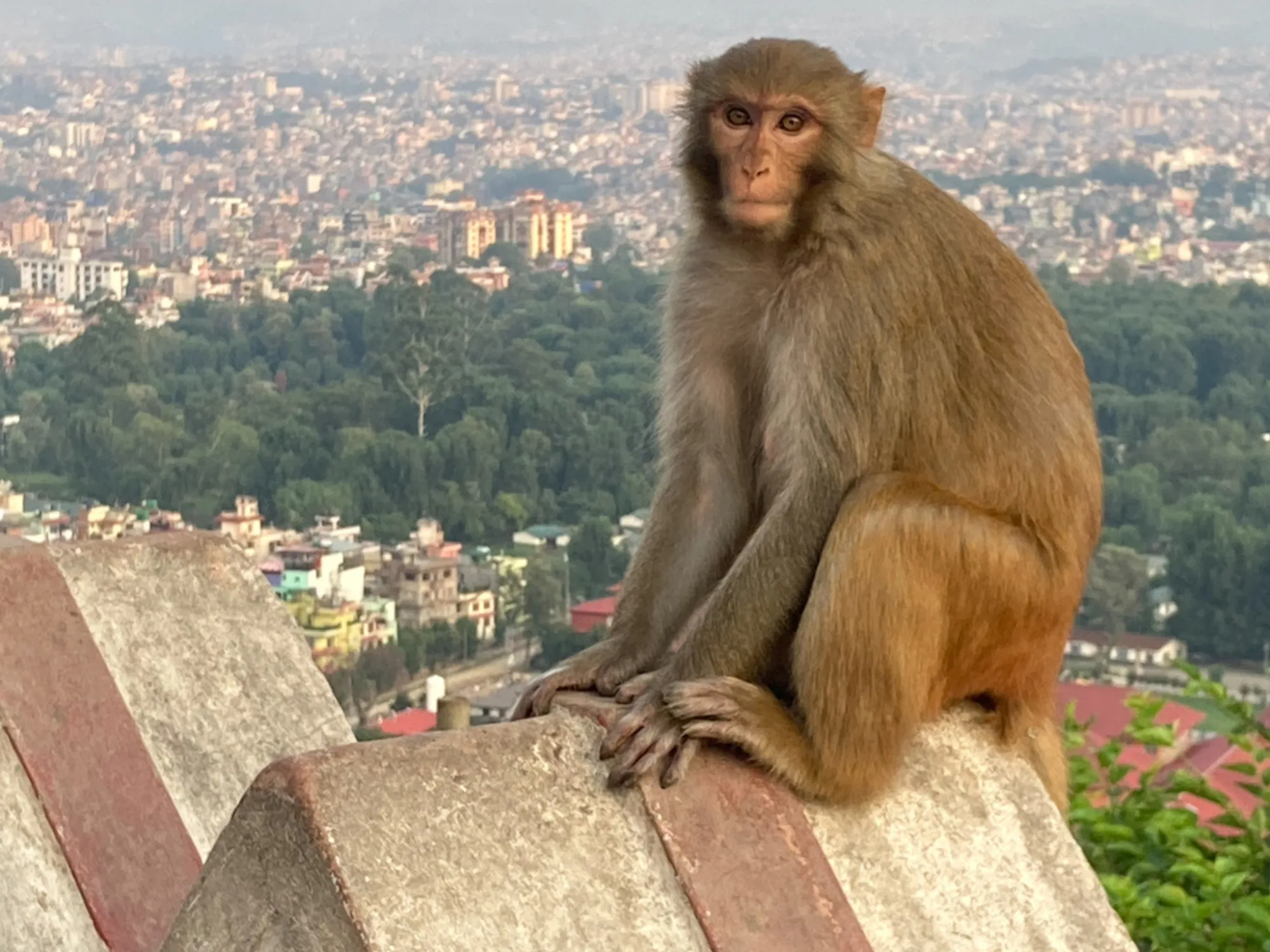
A pink, hairless face stands out against the brown or grey coat of the Rhesus Monkey (Macaca mulatta), an Old World monkey. Adult males average about 53 cm in length and 7.7 kg in weight, while females average 47 cm and 5.3 kg. The tail averages 20.7 to 22.9 cm. Native to Central, South and Southeast Asia, the species ranges from Afghanistan and Pakistan through India and Nepal to southern China, Myanmar, Thailand and Vietnam. It lives in grasslands, woodlands and mountains up to 2,500 m, as well as forest patches in agricultural areas. It also adapts to towns and cities, where troops can be larger than those in forests.
Active by day, these monkeys spend time both in trees and on the ground, and can swim across rivers. Troops contain 20 to 200 males and females, with females generally remaining in their birth group. They communicate through calls, facial expressions, postures and gestures, and make coos and grunts as they move or approach one another before grooming. Fruit makes up much of their diet, supplemented by seeds, roots, buds, bark and cereals; they also eat insects and bird eggs. In cities, they may eat food and rubbish from people. Females first breed at four years old, and older daughters sometimes help their mothers care for infants.
Habitat destruction and the spread of agriculture threaten the species, including in Thailand. As woodland is cleared and farming changes, monkeys may enter settlements looking for resources, bringing them into conflict with people. Crop raiding can turn farmers against them, and in India conflict has led to harsh action and legal culling.
Written from the English Wikipedia article Rhesus macaque (CC BY-SA 4.0).
- Records
- 885
- Countries
- 11
- Atlas places
- 14
- Jim Corbett National Park· India
- Bardiya National Park· Nepal
- Bandhavgarh National Park· India
- Chitwan National Park· Nepal
- Kaziranga National Park· India
- Pench National Park· India
- Sundarbans National Park· India
- Annapurna Conservation Area· Nepal
- Ranthambore National Park· India
- Kanha National Park· India
- Koshi Tappu Wildlife Reserve· Nepal
- Langtang National Park· Nepal
- Manas National Park· India
- Shuklaphanta National Park· Nepal
These are open occurrence records, so they show where people looked for and recorded the Rhesus Monkey as much as where it lives. Cells are up to 25 km across, and every location is generalised to its cell.
Generalised encounter areas, not exact locations. Each shape is a grid cell coloured by how likely the species is there.
- Very likelyIndia25 km zone · medium confidence · 486 records · updated 80 days ago
- Very likelyNepal25 km zone · medium confidence · 109 records · updated 80 days ago
- Very likelyHong Kong SAR China25 km zone · high confidence · 104 records · updated 80 days ago
- Very likelyChina25 km zone · medium confidence · 92 records · updated 80 days ago
- Very likelyUnited States25 km zone · medium confidence · 39 records · updated 80 days ago
- Very likelyVietnam25 km zone · medium confidence · 35 records · updated 80 days ago
- Very likelyPakistan25 km zone · medium confidence · 6 records · updated 80 days ago
- LikelyBangladesh25 km zone · medium confidence · 5 records · updated 80 days ago
- LikelyMyanmar (Burma)25 km zone · medium confidence · 5 records · updated 80 days ago
- LikelyThailand25 km zone · medium confidence · 3 records · updated 80 days ago
Conservation status not assessed here yet, so every location is generalised to its grid cell.