Japanese Macaque
Macaca fuscata
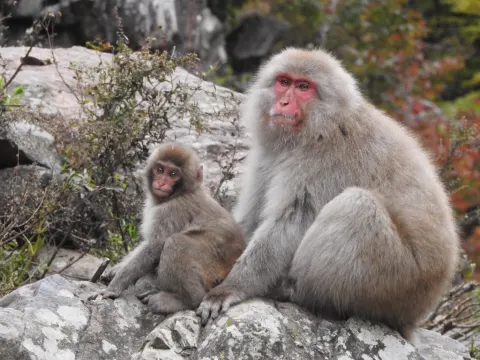
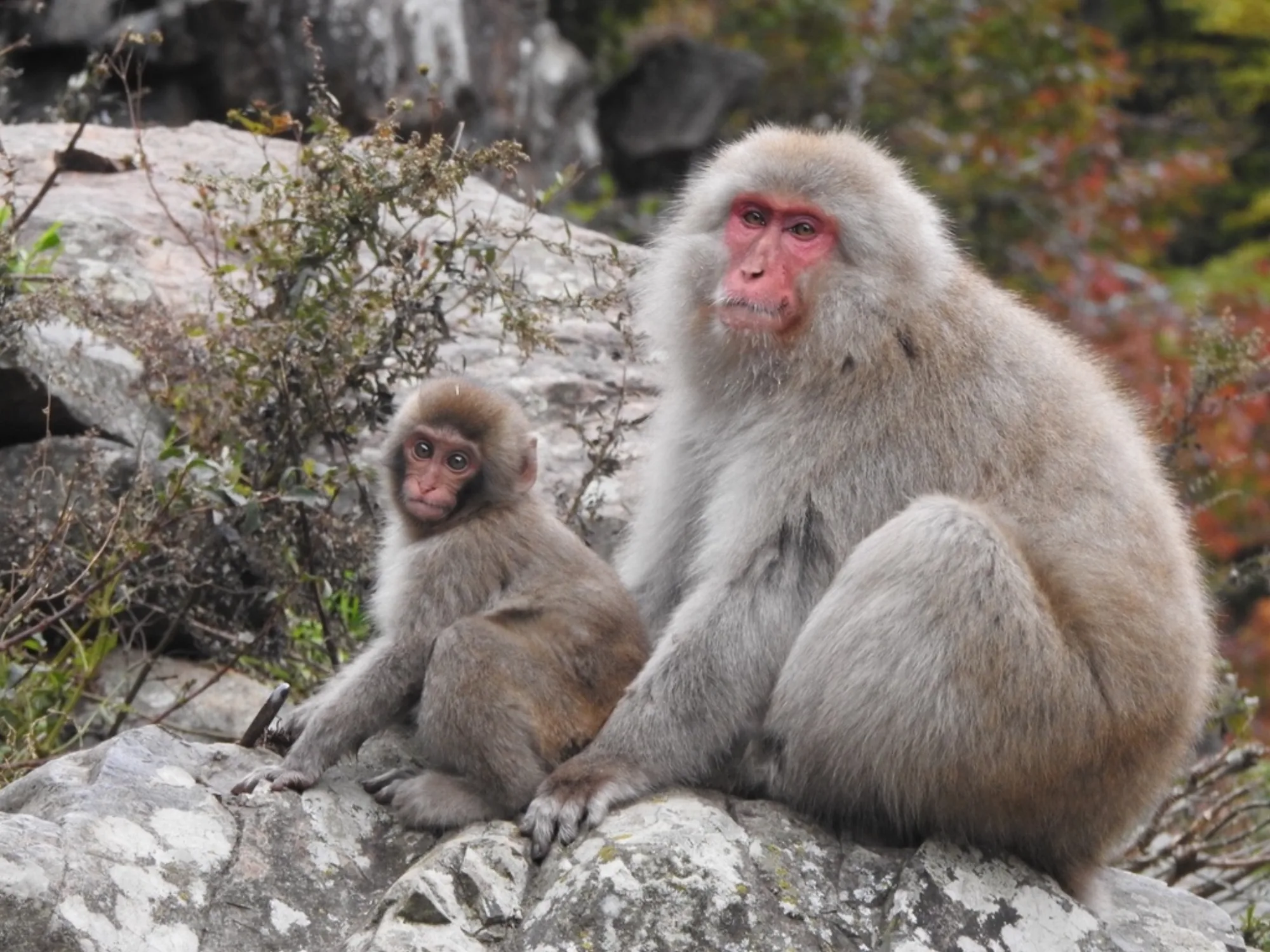
A pinkish-red face and short tail stand out against the Japanese Macaque's brown or greyish coat. Also called the snow monkey, it is native to Japan and lives farther north than any other non-human primate. Its coat grows thicker as temperatures fall, helping it cope with the cold.
The macaque lives on Honshu, Shikoku and Kyushu, as well as several smaller Japanese islands. Its range reaches from subtropical forests in the south to subarctic mountain forests in the north. It also inhabits deciduous forests in central and northern Japan and broadleaf evergreen forests in the southwest. Active during the day, macaques move mostly on all fours, leap, and are strong swimmers. Females spend more time in trees, while males spend more time on the ground. They usually sleep in trees and huddle together for warmth in winter. At Jigokudani Monkey Park, macaques visit hot springs to warm up during the colder months.
Troops include adult males and females, with females remaining in their birth groups for life and males leaving before maturity. Grooming helps females maintain social bonds, while calls can help keep a moving or feeding troop together. Mothers usually give birth on the ground, and their infants start eating solid foods when they are five to six weeks old. Their varied diet includes fruit, seeds, leaves, insects, fungi and bark, with seasonal foods changing across their range. Natural forests have been replaced by lumber plantations, and macaques are culled to reduce crop damage. There are concerns that this culling is shrinking their range.
Written from the English Wikipedia article Japanese macaque (CC BY-SA 4.0).
- Records
- 2,458
- Countries
- 1
No atlas park has a record of the Japanese Macaque in or around it yet.
These are open occurrence records, so they show where people looked for and recorded the Japanese Macaque as much as where it lives. Cells are up to 25 km across, and every location is generalised to its cell.
Generalised encounter areas, not exact locations. Each shape is a grid cell coloured by how likely the species is there.
- Very likelyJapan25 km zone · high confidence · 2458 records · updated 80 days ago
Conservation status not assessed here yet, so every location is generalised to its grid cell.