Black Grouse
Lyrurus tetrix
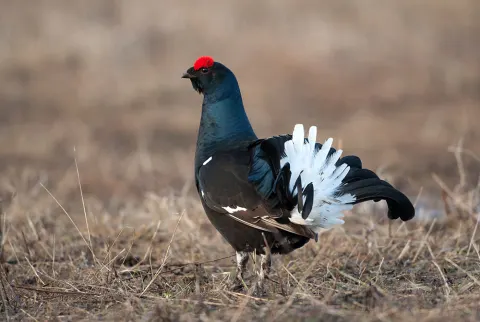
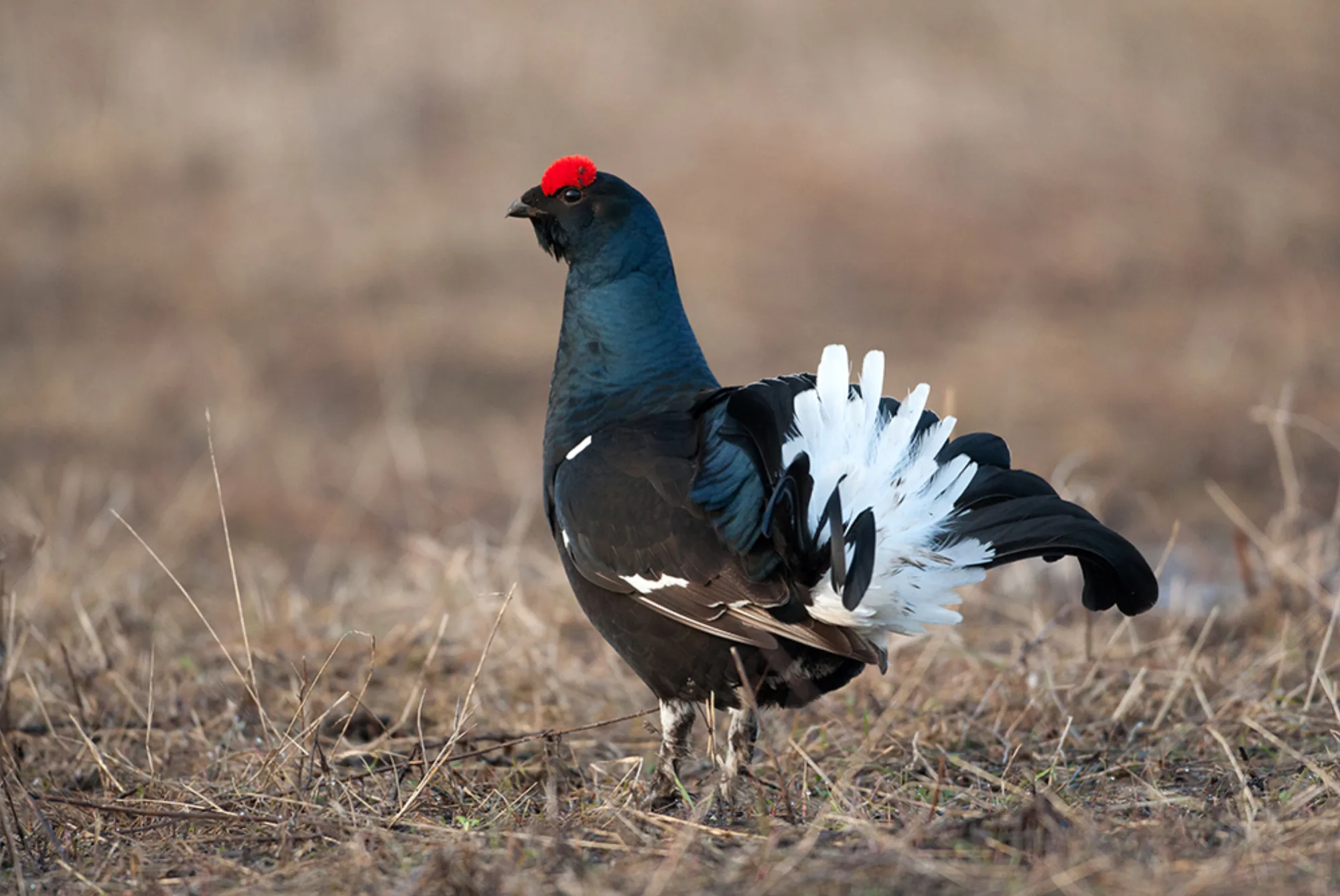
At spring dawn, a bubbling murmur can draw attention to Black Grouse displaying on open ground. The males are large, mostly black birds, with deep-blue colour on the neck and back, a white wing line and red skin above each eye. Their long outer tail feathers curve outwards into the shape of a lyre. Females are smaller and greyish-brown, with colouring that helps them blend into dense undergrowth; their call is a cackle or warble.
Black Grouse live across parts of Europe and Asia, from Great Britain and Scandinavia across Russia to parts of Kazakhstan, Mongolia and China. They often use the edges between forest and open ground, including heathland, grassland, steppe and pasture. In the United Kingdom, search the uplands of the Pennines, north Wales and much of Scotland, particularly farmland and moorland close to forestry or scattered trees. Winter brings them together in dense woodland, where flocks feed mostly on the leaves and buds of trees. In spring and summer, they favour open spaces and eat berries, shoots and stems from shrubs including cranberries and bog bilberries.
Males gather at traditional display sites known as leks, where they fan their tails and call. After mating, a female chooses a sheltered nest site among dense shrubs or tall vegetation and cares for the chicks herself. She lays about 6 to 11 pale buff eggs with brown speckles; the chicks eat invertebrates before taking more plant food as they grow. Habitat loss, disturbance, predators and the gradual disappearance of small populations have contributed to declines. In northeastern China and Manchuria, excessive hunting has also played a part, while in France birds risk flying into ski lifts.
Written from the English Wikipedia article Black grouse (CC BY-SA 4.0).
- Records
- 77,184
- Countries
- 9
No atlas park has a record of the Black Grouse in or around it yet.
These are open occurrence records, so they show where people looked for and recorded the Black Grouse as much as where it lives. Cells are up to 25 km across, and every location is generalised to its cell.
Generalised encounter areas, not exact locations. Each shape is a grid cell coloured by how likely the species is there.
- Very likelyNorway25 km zone · high confidence · 32836 records · updated 80 days ago
- Very likelyFrance25 km zone · high confidence · 22785 records · updated 80 days ago
- Very likelyFinland25 km zone · high confidence · 17333 records · updated 80 days ago
- Very likelyItaly25 km zone · high confidence · 2357 records · updated 80 days ago
- Very likelyUnited Kingdom25 km zone · high confidence · 787 records · updated 80 days ago
- Very likelyRussia25 km zone · high confidence · 375 records · updated 80 days ago
- Very likelyUkraine25 km zone · high confidence · 281 records · updated 80 days ago
- Very likelySwitzerland25 km zone · high confidence · 269 records · updated 80 days ago
- Very likelySweden25 km zone · high confidence · 161 records · updated 80 days ago
Conservation status not assessed here yet, so every location is generalised to its grid cell.