Bobcat
Lynx rufus
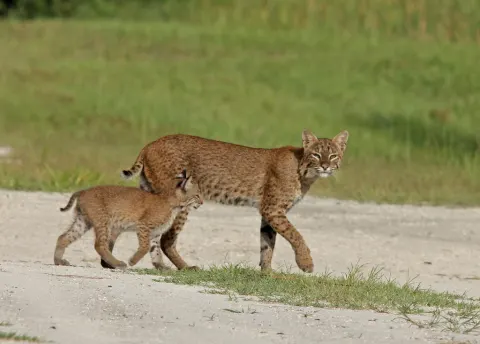
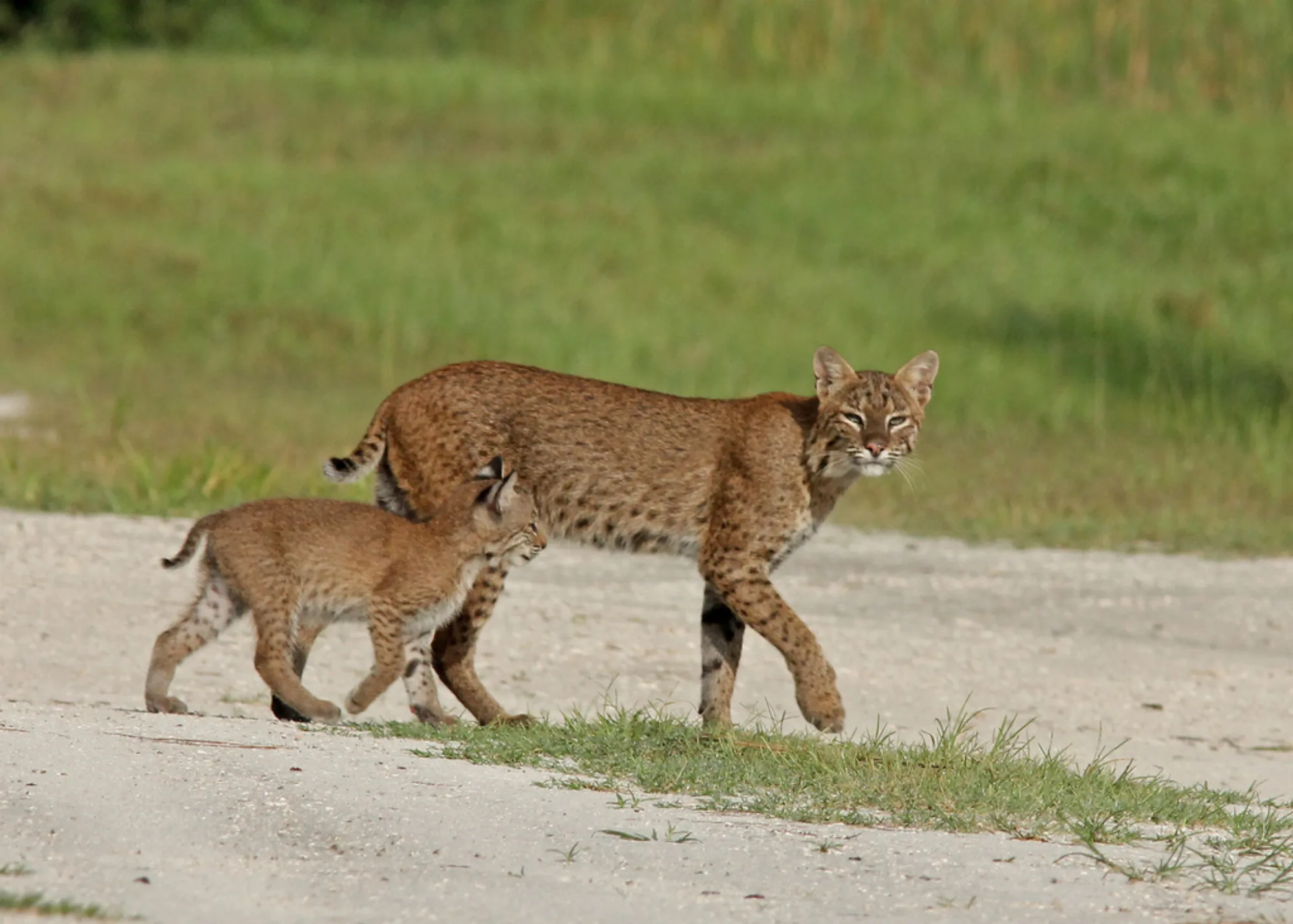
A short, black-tipped tail and dark bars on the forelegs help distinguish the Bobcat, a medium-sized wild cat native to North America. Its coat is generally tan to greyish brown, marked with dark streaks and spots that provide camouflage. Pointed ears with short black tufts and a broad-looking face framed by longer hair add to its distinctive appearance. Including the tail, it can reach 125 cm in total length.
From southern Canada, the Bobcat's range extends across most of the mainland United States and south into Mexico as far as Oaxaca. It favours woodland, but also lives in swamps, semidesert and mountains, and can appear in backyards where development meets natural habitat. In northern and central Mexico, it occupies dry scrubland and pine and oak forests. Mostly active around twilight, it may become more active by day in autumn and winter as its prey changes its own schedule. It is largely solitary and territorial, marking its range with scent and claw marks. Shelters can include hollow logs, thickets and spaces beneath rock ledges.
Rabbits and hares are favoured prey, although the Bobcat also takes rodents, birds, insects and deer. It stalks its quarry and ambushes it with a short chase or pounce. Breeding runs from winter into spring, and the female raises the young alone, usually giving birth to two to four kittens in an enclosed place. Habitat fragmentation, roads and development can isolate populations, while hunting and vehicle collisions also cause deaths. In California, rodenticides have been linked to poisoning and severe mite infestations in Bobcats using urban habitats.
Written from the English Wikipedia article Bobcat (CC BY-SA 4.0).
- Records
- 3,037
- Countries
- 3
- Atlas places
- 2
These are open occurrence records, so they show where people looked for and recorded the Bobcat as much as where it lives. Cells are up to 25 km across, and every location is generalised to its cell.
Generalised encounter areas, not exact locations. Each shape is a grid cell coloured by how likely the species is there.
- Very likelyUnited States25 km zone · medium confidence · 2836 records · updated 81 days ago
- Very likelyCanada25 km zone · medium confidence · 113 records · updated 81 days ago
- Very likelyMexico25 km zone · medium confidence · 88 records · updated 81 days ago
Conservation status not assessed here yet, so every location is generalised to its grid cell.