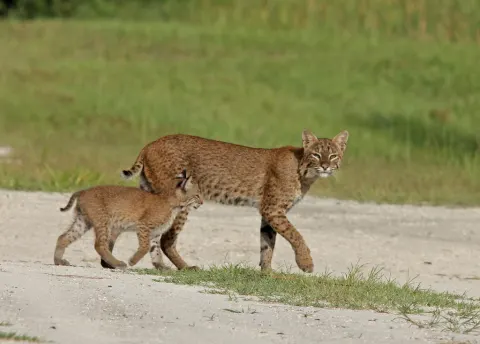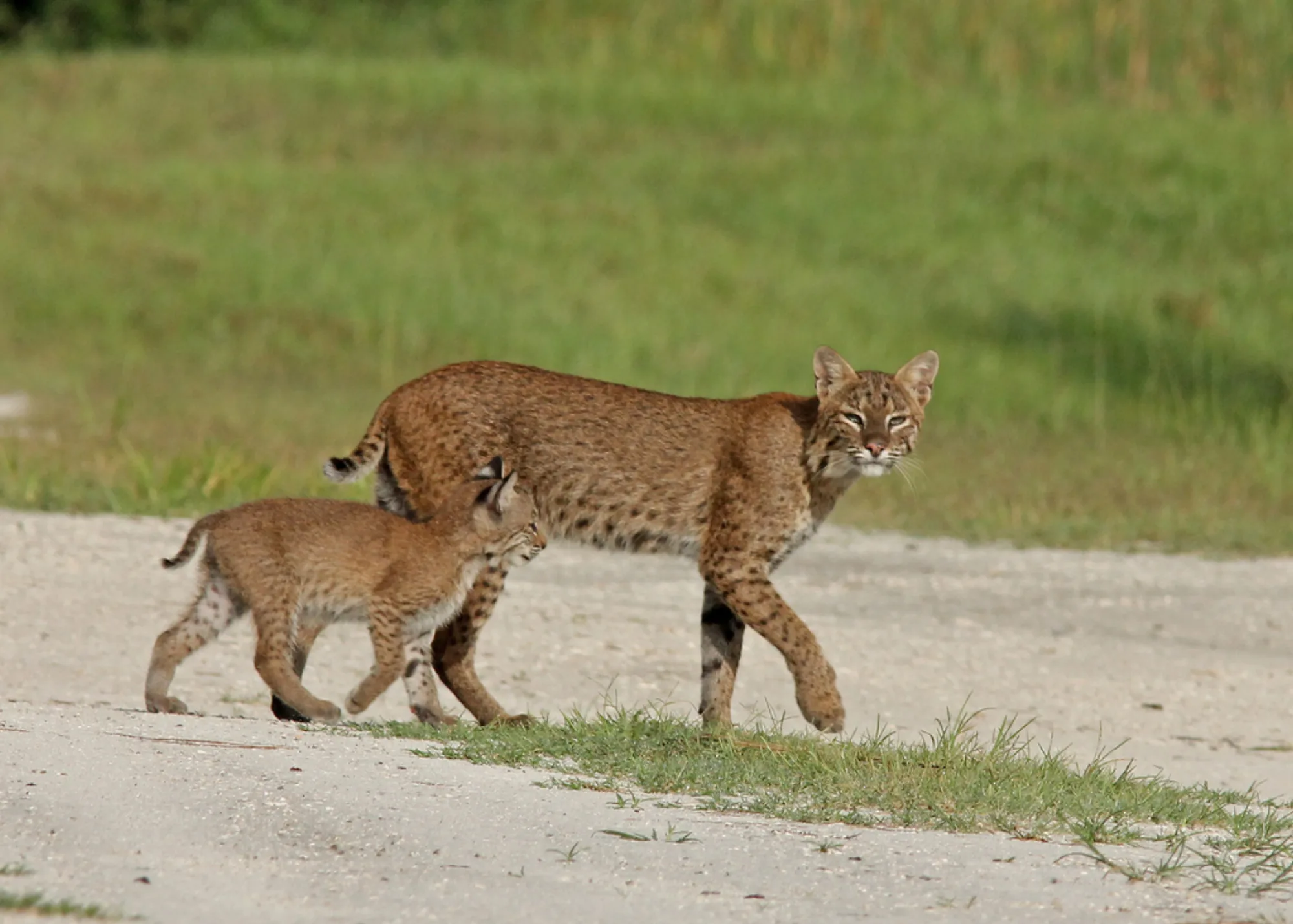
Eurasian Lynx
Lynx lynx
Black ear tufts, a short tail with an all-black tip and a grey-and-white ruff give the Eurasian Lynx its distinctive outline. This medium-sized wild cat has a reddish or brown coat with black spots that vary greatly in number and pattern. Its underparts, neck and chin are whitish, while its winter fur grows thicker and ranges from silver-grey to greyish brown. Large, furred paws help it move over snow, although loose, deep snow can be difficult for it.
Its range extends across northern, central and eastern Europe and into Central Asia and Siberia; it also occurs on the Tibetan Plateau and in the Himalayas. It occupies temperate and boreal forests as high as 5,500 m, as well as rugged country with places to hide and stalk prey. Depending on the location, that country can include rocky steppe, mixed forest-steppe and mountain forest. In mountainous areas it may follow prey down to the lowlands in winter. Adults live alone and are mainly active at night or around dawn and dusk, spending daylight hours asleep in cover. Secretive and generally quiet outside the breeding season, they can leave tracks or prey remains that are noticed long before the animal itself.
The lynx hunts by ambush and stalking, sometimes scanning its surroundings from a high rock or fallen tree. Its prey includes roe deer, hares, rabbits and birds, although the animals it favours vary by region. Females usually have two kittens, sheltering them in secluded dens beneath branches or tree roots. The young typically stay with their mother until around ten months old. Habitat loss and fragmentation, poaching and dwindling prey threaten the species across its range.
Written from the English Wikipedia article Eurasian lynx (CC BY-SA 4.0).
- Records
- 55,945
- Countries
- 10
No atlas park has a record of the Eurasian Lynx in or around it yet.
These are open occurrence records, so they show where people looked for and recorded the Eurasian Lynx as much as where it lives. Cells are up to 25 km across, and every location is generalised to its cell.
Generalised encounter areas, not exact locations. Each shape is a grid cell coloured by how likely the species is there.
- Very likelySwitzerland25 km zone · high confidence · 35459 records · updated 80 days ago
- Very likelyNorway25 km zone · high confidence · 13751 records · updated 80 days ago
- Very likelyFrance25 km zone · high confidence · 4299 records · updated 80 days ago
- Very likelyAustria25 km zone · high confidence · 953 records · updated 80 days ago
- Very likelySweden25 km zone · high confidence · 898 records · updated 80 days ago
- Very likelyFinland25 km zone · high confidence · 305 records · updated 80 days ago
- Very likelyUkraine25 km zone · high confidence · 171 records · updated 80 days ago
- LikelyEstonia25 km zone · medium confidence · 56 records · updated 80 days ago
- LikelyItaly25 km zone · medium confidence · 53 records · updated 80 days ago
Conservation status not assessed here yet, so every location is generalised to its grid cell.