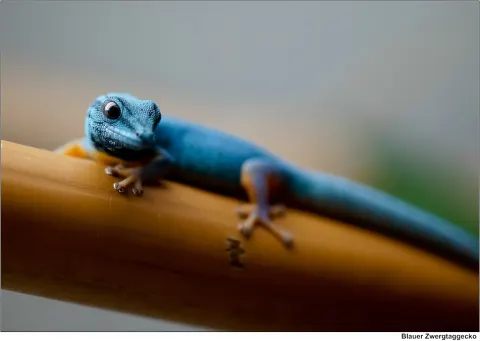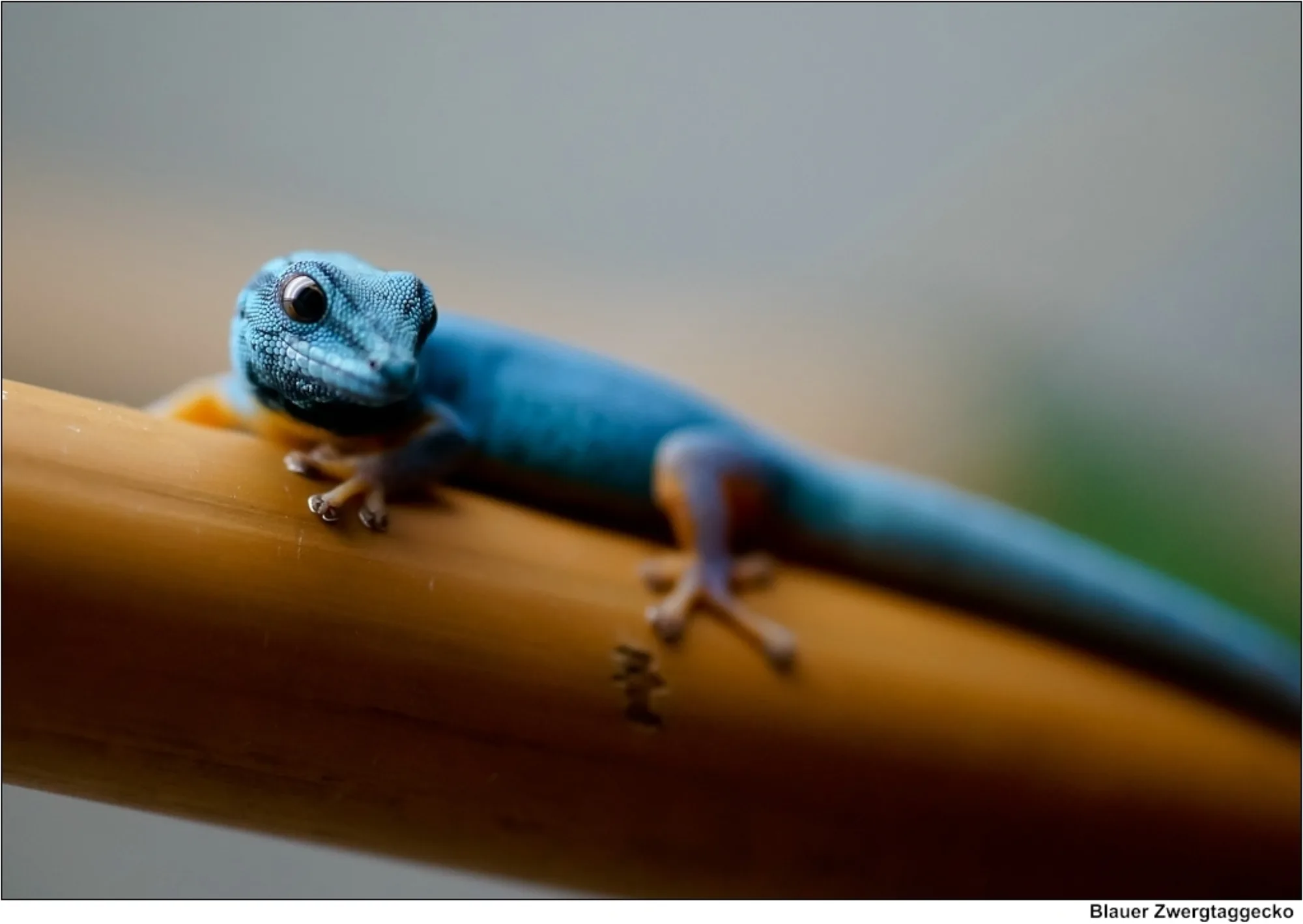
Turquoise Dwarf Gecko
Lygodactylus williamsi
Often called the electric blue gecko, this small lizard is found only in a tiny eight square kilometre patch of eastern Tanzania. They live at the base of the Uluguru Mountains, specifically within the Kimboza and Ruvu Forest Reserves. These lizards are exceptionally picky about their habitat, living only on large screwpine trees with leaves exceeding one metre in length. They spend most of their time in the leaf crowns of these specific trees at altitudes between 170 and 480 metres.
Spotting the Turquoise Dwarf Gecko requires looking for their distinct colours, which shift based on temperature and mood. Adult males typically display a brilliant blue with dark stripes on their throats, while females and young geckos appear in shades of green, bronze, or brown. These active, day-living creatures are quite bold and social. They survive on a diet of nectar, fruit, and small insects, often drinking water directly from the surface of leaves.
The species faces a rapid population decline due to several human pressures. Illegal collection for the international pet trade is the primary threat, with collectors sometimes cutting down whole trees to reach a single animal. Their tropical forest home is also shrinking because of mining for gold and gemstones, forest fires, and clearing for farmland. Because they are restricted to such a small area, these combined factors put the geckos at high risk of disappearing from the wild.
Written from the English Wikipedia article Lygodactylus williamsi (CC BY-SA 4.0).
- Records
- 0
- Countries
- 1
- Atlas places
- 0
These are open occurrence records, so they show where people looked for and recorded the Turquoise Dwarf Gecko as much as where it lives. Cells are up to 25 km across, and every location is generalised to its cell.
Generalised encounter areas, not exact locations. Each shape is a grid cell coloured by how likely the species is there.
- Very likelyTanzania50 km zone · low confidence · 0 records · updated 1 day ago