Common Wolf Snake
Lycodon aulicus
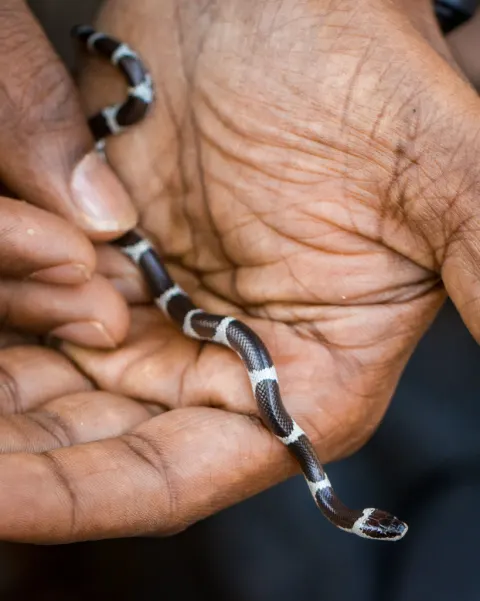
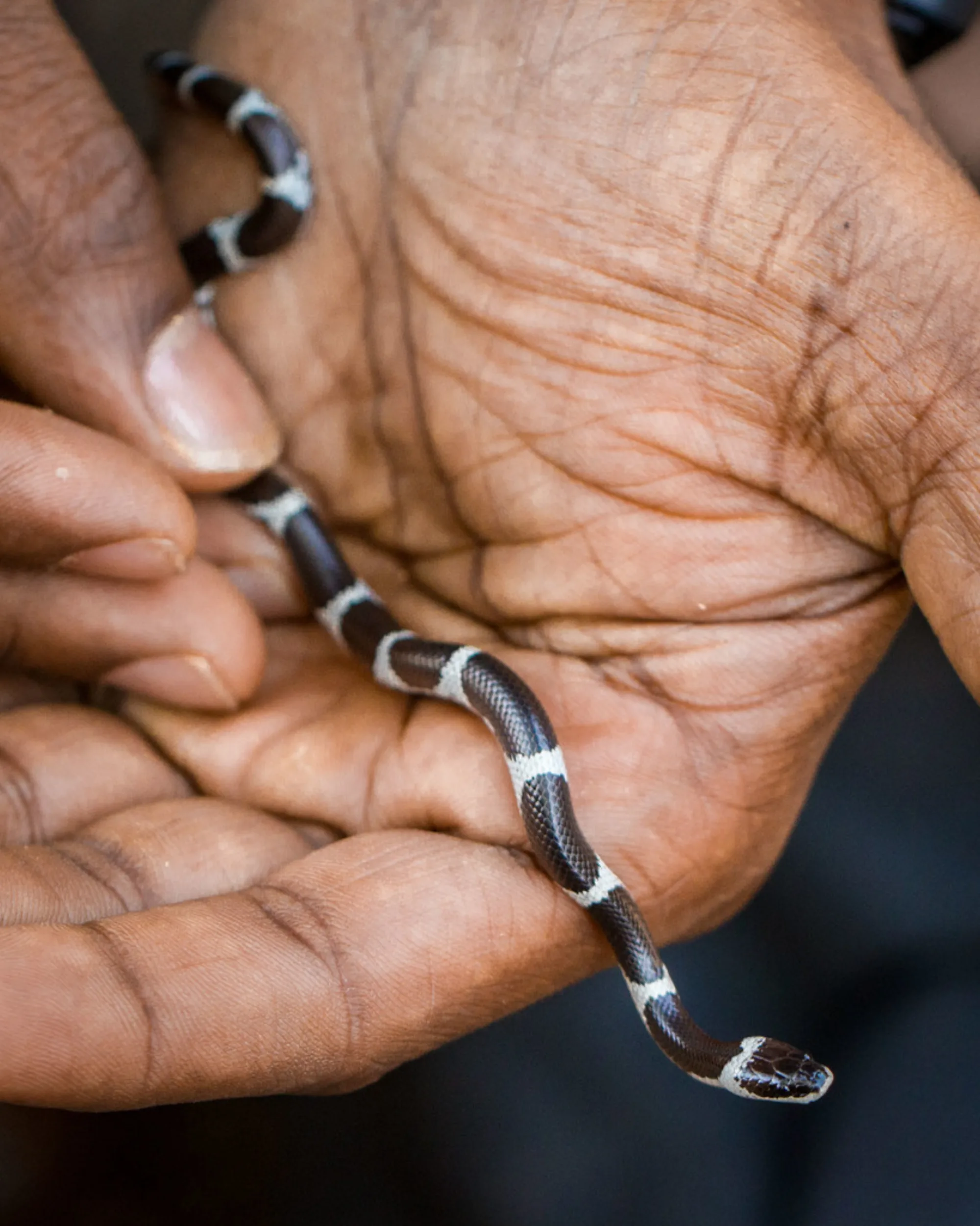
After dark, the Common Wolf Snake becomes active, spending the daytime inactive. Found across South and Southeast Asia, this nonvenomous snake is often confused with the venomous common krait. Its colour varies: some are uniformly brown above, while others have white bands or a white network. The upper lip can be white or marked with brown spots, and the underside is white. Some brown or greyish snakes have a white collar that is more distinct in young animals. One described form is chestnut-brown with white, brown-edged bars across the back, which become less distinct towards the rear of the body.
The snake occurs in Pakistan, Sri Lanka, India, Bangladesh, Nepal, Myanmar and the Maldives. Its recorded range in India extends north to the Himalayas and Assam, and includes Maharashtra and Gujarat. It is among the most common snakes in India and Sri Lanka, though it becomes scarcer along the southeastern Indian coast. Lizards and frogs are on its menu, and skinks have been described as making up almost all of its food. The snake may feign death both to lure prey and to avoid pursuit by predators.
When it cannot escape, it can defend itself vigorously and inflict severe cuts with its sharp front teeth. Females may grow larger than males, and breeding takes place before the monsoons. A female lays 5 to 7 eggs, which hatch in September or October, with the young measuring 14 to 19 cm long. The account identifies predators as a reason for feigning death, but does not describe other threats to the snake.
Written from the English Wikipedia article Lycodon aulicus (CC BY-SA 4.0).
- Records
- 128
- Countries
- 7
- Atlas places
- 3
These are open occurrence records, so they show where people looked for and recorded the Common Wolf Snake as much as where it lives. Cells are up to 25 km across, and every location is generalised to its cell.
Generalised encounter areas, not exact locations. Each shape is a grid cell coloured by how likely the species is there.
- Very likelyIndia25 km zone · medium confidence · 65 records · updated 80 days ago
- Very likelyRéunion25 km zone · medium confidence · 33 records · updated 80 days ago
- Very likelyMyanmar (Burma)25 km zone · medium confidence · 26 records · updated 80 days ago
- LikelyMauritius25 km zone · medium confidence · 2 records · updated 80 days ago
- PossibleBangladesh25 km zone · medium confidence · 1 record · updated 80 days ago
- PossibleSri Lanka25 km zone · medium confidence · 1 record · updated 80 days ago
- RareMaldives25 km zone · low confidence · 0 records · updated 80 days ago
Conservation status not assessed here yet, so every location is generalised to its grid cell.