Pampas Fox
Lycalopex gymnocercus
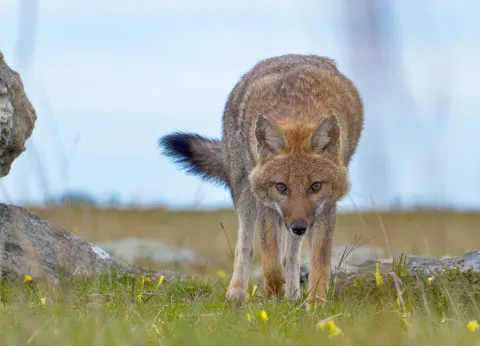
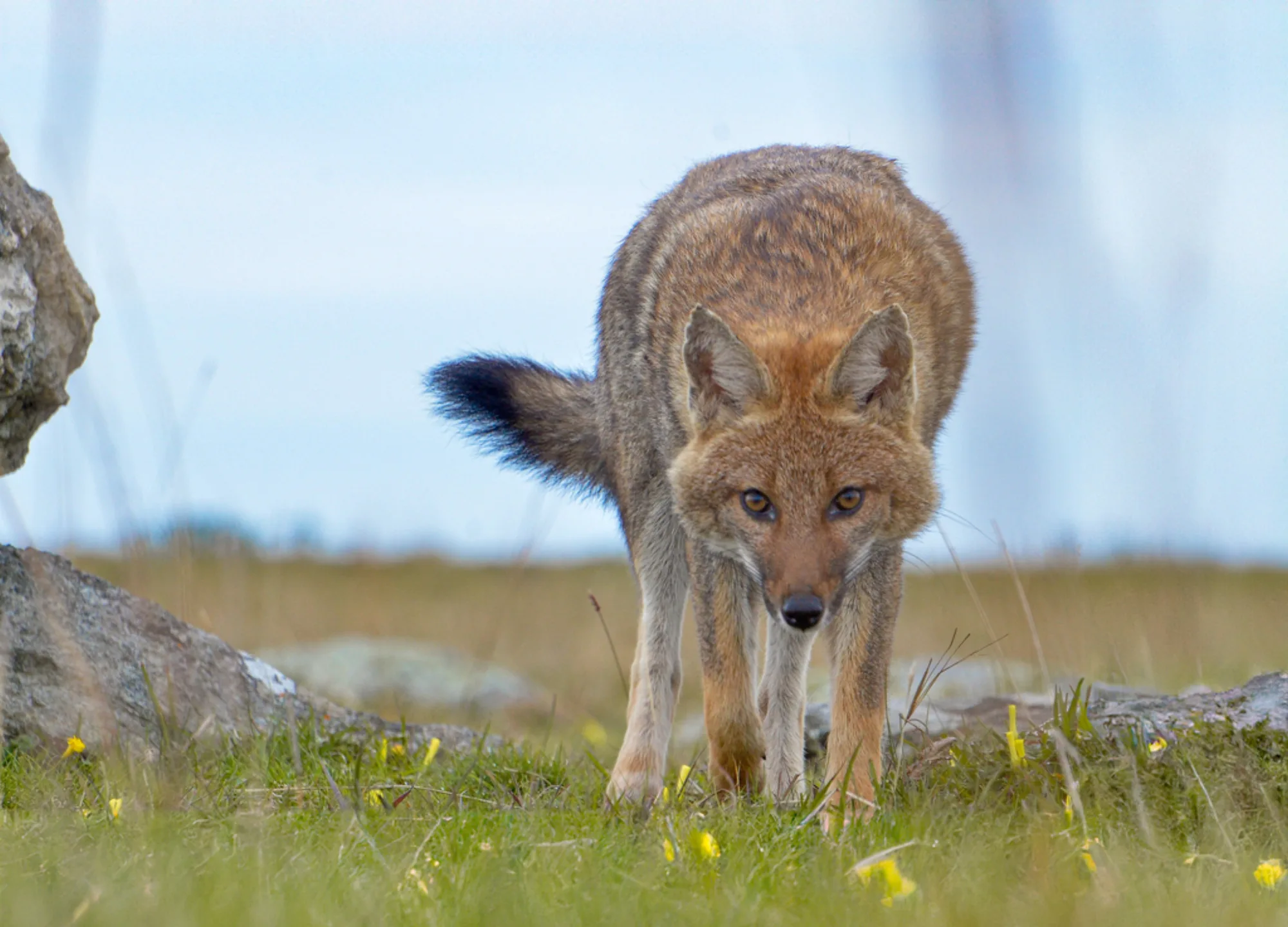
Across the South American Pampas, the Pampas Fox (Lycalopex gymnocercus) is a medium-sized false fox with short, dense fur. Its mostly grey coat has pale underparts, a reddish head and neck, and a black stripe extending down the back onto the tail. Look for the black mark on its muzzle, large triangular ears and a dark spot on each lower hind leg. Adults weigh 2.4 to 8.0 kg and measure 51 to 80 cm from head to body. Its main range covers Uruguay and Paraguay, along with parts of Argentina, Bolivia and southern Brazil. It favours open pampas, often near farmland, but also uses forests, dry scrub and wetlands. Most are found below 1,000 m, though they can occupy puna grasslands as high as 3,500 m.
Usually solitary, these foxes become active at dusk and are mainly nocturnal, although they can also be out during the day. They shelter in cavities such as caves, hollow trees and burrows made by viscachas or armadillos. Their varied diet includes birds, rodents, hares, fruit, carrion and insects; they also eat lambs, lizards, snails and eggs taken from ground nests. During the breeding season, foxes form monogamous pairs to raise their young, though adults generally hunt alone. After a gestation of 55 to 60 days, a mother gives birth to as many as eight kits, which are born between September and December. The pups stay in the den until they are at least 3 months old, when they begin hunting with their parents. People hunt Pampas Foxes for their fur and to prevent attacks on livestock, while habitat loss may also affect them.
Written from the English Wikipedia article Pampas fox (CC BY-SA 4.0).
- Records
- 448
- Countries
- 5
- Atlas places
- 3
These are open occurrence records, so they show where people looked for and recorded the Pampas Fox as much as where it lives. Cells are up to 25 km across, and every location is generalised to its cell.
Generalised encounter areas, not exact locations. Each shape is a grid cell coloured by how likely the species is there.
- Very likelyArgentina25 km zone · medium confidence · 330 records · updated 80 days ago
- Very likelyBrazil25 km zone · medium confidence · 59 records · updated 80 days ago
- Very likelyUruguay25 km zone · medium confidence · 54 records · updated 80 days ago
- LikelyChile25 km zone · medium confidence · 3 records · updated 80 days ago
- PossibleParaguay25 km zone · medium confidence · 2 records · updated 80 days ago
Conservation status not assessed here yet, so every location is generalised to its grid cell.