Darwin's Fox
Lycalopex fulvipes
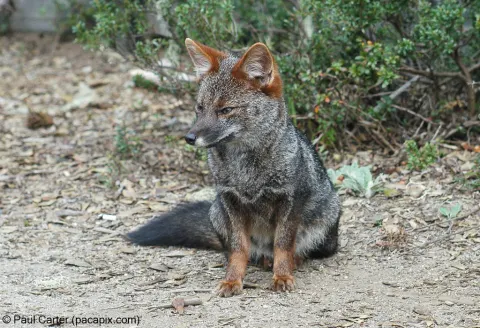
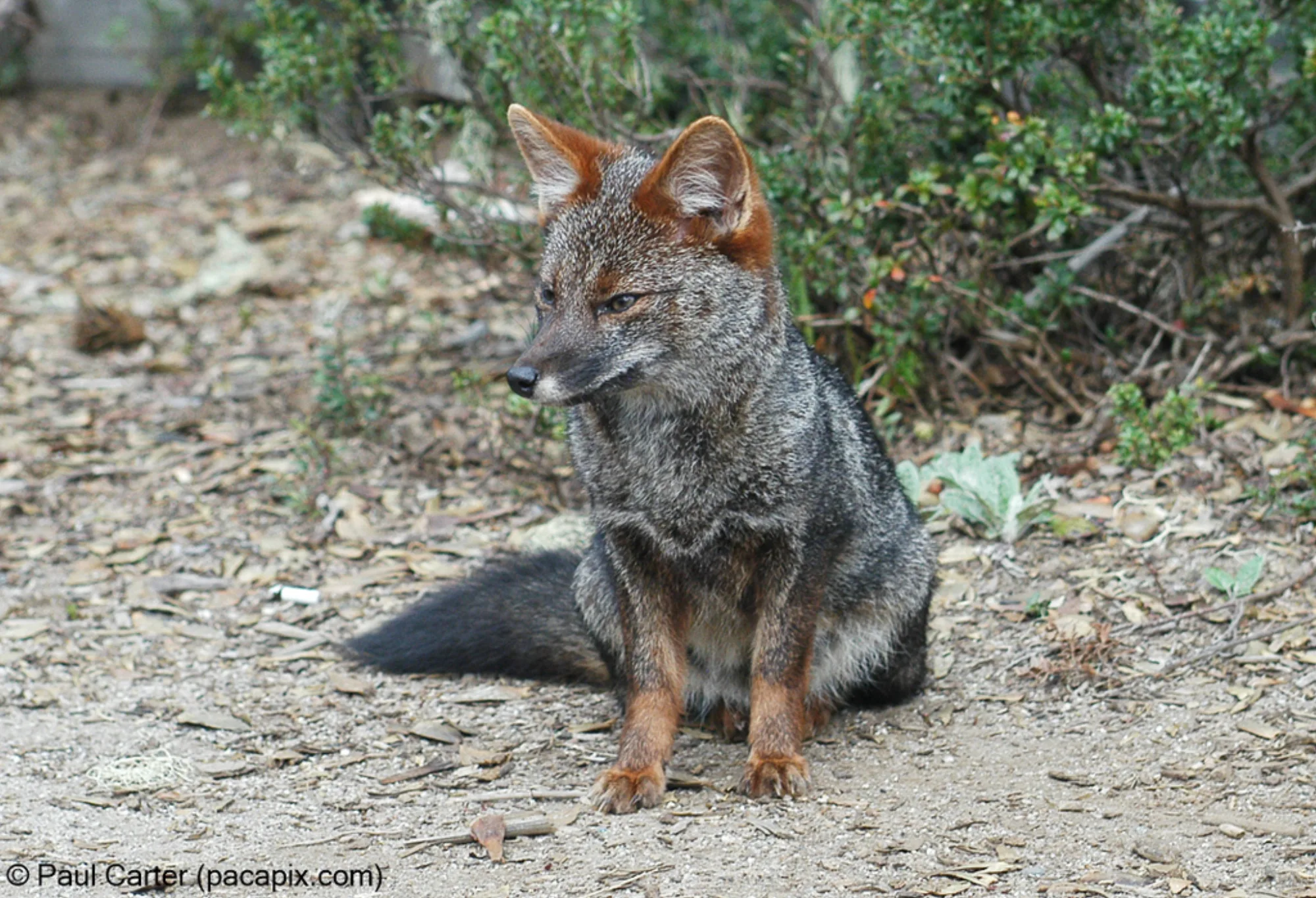
Small, dark and short-legged, Darwin's Fox (Lycalopex fulvipes) has a broad head and a mottled coat of black and grey. Its ears and lower legs show reddish tones, while white marks appear beneath the chin, on the belly and inside the legs. A short, bushy, dark grey tail helps distinguish it from related species. It weighs 1.8 to 3.95 kg and measures 48 to 59 cm from head to body.
Found only in Chile, the fox lives in the temperate rainforests of Chiloé Island and several mainland areas, including Nahuelbuta National Park. Most individuals are found on Chiloé, with smaller populations on the mainland. It uses primary and second-growth forest and shrubland, and occasionally coastal dunes. In the Valdivian Coastal Range, it has also been recorded in unmanaged eucalyptus plantations. Twilight and the hours before sunrise are its busiest times. Their home ranges overlap considerably, and males show no territorial behaviour or aggression towards other males moving through these areas. They eat insects, small mammals, birds, reptiles, fruit and seeds. On Chiloé, their diet changes with the seasons, with more rodents and fewer invertebrates eaten in winter. The species has reproduced in captivity near Villarrica.
Dogs pose a major threat, attacking foxes and potentially passing on diseases. Foxes also tend to avoid places occupied by dogs, including forest areas the dogs visit frequently. Agriculture and forestry contribute to habitat loss, while human disturbance has a negative effect. On Chiloé, local communities report that foxes are killed because they are perceived as a threat to domestic animals.
Written from the English Wikipedia article Darwin's fox (CC BY-SA 4.0).
- Records
- 1
- Countries
- 1
No atlas park has a record of the Darwin's Fox in or around it yet.
These are open occurrence records, so they show where people looked for and recorded the Darwin's Fox as much as where it lives. Cells are up to 25 km across, and every location is generalised to its cell.
Generalised encounter areas, not exact locations. Each shape is a grid cell coloured by how likely the species is there.
- Very likelyChile25 km zone · medium confidence · 1 record · updated 80 days ago
Conservation status not assessed here yet, so every location is generalised to its grid cell.