Smooth-coated Otter
Lutrogale perspicillata
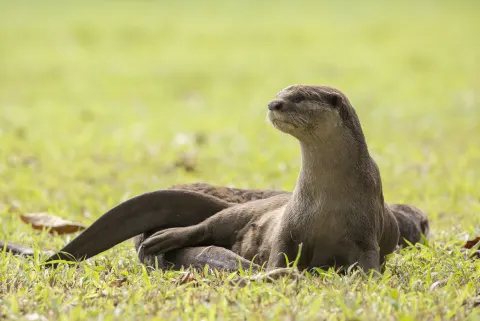
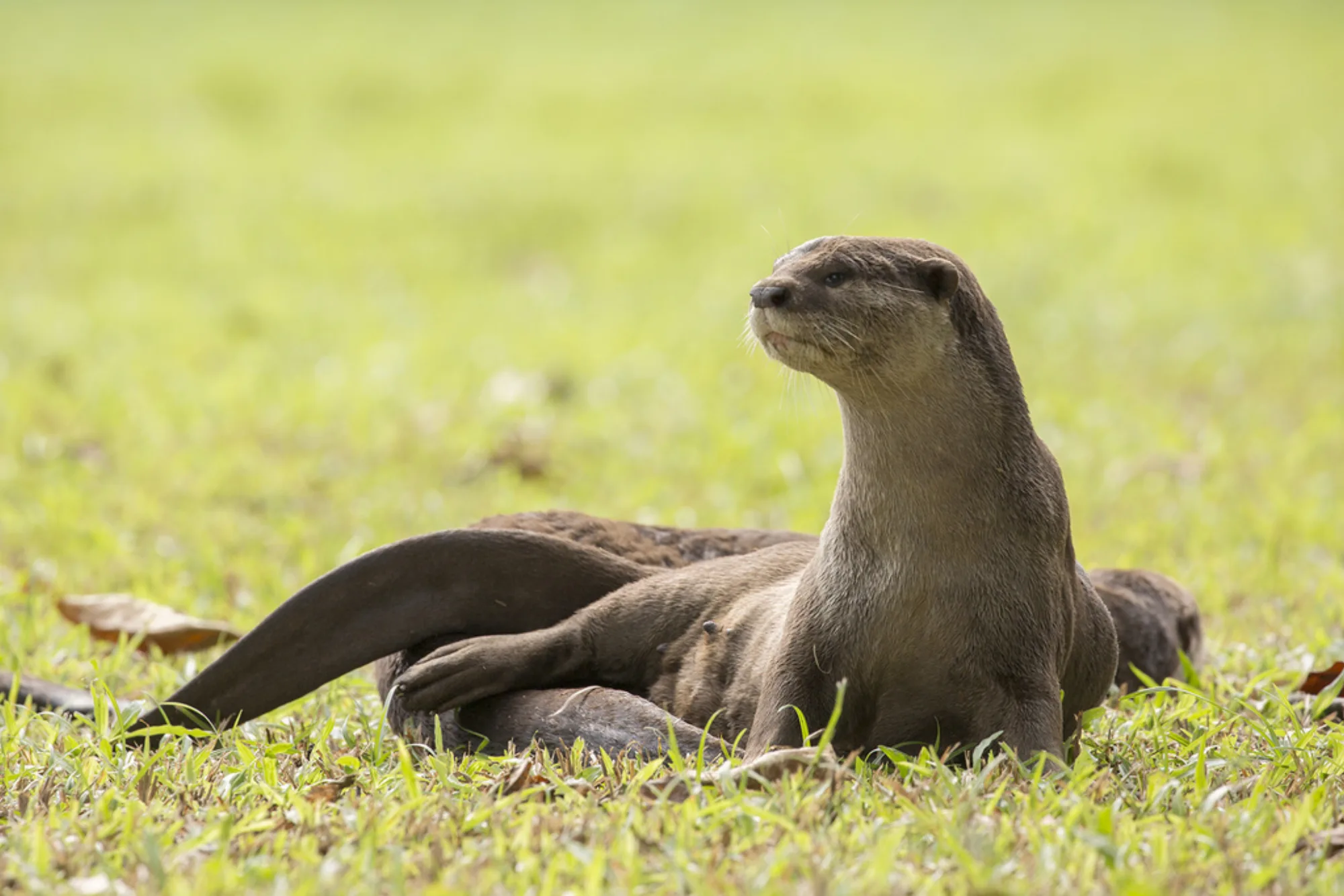
With a rounded head, flattened tail and short, sleek fur, the Smooth-coated Otter is a distinctive freshwater hunter. Its back ranges from dark brown to reddish brown, while its underside is a lighter greyish brown. A relatively large otter, it weighs 7 to 11 kg and has a head-body length of around 59 to 64 cm, plus a tail measuring 37 to 43 cm. Its range stretches across South and Southeast Asia, including Borneo, Sumatra and Java, with an isolated population in the marshes of Iraq. Look for it by rivers and lakes, in rice paddies, and across wetlands and seasonal swamps. It also visits coastal saltwater, particularly around smaller islands, but needs fresh water nearby.
Smooth-coated Otters live in groups of up to 11 and rest on sandy riverbanks, with dens under tree roots or among boulders. In Peninsular Malaysia, observations suggest they are most active by day and take a short rest at midday. Fish make up most of their diet, though they also hunt rats in rice fields during planting season and eat small amounts of snakes, amphibians and insects. One group in Kuala Selangor Nature Park was seen hunting in a broad, moving formation before diving for fish. Family groups consist of a breeding pair and up to four offspring from previous seasons. Mothers raise their pups in burrows near water, either dug by the otters or taken over from other animals. Where food is sufficient, breeding takes place throughout the year; where it depends on monsoon rainfall, it occurs between October and February.
Wetland loss, water pollution and poaching threaten the species and can reduce its prey. Otters are also killed at aquaculture sites, while people harvesting crops and collecting wood disturb those raising young along India's Chambal River.
Written from the English Wikipedia article Smooth-coated otter (CC BY-SA 4.0).
- Records
- 146
- Countries
- 6
- Atlas places
- 5
These are open occurrence records, so they show where people looked for and recorded the Smooth-coated Otter as much as where it lives. Cells are up to 25 km across, and every location is generalised to its cell.
Generalised encounter areas, not exact locations. Each shape is a grid cell coloured by how likely the species is there.
- Very likelySingapore25 km zone · medium confidence · 109 records · updated 80 days ago
- Very likelyIndia25 km zone · medium confidence · 21 records · updated 80 days ago
- Very likelyMalaysia25 km zone · medium confidence · 15 records · updated 80 days ago
- LikelyNepal25 km zone · medium confidence · 1 record · updated 80 days ago
- PossibleThailand25 km zone · low confidence · 0 records · updated 80 days ago
- UncommonCambodia25 km zone · low confidence · 0 records · updated 80 days ago
Conservation status not assessed here yet, so every location is generalised to its grid cell.