Red Snapper
Lutjanus campechanus
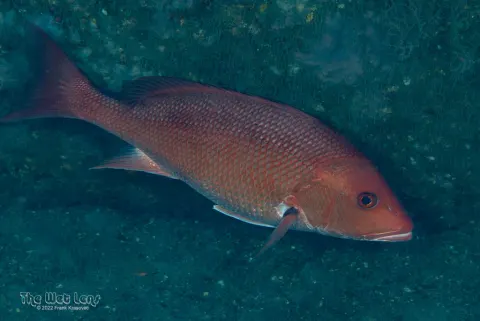
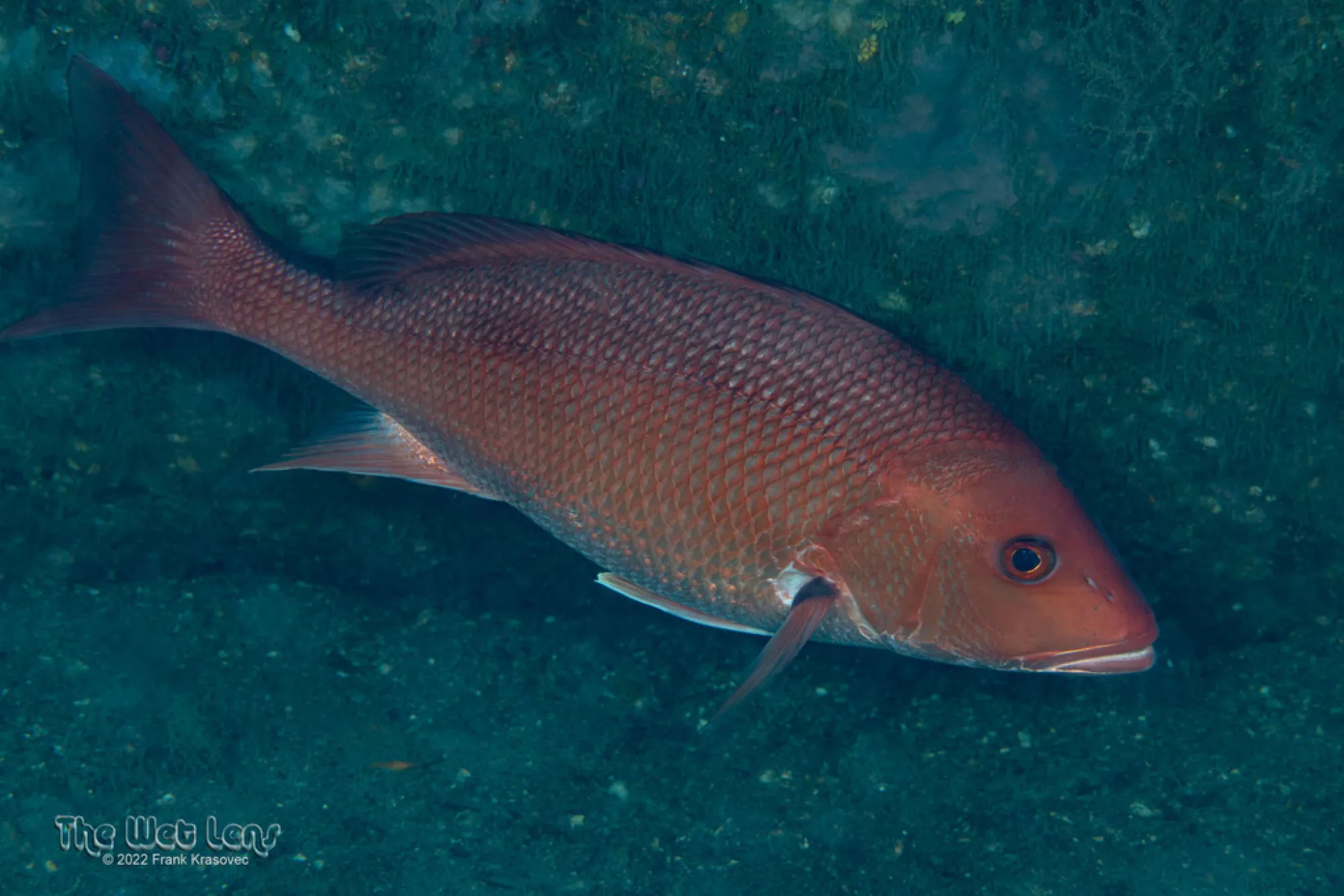
In the western Atlantic, the Red Snapper (Lutjanus campechanus) brings a wash of red to reefs and rocky bottoms. This marine fish has a sloping profile, a spiny fin along its back and light red colouring that deepens on the back. Adults commonly measure 60 cm, although they can reach 100 cm, and younger fish may have a dark spot on each side that fades as they grow. Its range extends through the Gulf of Mexico and Caribbean waters, along the Atlantic shores of southeastern Mexico and the United States, and less commonly north to Massachusetts. It usually lives in water 9 to 60 m deep, staying near the bottom among rocks, ledges and ridges, or around artificial reefs such as shipwrecks and offshore oil rigs.
Red snapper often gather in large schools around reefs and wrecks, usually alongside fish of a similar size. Their choice of habitat changes as they grow: newly hatched fish spread across open bottom habitat before moving to places with low cover, including oyster beds. Older fish move towards reefs with more relief, while at oil platforms larger adults occupy deeper areas and keep smaller fish out. The largest individuals also spread into open habitats beyond reefs. Red snapper eat a wide range of food, with small fish and crustaceans among their favourites. They become sexually mature between the ages of two and five, while adults can live for more than 50 years. Both commercial and recreational fishing target the species, and researchers consider the accidental catch of young snapper, especially by shrimp trawlers, a significant concern.
Written from the English Wikipedia article Northern red snapper (CC BY-SA 4.0).
- Records
- 665
- Countries
- 4
No atlas park has a record of the Red Snapper in or around it yet.
These are open occurrence records, so they show where people looked for and recorded the Red Snapper as much as where it lives. Cells are up to 25 km across, and every location is generalised to its cell.
Generalised encounter areas, not exact locations. Each shape is a grid cell coloured by how likely the species is there.
- Very likelyUnited States25 km zone · medium confidence · 515 records · updated 80 days ago
- Very likelyMexico25 km zone · medium confidence · 131 records · updated 80 days ago
- Very likelyCosta Rica25 km zone · medium confidence · 16 records · updated 80 days ago
- PossibleBelize25 km zone · medium confidence · 3 records · updated 80 days ago
Conservation status not assessed here yet, so every location is generalised to its grid cell.