Bluethroat
Luscinia svecica
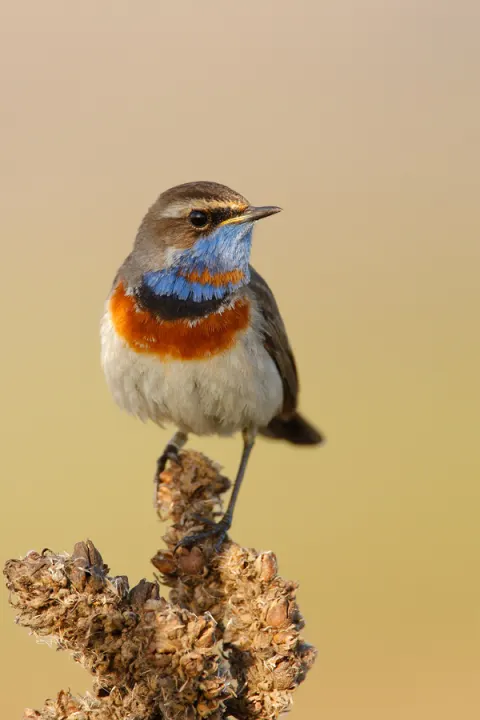
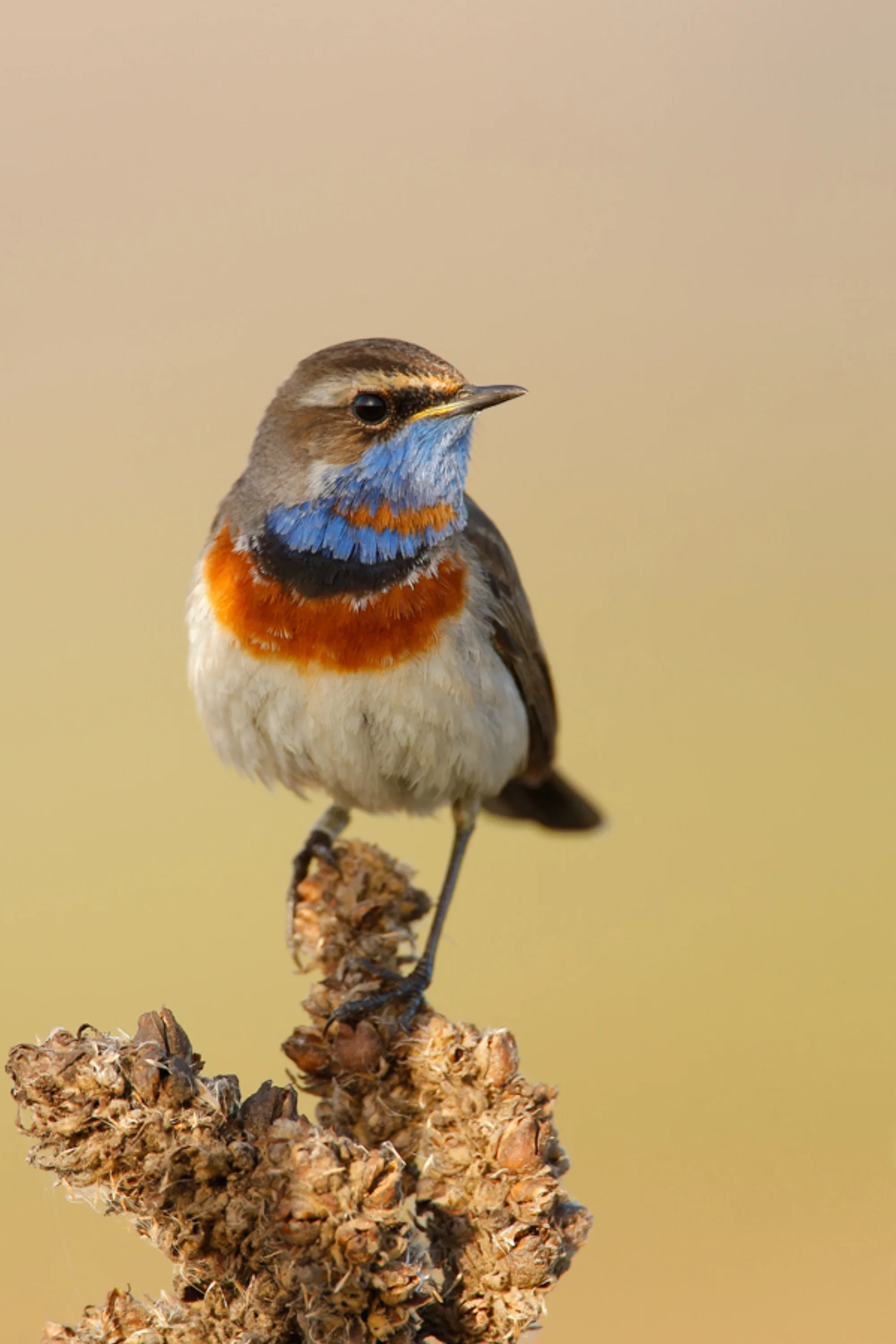
A flash of blue at the throat can give away a male Bluethroat, a small migratory bird about the size of a European robin. Measuring 13 to 14 cm, it is plain brown above, with a prominent white stripe over the eye. Its brown tail has black outer corners and red patches near the base. The male's glossy blue throat is usually edged below by a narrow black band and a broader brick-red band. A red or white spot often sits within the blue, although some birds have no spot. Male plumage is at its most colourful during spring and summer; pale tips on newly moulted feathers later conceal the throat pattern until they wear away towards spring. Females usually have a cream throat and breast, a dark crescent and little blue, though older birds can look more like males.
Bluethroats breed in wet birch woods and bushy swamps across Europe and the Palearctic, reaching western Alaska. Their breeding habitats also include subarctic shrub tundra, lowland reedbeds and mountains, depending on the population. For winter, they travel to the Iberian Peninsula, northern Africa and southern Asia, including the Indian subcontinent. Some birds breeding in the northern Carpathian Mountains migrate to India, while others breeding at lower levels in the same area winter in Africa. The species eats insects and places its nest in tussocks or low in dense bushes. A male's song is varied and highly imitative, while its call makes a chack sound. Young birds are freckled and spotted dark brown for a few weeks after leaving the nest, before moulting into plumage resembling that of adult females.
Written from the English Wikipedia article Bluethroat (CC BY-SA 4.0).
- Records
- 264,016
- Countries
- 27
- Atlas places
- 1
These are open occurrence records, so they show where people looked for and recorded the Bluethroat as much as where it lives. Cells are up to 25 km across, and every location is generalised to its cell.
Generalised encounter areas, not exact locations. Each shape is a grid cell coloured by how likely the species is there.
- Very likelyBelgium25 km zone · high confidence · 41874 records · updated 80 days ago
- Very likelySweden25 km zone · high confidence · 38018 records · updated 80 days ago
- Very likelyFrance25 km zone · high confidence · 36570 records · updated 80 days ago
- Very likelyFinland25 km zone · high confidence · 26773 records · updated 80 days ago
- Very likelySpain25 km zone · high confidence · 19207 records · updated 80 days ago
- Very likelyNorway25 km zone · high confidence · 17829 records · updated 80 days ago
- Very likelyIndia25 km zone · high confidence · 17296 records · updated 80 days ago
- Very likelyIsrael25 km zone · high confidence · 16200 records · updated 80 days ago
- Very likelyPortugal25 km zone · high confidence · 11482 records · updated 80 days ago
- Very likelyNetherlands25 km zone · high confidence · 8121 records · updated 80 days ago
Conservation status not assessed here yet, so every location is generalised to its grid cell.