Common Nightingale
Luscinia megarhynchos
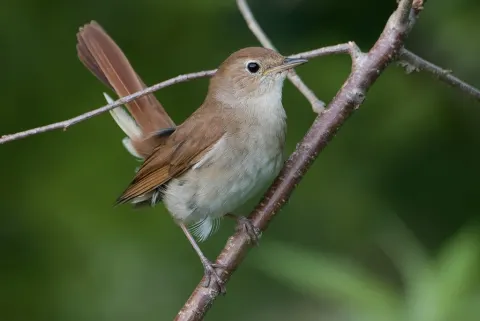
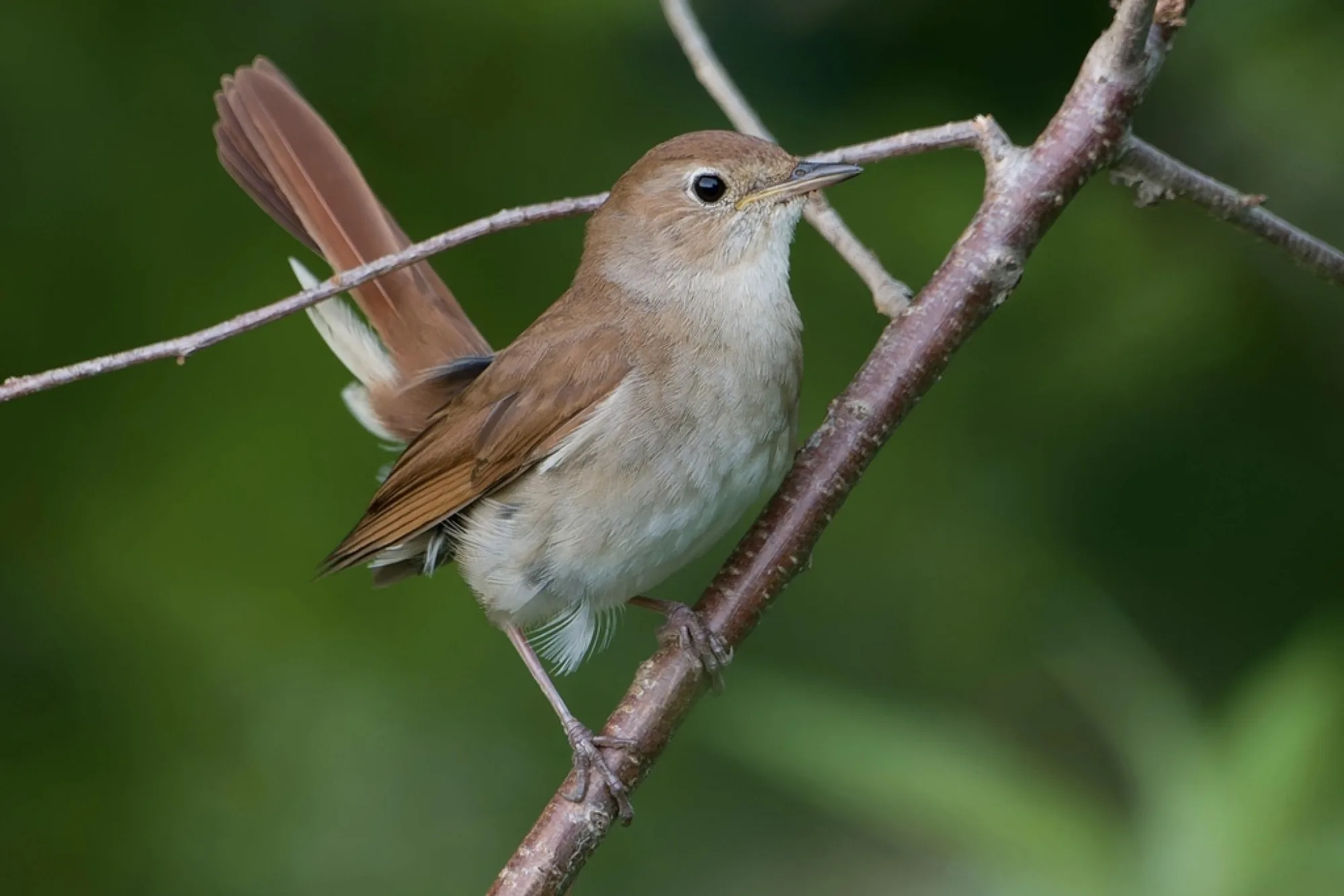
A loud, rising whistle can reveal a Common Nightingale long before the bird comes into view. This small flycatcher is slightly larger than a European robin, measuring 15 to 16.5 cm in length. Its upperparts are plain brown, with a reddish tail, while the underside ranges from buff to white; males and females look alike. Eastern and Caucasian birds have paler upperparts and stronger facial markings, including a pale stripe above the eye.
The species migrates between breeding grounds in Europe and the Palearctic and winter quarters in sub-Saharan Africa. It breeds in forest and scrub, placing its nest on or close to the ground among dense vegetation. At the northern edge of its range in the UK, a survey in 2012 and 2013 found most territories concentrated in parts of East Anglia and South East England. Nightingales eat insects and spend much of their time hidden in shrubs, thickets and undergrowth, avoiding open ground and human activity. A bird sensing danger may stay motionless, adding to the challenge of finding it.
Listen for the male's varied whistles, trills and gurgles, delivered from a concealed perch by day or night. His song is especially noticeable after dark, when fewer other birds are singing; only unpaired males sing regularly at night. Near towns and cities, nightingales sing more loudly to overcome background noise. The UK range has contracted in recent years, and the population dropped by 53 percent from 1995 to 2008, even as local efforts sought to safeguard favoured coppice and scrub. The account does not identify the cause of that decline.
Written from the English Wikipedia article Common nightingale (CC BY-SA 4.0).
- Records
- 267,713
- Countries
- 24
No atlas park has a record of the Common Nightingale in or around it yet.
These are open occurrence records, so they show where people looked for and recorded the Common Nightingale as much as where it lives. Cells are up to 25 km across, and every location is generalised to its cell.
Generalised encounter areas, not exact locations. Each shape is a grid cell coloured by how likely the species is there.
- Very likelyFrance25 km zone · high confidence · 113456 records · updated 80 days ago
- Very likelySpain25 km zone · high confidence · 91183 records · updated 80 days ago
- Very likelyPortugal25 km zone · high confidence · 15018 records · updated 80 days ago
- Very likelyBelgium25 km zone · high confidence · 12917 records · updated 80 days ago
- Very likelyGermany25 km zone · high confidence · 7781 records · updated 80 days ago
- Very likelyCzechia25 km zone · high confidence · 4128 records · updated 80 days ago
- Very likelyUnited Kingdom25 km zone · high confidence · 3444 records · updated 80 days ago
- Very likelySerbia25 km zone · high confidence · 2640 records · updated 80 days ago
- Very likelyPalestinian Territories25 km zone · high confidence · 2429 records · updated 80 days ago
- Very likelyGreece25 km zone · high confidence · 2132 records · updated 80 days ago
Conservation status not assessed here yet, so every location is generalised to its grid cell.