Thrush Nightingale
Luscinia luscinia
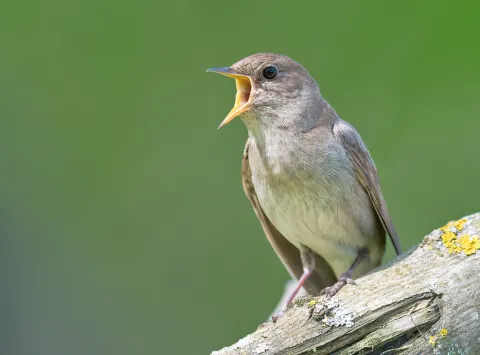
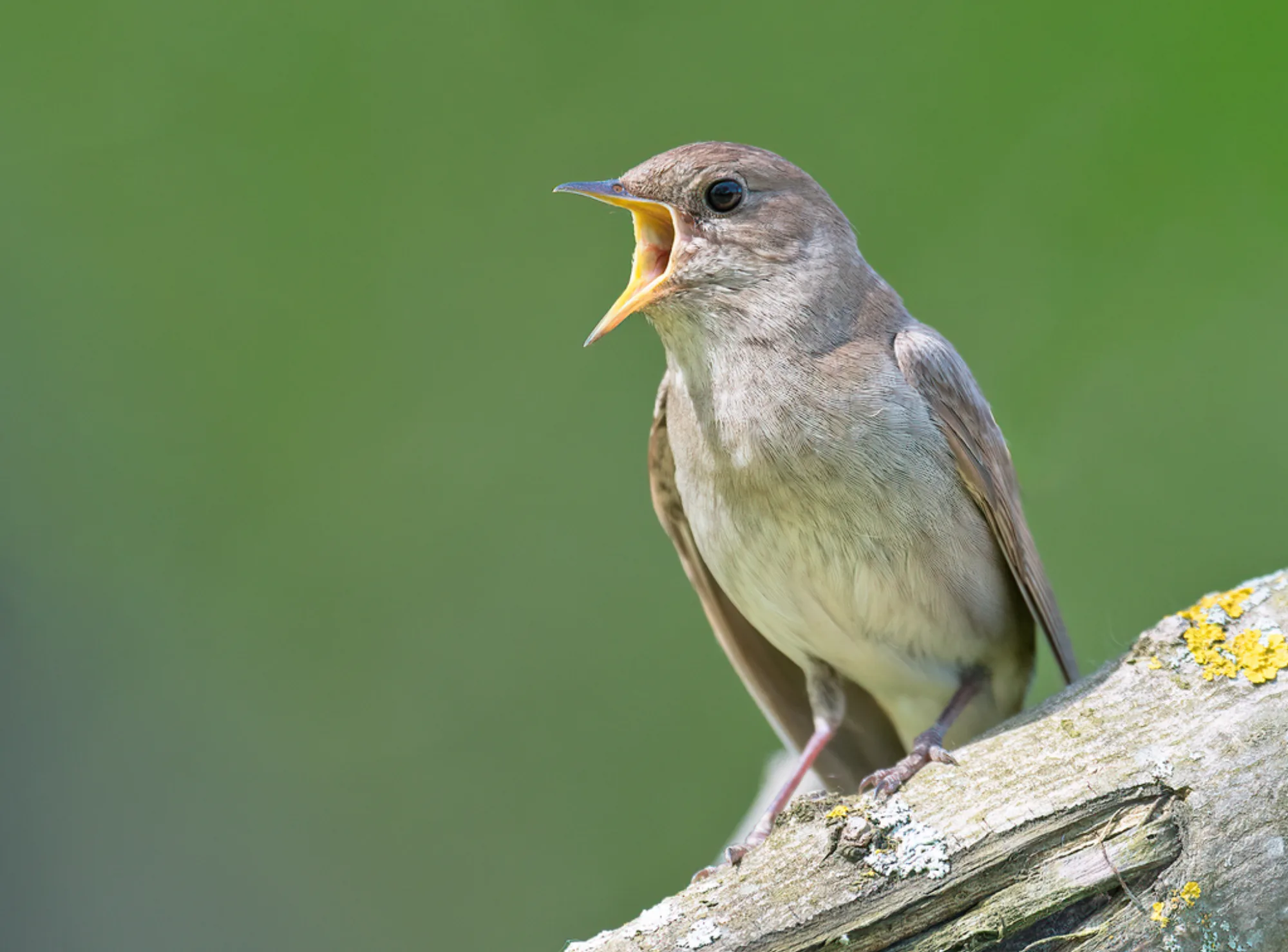
A small, brown songbird about the size of a European robin, the Thrush Nightingale can be hard to distinguish from its close relative, the common nightingale. Adults are about 16 centimetres long, with dark brown upperparts, a slight olive tinge and a pale, mottled breast. Males and females look alike, while young birds are darker and more mottled. Compared with the common nightingale, it has greyer tones underneath and lacks obvious rufous patches on the sides of the tail. Listen for the male's loud song, a mixture of whistles, trills and clicks that can include a clear, flute-like note and an occasional rasp.
This migrant breeds in eastern Europe and western temperate Asia, and spends the winter in Africa south of the Sahara. During the breeding season, look for it in damp deciduous woodland, often among alder and birch, with dense shrubs, brambles and tangled growth near water. In winter it uses thick thorn bush, particularly in valley bottoms near watercourses, and sometimes dense vegetation along woodland edges. It feeds mostly on the ground, taking earthworms, spiders and insects, including beetles, small moths, ants and flies. In autumn it also eats currant and elder berries, and before crossing the Sahara it builds up fat reserves.
The female builds a nest on the ground in damp forest, often among stinging nettles, using dead plant material on a platform of leaves. She lays four or five eggs, occasionally six, and incubates them for about thirteen days. Both parents feed the young, which leave the nest at about eleven days old but remain dependent for roughly another twelve days.
Written from the English Wikipedia article Thrush nightingale (CC BY-SA 4.0).
- Records
- 91,297
- Countries
- 64
- Atlas places
- 15
- Chobe National Park· Botswana
- Zambezi National Park· Zimbabwe
- Kruger National Park· South Africa
- Okavango Delta· Botswana
- Tsavo East National Park· Kenya
- Tsavo West National Park· Kenya
- Amboseli National Park· Kenya
- Arusha National Park· Tanzania
- Bwabwata National Park· Namibia
- Matobo National Park· Zimbabwe
- Nairobi National Park· Kenya
- Nkasa Rupara National Park· Namibia
- Ruaha National Park· Tanzania
- Samburu National Reserve· Kenya
- South Luangwa National Park· Zambia
These are open occurrence records, so they show where people looked for and recorded the Thrush Nightingale as much as where it lives. Cells are up to 25 km across, and every location is generalised to its cell.
Generalised encounter areas, not exact locations. Each shape is a grid cell coloured by how likely the species is there.
- Very likelyFinland25 km zone · high confidence · 25930 records · updated 86 days ago
- Very likelyNorway25 km zone · high confidence · 20768 records · updated 86 days ago
- Very likelySweden25 km zone · high confidence · 18120 records · updated 86 days ago
- Very likelyIsrael25 km zone · high confidence · 5200 records · updated 86 days ago
- Very likelyRussia25 km zone · high confidence · 3412 records · updated 86 days ago
- Very likelyPoland25 km zone · high confidence · 2959 records · updated 86 days ago
- Very likelyDenmark25 km zone · high confidence · 1947 records · updated 86 days ago
- Very likelyUkraine25 km zone · high confidence · 1555 records · updated 86 days ago
- Very likelyJordan25 km zone · high confidence · 1427 records · updated 86 days ago
- Very likelyTürkiye25 km zone · high confidence · 1392 records · updated 86 days ago
Conservation status not assessed here yet, so every location is generalised to its grid cell.