African Forest Elephant
Loxodonta cyclotis
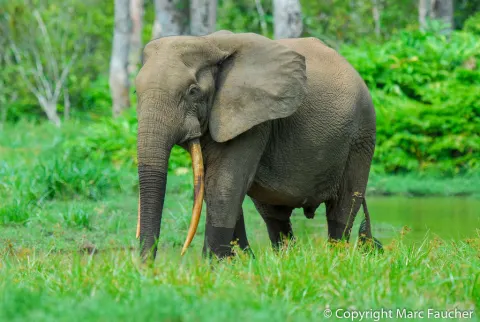
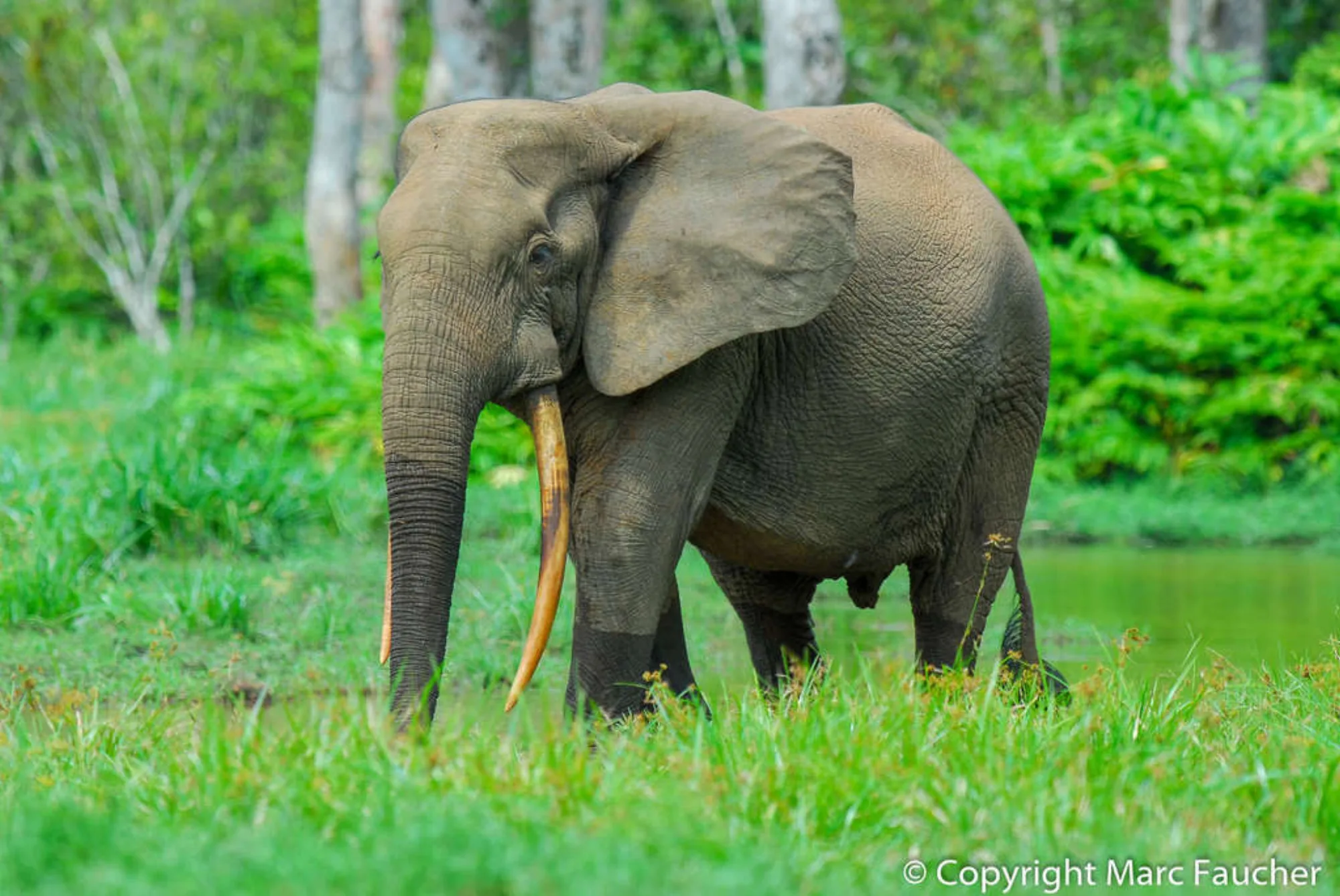
Smaller than its African bush relative, the African Forest Elephant has a nearly straight back, oval ears and straight tusks that point downwards. Both males and females have tusks, which they use to push through dense undergrowth. Its grey skin can look yellow to reddish after a wallow. It inhabits humid tropical forest across West Africa and the Congo Basin, including extensive rainforest stretching between Cameroon and the Democratic Republic of the Congo. It also lives in the Upper Guinean forests of Ivory Coast and Ghana.
Family groups can number up to 20 elephants, including adult females, their daughters and younger sons, and relatives help care for calves. Young males leave the family when they reach sexual maturity and usually live alone, while adult bulls join family groups during the mating season. The elephants travel along permanent trails linking fruit trees, forest clearings and mineral licks, and their seasonal movements follow the availability of ripe fruit. They eat leaves, bark, seeds and fruit, gathering at mineral-rich waterholes and licks to supplement their diet. Seeds carried in their dung help maintain forest diversity. Females start breeding at 23 years old on average, then have a calf every 5 to 6 years; calves are weaned at roughly 4 or 5 years old.
Poaching for ivory and bushmeat threatens forest elephants in Central Africa. Forest conversion for plantations, livestock farming and urban and industrial development destroys and fragments habitat, increasing conflict between people and elephants. Some elephants are confined to small forest patches without enough food. Poaching and habitat loss were responsible for an estimated 86% fall in the Central African population over the 31 years before 2021.
Written from the English Wikipedia article African forest elephant (CC BY-SA 4.0).
- Records
- 19
- Countries
- 5
No atlas park has a record of the African Forest Elephant in or around it yet.
These are open occurrence records, so they show where people looked for and recorded the African Forest Elephant as much as where it lives. Cells are up to 25 km across, and every location is generalised to its cell.
Generalised encounter areas, not exact locations. Each shape is a grid cell coloured by how likely the species is there.
- Very likelyGabon25 km zone · medium confidence · 8 records · updated 80 days ago
- Very likelyGhana25 km zone · medium confidence · 6 records · updated 80 days ago
- Very likelyCentral African Republic25 km zone · medium confidence · 3 records · updated 80 days ago
- Very likelyCongo - Brazzaville25 km zone · medium confidence · 2 records · updated 80 days ago
- LikelyLiberia25 km zone · low confidence · 0 records · updated 80 days ago
Conservation status not assessed here yet, so every location is generalised to its grid cell.