Red Crossbill
Loxia curvirostra
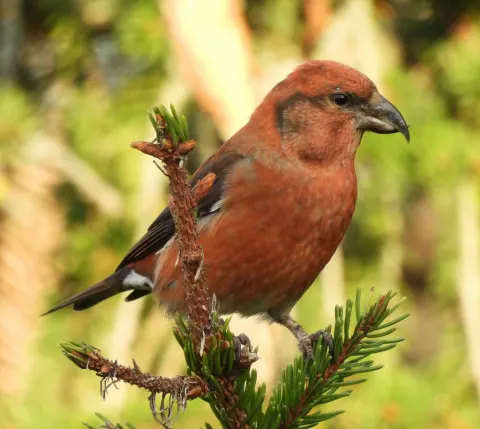
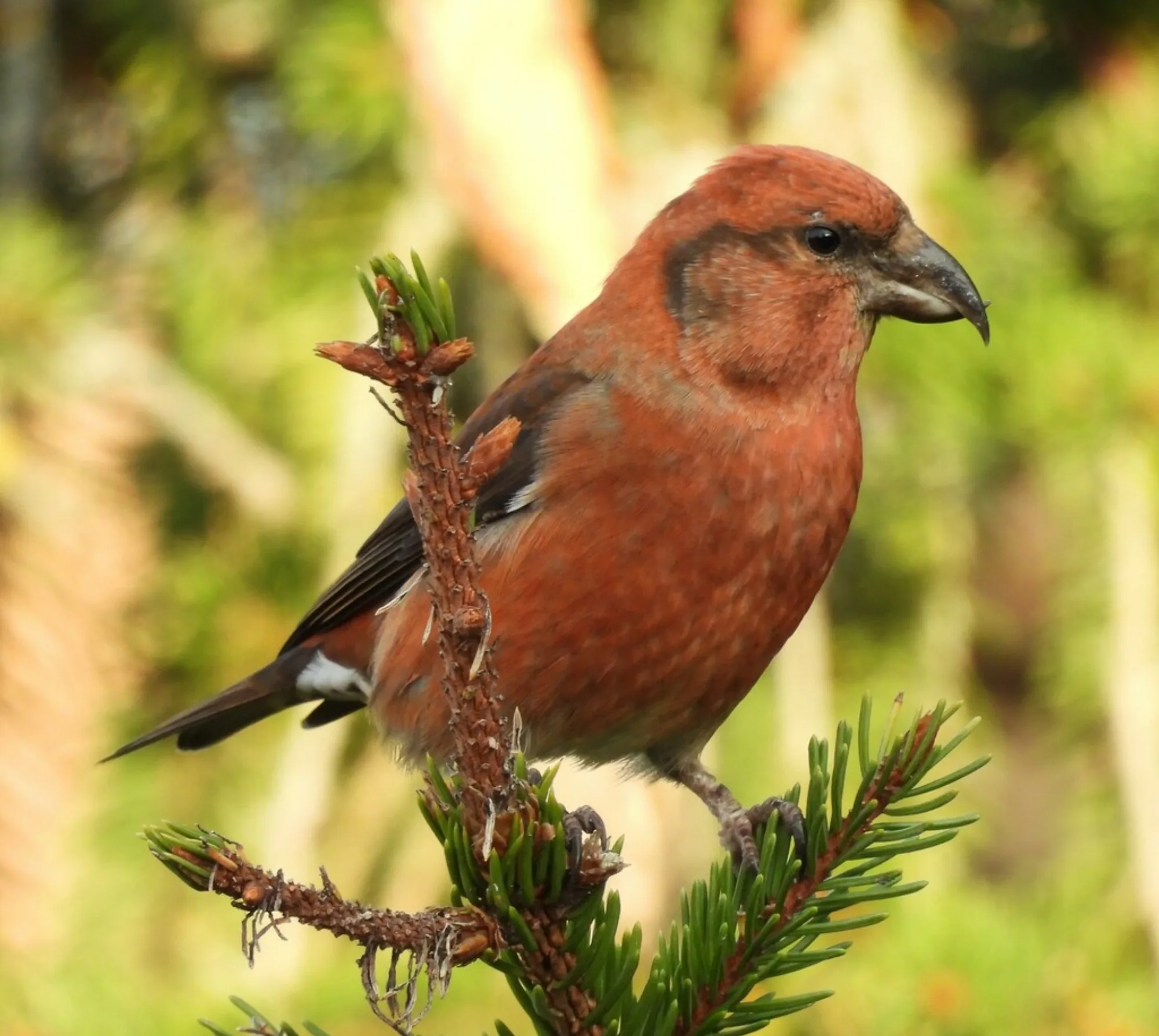
Look for a small finch with a bill whose tips cross, a feature that helps the Red Crossbill prise seeds from conifer cones. Males are often red or orange, while females are green or yellow and young birds are greyish-green with streaks. Its wings are brownish-black, unlike those of the similar two-barred crossbill, which has two bright white wing bars. Several other crossbills are difficult to tell apart by sight, and their calls are generally a better guide. Red Crossbills frequently give a single-note chip call, though calls vary considerably between types.
Red Crossbills breed in coniferous forests across North America and Eurasia, but finding them in a particular place can depend on the cone crop. Conifer seeds are their main food, and when local crops fail, the birds may travel widely in search of food and breeding places. Their presence can be irregular, with birds appearing in some years and absent in others, although a few populations stay in one area. Outside the breeding season, different types may gather in flocks together or join other crossbill species. Nesting usually takes place from June to September, when the seeds of most conifers mature, but can occur at any time of year where a suitable cone crop is available. Different types favour different conifers, and each achieves its best breeding success in a particular kind of conifer forest. Cone seed production varies greatly from year to year, making the availability of this main food source uncertain; the supplied account does not describe other threats.
Written from the English Wikipedia article Red crossbill (CC BY-SA 4.0).
- Records
- 342,160
- Countries
- 13
- Atlas places
- 9
- Olympic National Park· United States
- Algonquin Provincial Park· Canada
- Pacific Rim National Park Reserve· Canada
- Acadia National Park· United States
- Glacier National Park· United States
- Rocky Mountain National Park· United States
- Grand Canyon National Park· United States
- Kenai Fjords National Park· United States
- Redwood National and State Parks· United States
These are open occurrence records, so they show where people looked for and recorded the Red Crossbill as much as where it lives. Cells are up to 25 km across, and every location is generalised to its cell.
Generalised encounter areas, not exact locations. Each shape is a grid cell coloured by how likely the species is there.
- Very likelyUnited States25 km zone · high confidence · 199776 records · updated 80 days ago
- Very likelyCanada25 km zone · high confidence · 68096 records · updated 80 days ago
- Very likelyNorway25 km zone · high confidence · 39967 records · updated 80 days ago
- Very likelyFrance25 km zone · high confidence · 10833 records · updated 80 days ago
- Very likelyFinland25 km zone · high confidence · 7322 records · updated 80 days ago
- Very likelyBelgium25 km zone · high confidence · 5895 records · updated 80 days ago
- Very likelySpain25 km zone · high confidence · 3867 records · updated 80 days ago
- Very likelyUnited Kingdom25 km zone · high confidence · 2521 records · updated 80 days ago
- Very likelyDenmark25 km zone · high confidence · 1512 records · updated 80 days ago
- Very likelyPoland25 km zone · high confidence · 1255 records · updated 80 days ago
Conservation status not assessed here yet, so every location is generalised to its grid cell.