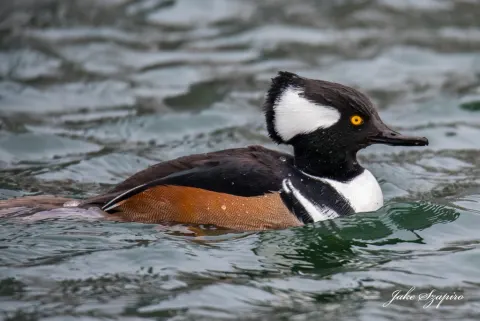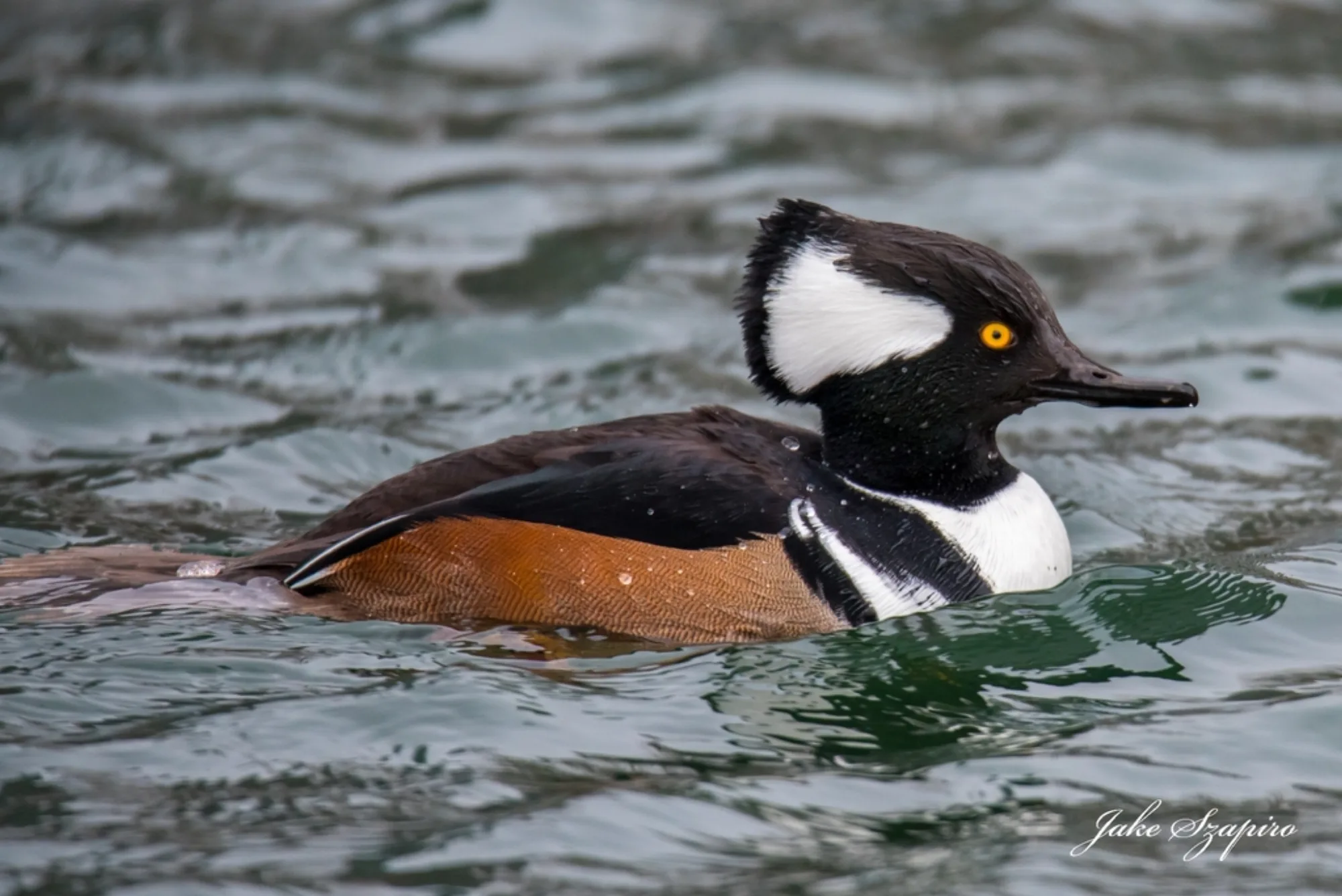
Hooded Merganser
Lophodytes cucullatus
A raised crest gives the Hooded Merganser a distinctive outline on the water. This fish-eating duck can raise or lower its crest, and the breeding male shows a large white patch on each side against a mainly black head and neck. His flanks are chestnut, while his breast and undersides are largely white. The female has a greyish-brown body and a light reddish-brown crest extending behind her head. Outside the breeding season, males resemble females, though their eyes are yellow instead of brown.
Native to North America, the duck has year-round ranges in the eastern United States and a smaller area encompassing southern British Columbia, Washington state and northern Idaho. It also breeds across parts of southern Canada and the northern United States, moving when necessary to escape winter conditions. It favours small ponds and estuaries with plenty of aquatic vegetation rising above the water, although it also uses larger wetlands, flooded timber and rivers. Fresh water is preferred, but it occurs in brackish water too. Hunting underwater largely by sight, it eats mostly fish, along with aquatic insects, crabs and crayfish.
Females seek nesting cavities in dead trees or use artificial nest boxes, laying 7 to 15 eggs. Depending on location, breeding can begin in late February and continue through late June. The male leaves after the female has chosen a cavity and finished laying, and she incubates the eggs and cares for the brood. Ducklings usually leave the nest within 24 hours of hatching and can dive and forage, though they stay with their mother for warmth and protection. Large-scale deforestation has been linked to past population declines, while pollution can poison the birds through their prey or reduce the prey available.
Written from the English Wikipedia article Hooded merganser (CC BY-SA 4.0).
- Records
- 1,275,286
- Countries
- 2
- Atlas places
- 1
These are open occurrence records, so they show where people looked for and recorded the Hooded Merganser as much as where it lives. Cells are up to 25 km across, and every location is generalised to its cell.
Generalised encounter areas, not exact locations. Each shape is a grid cell coloured by how likely the species is there.
- Very likelyUnited States25 km zone · high confidence · 1009037 records · updated 80 days ago
- Very likelyCanada25 km zone · high confidence · 266249 records · updated 80 days ago
Conservation status not assessed here yet, so every location is generalised to its grid cell.