Angler
Lophius piscatorius
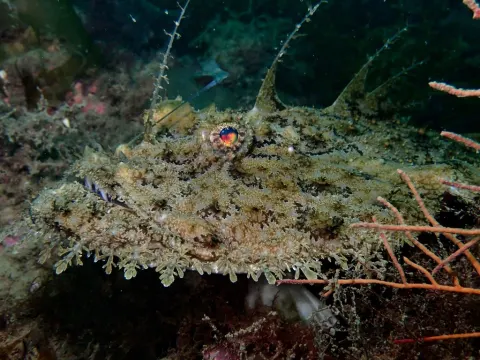
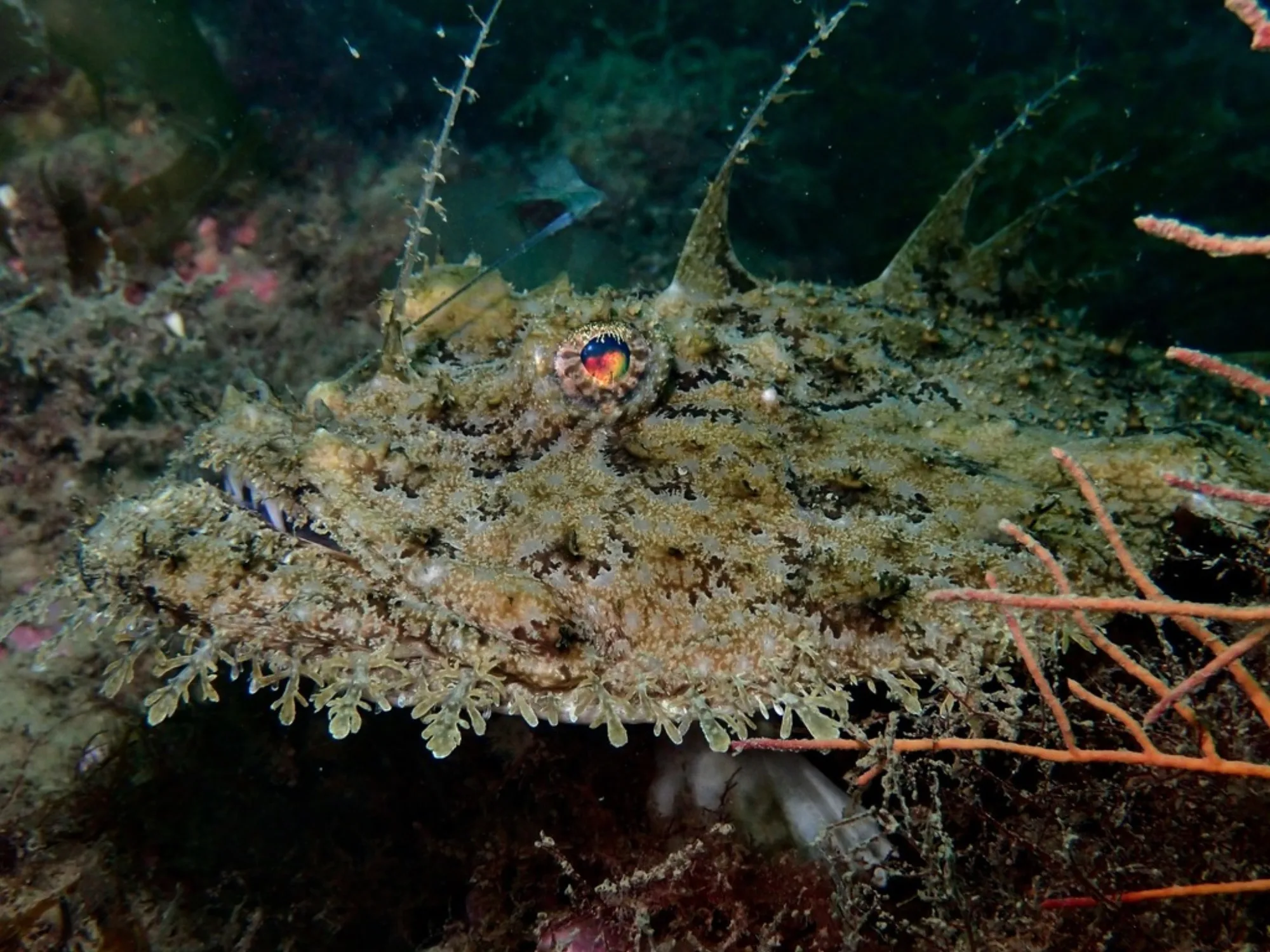
A broad, flattened head and a vast mouth give the Angler its distinctive outline, with the rest of its body looking small by comparison. Long, pointed teeth line its jaws, and its scaleless skin carries fringes that resemble short pieces of seaweed. It can change colour to blend into its surroundings, often hiding in sand or among seaweed on the seabed. Its fins also help it walk along the bottom.
The species ranges across the northeastern Atlantic, inhabiting coastal and continental shelf waters between the Barents Sea and the Strait of Gibraltar, and also occurs in the Mediterranean and Black Sea. It favours muddy and sandy bottoms, occasionally occurs over rock, and has been recorded at depths of up to 1,000 metres. A movable lure projects from its head and is thought to draw fish close enough for its huge jaws to seize them. Adults eat mostly fish, while younger anglers feed mainly on marine invertebrates. Its stomach can expand enough to accommodate prey as large as the fish itself, and it may surface to try to catch waterbirds.
Breeding peaks in spring, during a main spawning season that runs from February to June, with a smaller secondary season in November and December. Females release eggs in a transparent, jelly-like sheet that floats near the surface, where wind and currents can help carry it away. The larvae swim freely. Fishing is a pressure: the Angler has long been taken as valuable bycatch, and catches rose substantially as deep-water fishing technology improved. The Irish Sea is among the places where it sustains an important commercial fishery.
Written from the English Wikipedia article Lophius piscatorius (CC BY-SA 4.0).
- Records
- 2,113
- Countries
- 7
No atlas park has a record of the Angler in or around it yet.
These are open occurrence records, so they show where people looked for and recorded the Angler as much as where it lives. Cells are up to 25 km across, and every location is generalised to its cell.
Generalised encounter areas, not exact locations. Each shape is a grid cell coloured by how likely the species is there.
- Very likelyNorway25 km zone · medium confidence · 1282 records · updated 80 days ago
- Very likelyUnited Kingdom25 km zone · medium confidence · 548 records · updated 80 days ago
- Very likelyIreland25 km zone · medium confidence · 116 records · updated 80 days ago
- Very likelyIsle of Man25 km zone · medium confidence · 77 records · updated 80 days ago
- Very likelyFrance25 km zone · medium confidence · 51 records · updated 80 days ago
- LikelyDenmark25 km zone · medium confidence · 18 records · updated 80 days ago
- LikelySweden25 km zone · medium confidence · 17 records · updated 80 days ago
- PossibleUnnamed area25 km zone · medium confidence · 4 records · updated 80 days ago
Conservation status not assessed here yet, so every location is generalised to its grid cell.