Scaly-breasted Munia
Lonchura punctulata
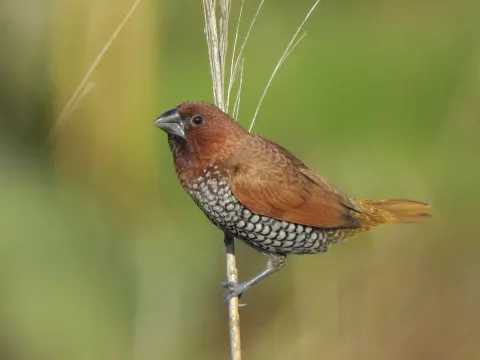
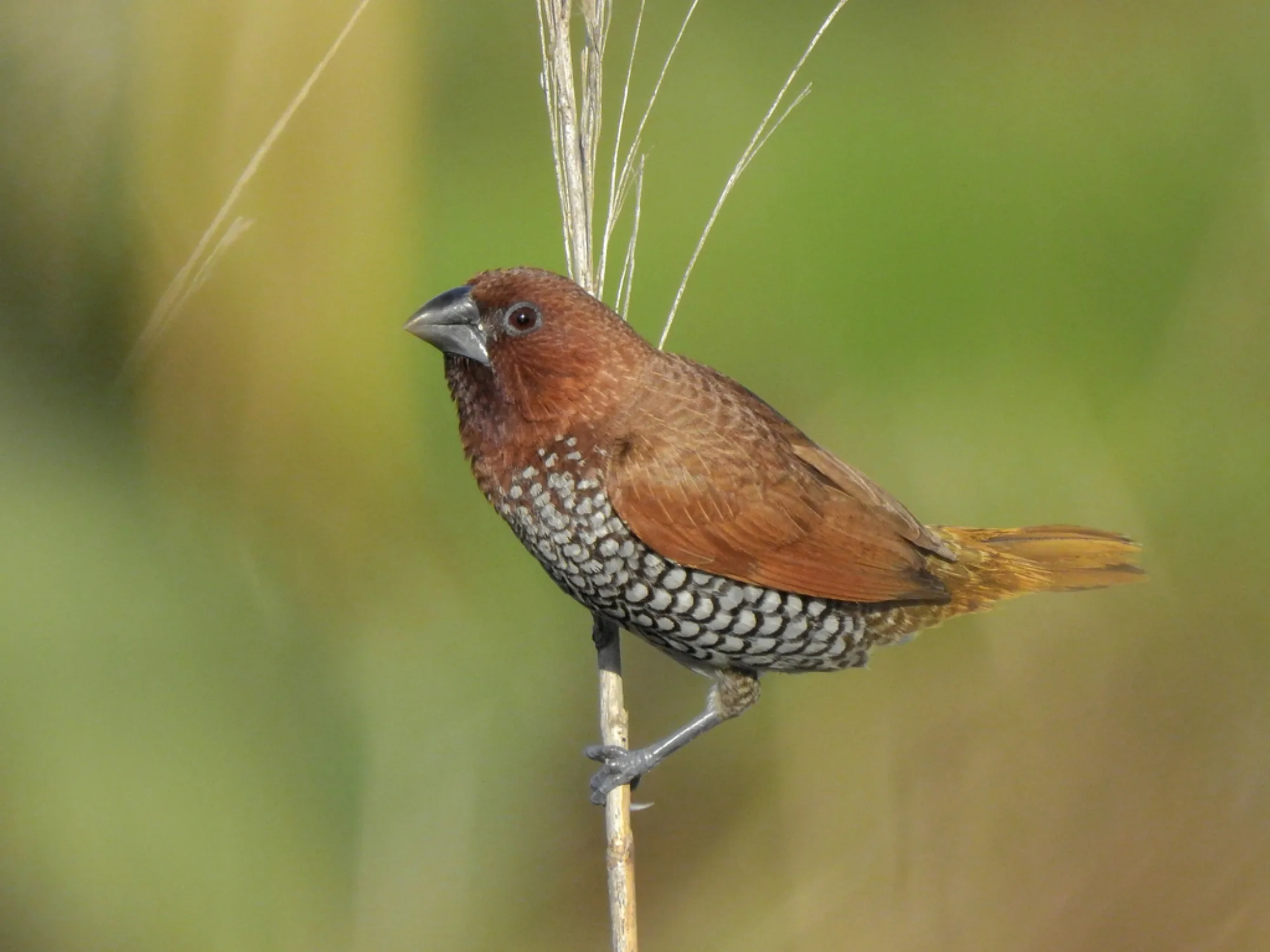
Look for a sparrow-sized finch with a dark brown head, brown back and a pale underside patterned with dark scales. The adult Scaly-breasted Munia has a short, dark bill, while young birds are paler brown, without the adult’s dark head or scaled underparts. Young birds can be confused with other munias, including the tricoloured munia.
Native to tropical Asia, it ranges from India and Sri Lanka eastwards to Indonesia and the Philippines. It usually stays near water and grassland, and in India it is especially common in paddy fields. Although mainly a bird of the plains, it also occurs in Himalayan foothills and in the Nilgiris during summer. Escaped cagebirds have established wild populations elsewhere, including Hawaii, Japan and the southern United States.
Munias forage in flocks of up to 100, eating mainly grass seeds along with small berries and insects. Listen for soft calls and whistles, including a sharp chipping alarm note, and watch for birds flicking their wings or tails as they hop. At communal roosts they sit close together, and flock members sometimes preen one another. Breeding usually takes place in the summer rainy season, although timing varies. Both parents build a large, domed nest of grass or leaves in a tree or beneath a house roof, and incubate the eggs. Some populations have declined as bird caging has increased. In Southeast Asia, large numbers are trapped for Buddhist life release rituals, and mortality after release can be high.
Written from the English Wikipedia article Scaly-breasted munia (CC BY-SA 4.0).
- Records
- 571,275
- Countries
- 18
- Atlas places
- 4
These are open occurrence records, so they show where people looked for and recorded the Scaly-breasted Munia as much as where it lives. Cells are up to 25 km across, and every location is generalised to its cell.
Generalised encounter areas, not exact locations. Each shape is a grid cell coloured by how likely the species is there.
- Very likelyUnited States25 km zone · high confidence · 210097 records · updated 80 days ago
- Very likelyTaiwan25 km zone · high confidence · 136147 records · updated 80 days ago
- Very likelyIndia25 km zone · high confidence · 134067 records · updated 80 days ago
- Very likelyThailand25 km zone · high confidence · 26745 records · updated 80 days ago
- Very likelyChina25 km zone · high confidence · 13499 records · updated 80 days ago
- Very likelyAustralia25 km zone · high confidence · 13355 records · updated 80 days ago
- Very likelySri Lanka25 km zone · high confidence · 8335 records · updated 80 days ago
- Very likelyIndonesia25 km zone · high confidence · 7162 records · updated 80 days ago
- Very likelyCambodia25 km zone · high confidence · 5933 records · updated 80 days ago
- Very likelyMalaysia25 km zone · high confidence · 3777 records · updated 80 days ago
Conservation status not assessed here yet, so every location is generalised to its grid cell.