Tripletail
Lobotes surinamensis
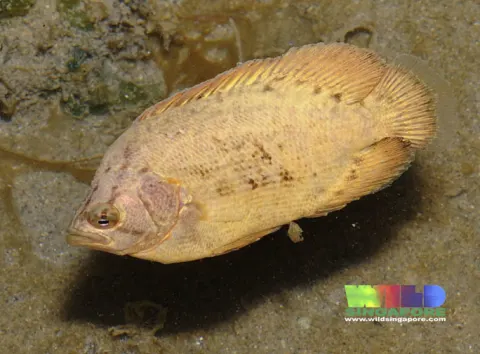
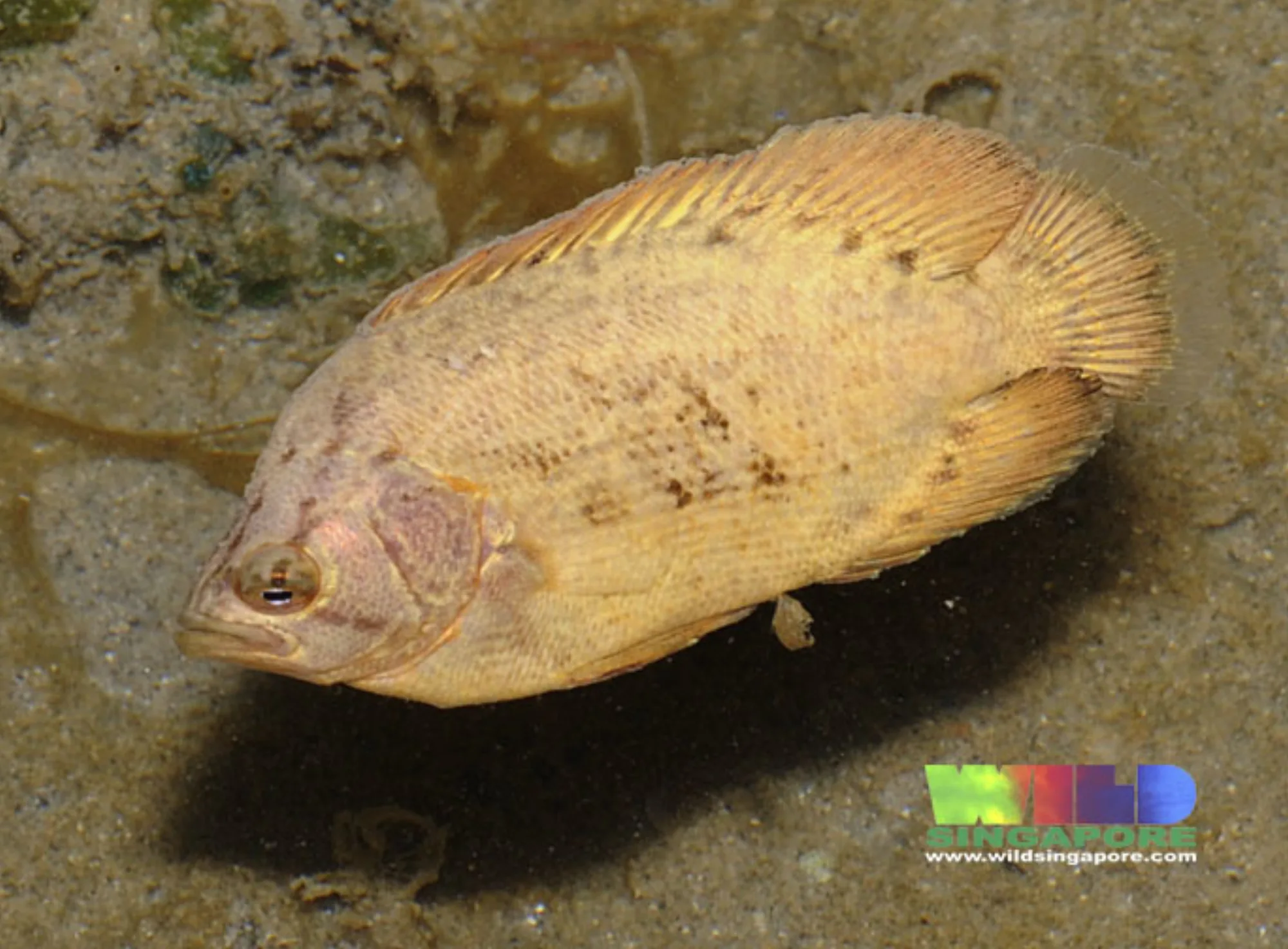
A rounded tail and two large, rounded fins give the Tripletail the appearance of having three tails. This marine fish has a flattened, oval to diamond-shaped body, with adults coloured dark brown or greenish yellow above and greyish silver below. Young fish are mottled yellow, brown and black. A typical Tripletail reaches 80 cm, though the maximum published length is 110 cm.
Tripletails live in tropical and subtropical seas around the world. They occur along coasts and spend time in open water, moving between areas and usually travelling alone, although they sometimes form schools. Bays, sounds and estuaries provide summer habitat, while young fish often shelter beneath patches of Sargassum algae. Large adults may be near the surface over deep water, associated with floating objects. Young fish also gather around structures and debris, including shipwrecks, jetties and sea buoys.
A Tripletail may float just below the surface on its side, resembling a leaf or drifting debris. It can change between lighter and darker shades, a behaviour that may help young fish avoid predators. Floating cover may also conceal the fish as it waits to ambush prey. Its diet consists mostly of small fish, but it also eats crabs, shrimp and other crustaceans. Spawning takes place in open water, mainly in summer along the Atlantic and US Gulf coasts, and females can produce up to 700,000 buoyant eggs at a time. Sharks, barracuda and other large fish prey on Tripletails, while birds also take juveniles. People catch them commercially and for sport, and they are also taken as bycatch in tuna driftnets.
Written from the English Wikipedia article Atlantic tripletail (CC BY-SA 4.0).
- Records
- 1,037
- Countries
- 35
- Atlas places
- 1
These are open occurrence records, so they show where people looked for and recorded the Tripletail as much as where it lives. Cells are up to 25 km across, and every location is generalised to its cell.
Generalised encounter areas, not exact locations. Each shape is a grid cell coloured by how likely the species is there.
- Very likelyUnnamed area25 km zone · medium confidence · 345 records · updated 80 days ago
- Very likelyMozambique25 km zone · medium confidence · 257 records · updated 80 days ago
- Very likelyColombia25 km zone · medium confidence · 56 records · updated 80 days ago
- Very likelySeychelles25 km zone · medium confidence · 53 records · updated 80 days ago
- Very likelyJapan25 km zone · medium confidence · 50 records · updated 80 days ago
- Very likelyGabon25 km zone · medium confidence · 31 records · updated 80 days ago
- Very likelyGuinea25 km zone · medium confidence · 28 records · updated 80 days ago
- Very likelyMayotte25 km zone · medium confidence · 21 records · updated 80 days ago
- Very likelySierra Leone25 km zone · medium confidence · 9 records · updated 80 days ago
- LikelyUnited States25 km zone · medium confidence · 41 records · updated 80 days ago
Conservation status not assessed here yet, so every location is generalised to its grid cell.